 Account Statement
  Capital Gain Statement
  Key Information Memorandum
  PAN Updation
  Register / Modify KYC Online
  Nominee Registration
  Email / Phone Updation
  OTM / eNACH Registration
  Voluntary Lock-in for Mutual Fund Folios
  FAQs
FAQs Reach us





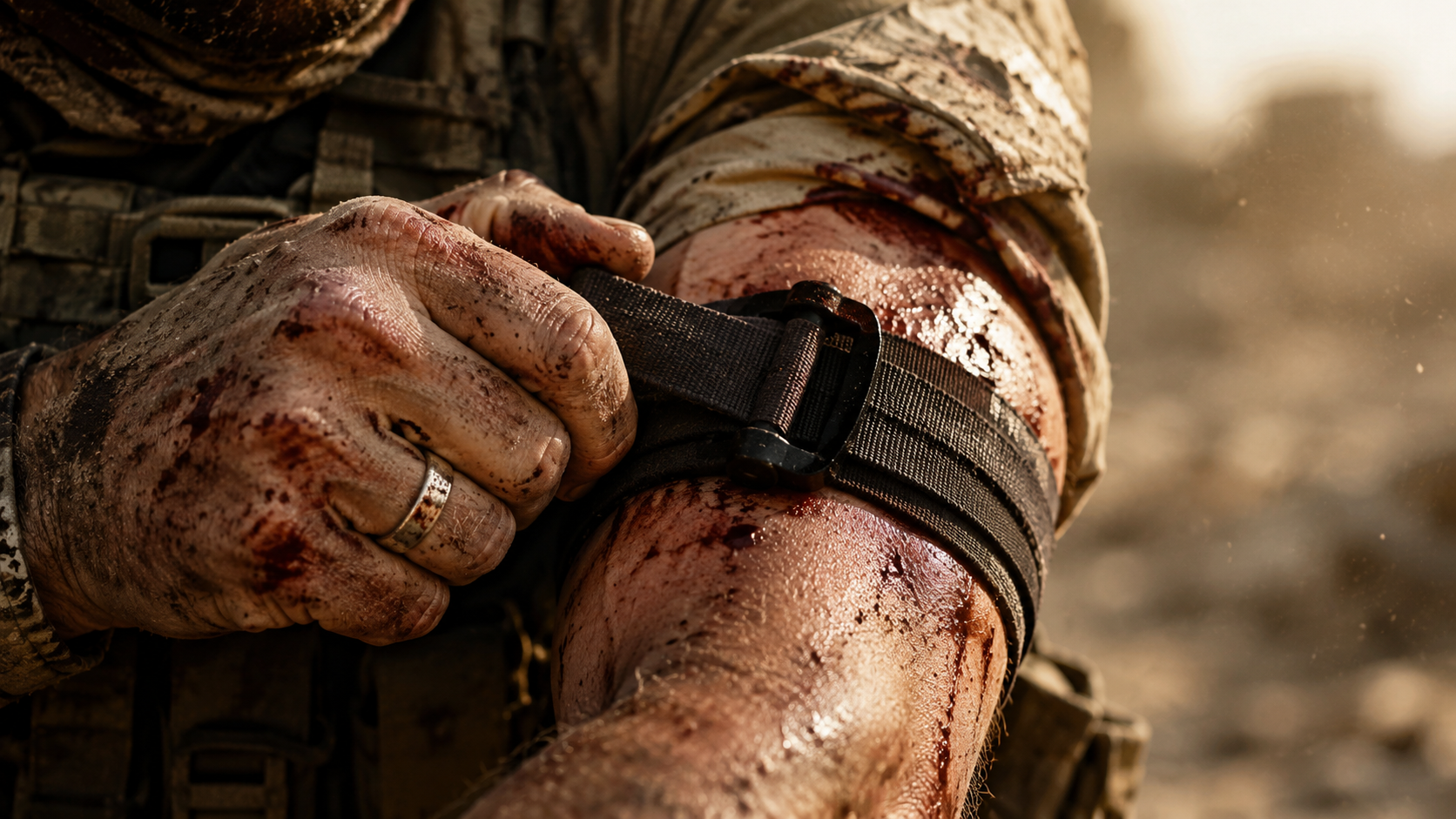
I was reading a story from the battlefield that would not leave me alone.
It involved a Navy SEAL, an ambush in Iraq, a shredded arm, a face torn open by machine-gun fire, and a small strap of nylon that stood between life and death.
A tourniquet.
It is a strange instrument. Brutal in appearance and counterintuitive in principle. It saves a body by constricting a part of it. It protects life by temporarily denying blood to a limb. You tie it on the wounded part, making sure that you constrict the blood flow, to save the limb.
In gentler times, we are taught to preserve, repair, improve, optimize. In emergencies, the hierarchy changes to survival.
First, stop the bleeding.
Only then can you think about healing.
Medicine knows this. Soldiers know this. Investors should too.
Damage-control surgery.
In trauma medicine, there is a concept called damage-control surgery. When a patient arrives with catastrophic injuries and severe bleeding, the surgeon does not always attempt a perfect, complete repair immediately. That can kill the patient.
Instead, the first objective is brutally narrow:
control the hemorrhage, limit contamination, stabilize physiology.
The definitive repair comes later, if the patient survives long enough to receive it.
There is wisdom here far beyond the operating room.
When a business is bleeding cash, when a portfolio is just a collection of wild running trading bets, when a family’s finances are stretched to fragility, when a person’s life has become too complicated to carry, the instinct is often to “fix everything.”
That instinct can be fatal.
In crisis, elegance is secondary. Survival is primary.
First stop the bleeding.
Then preserve optionality.
Then rebuild.
A surgeon who insists on completing a beautiful reconstruction while the patient is dying has misunderstood the moment.
An investor who insists on defending every position while the portfolio is losing its ability to survive may be doing the same.
The first report is always wrong.
RUMINT is a military/intelligence slang term for rumour-based “intelligence”. In simpler terms it means that the first inputs are almost always wrong. This is a long-used military maxim about combat information. In the first minutes of a firefight or ambush, reports are fragmented, emotional, and often contradictory. A soldier may mistake the direction of fire. A unit may overestimate enemy strength. Casualty counts may be wrong. What feels certain in the fog of battle is often only the earliest, most distorted version of events.
A combat saying expands it neatly:
The first report is wrong. The second report is only half right. By the third or fourth, you may begin to understand what happened.
In investing, it equals to common narratives.
The first inputs we hear are loud and noisey.
They are either celebratory or ominous.
But they are mostly wrong.
Investors should let more facts flow in.
Not stories. Not emotions.
Facts and data.
The enemy gets a vote.
Jason Redman, the Navy SEAL whose story I will come to, uses this line while describing combat:
"The enemy always gets a vote."
You may prepare well. You may study the terrain. You may have the right people, the right equipment, and the right plan. Then the enemy adapts. Reality intervenes. Something changes.
That is war.
That is also life.
That is also investing.
We build models. Markets build surprises.
We form expectations. Cycles form their own.
We make plans. Liquidity, geopolitics, earnings, regulation, interest rates, and human behavior cast their vote.
A plan is useful.
But the plan is not sovereign.
This is why rigid conviction often becomes vulnerability. The problem is not being wrong. Everyone is wrong. The problem is refusing to recognize that the battlefield has changed.
The enemy gets a vote.
So must humility.
Investors make plans.
They forget to review it.
They let the market vote. Deliver a blow.
Then they wonder what went wrong.
Get off the X.
In special operations training, the X is the point of attack. The kill zone. The place where the ambush is focused. Jason Redman later used the phrase repeatedly in life and leadership:
"Get off the X."
When you are on the X, staying still is not neutral. It is surrender. The longer you remain at the point of maximum danger, the harder it becomes to escape.
This may be the most important battlefield idea for investors.
When a thesis has broken, when leverage has become unmanageable, when an asset has gone from volatile to existentially dangerous, when one mistake is threatening the whole balance sheet, you are on the X.
Getting off it may involve a laser focus on valuations.
Getting off it may involve selling something you love.
Exiting high flying assets which are far from base rates.
Raising cash before you feel ready.
Reducing concentration.
Abandoning a cherished forecast.
Accepting a smaller loss instead of risking a ruinous one.
It feels like defeat.
Often, it is discipline.
Soldiers do not get off the X because they are cowards.
They do it because remaining exposed makes every other virtue irrelevant.
The tourniquet
A tourniquet is not a cure.
It is a declaration of priority.
The body is saying:
I cannot save everything in this instant. I must save the whole.
That is why the tourniquet is such a powerful metaphor.
It is painful.
It is restrictive.
It can look extreme to someone who does not understand the wound.
But when arterial bleeding has begun, moderation may be madness.
In investing, a tourniquet may be a cash buffer.
It may be multi asset allocation.
It may be position limits.
It may be selling a beloved but dangerous holding.
It may be saying no to a return that requires fragility.
It may be refusing to average down when the original reason for owning has disappeared.
A tourniquet is not pessimism.
It is respect for consequences.
Jason Redman’s arm
On September 13, 2007, U.S. Navy SEAL Lieutenant Jason Redman led an assault team on a mission near Fallujah, Iraq, to capture a high-value Al-Qaeda leader. The team walked into a carefully prepared ambush.
They were badly outnumbered. Redman later estimated 12 to 15 enemy fighters, armed with two PKM machine guns. Several SEALs were hit. Redman took rounds across his body armor. Then two bullets smashed into his left elbow.
He thought his arm had been shot off.
He reached for it and could not feel it. In the confusion of the gunfire, in the shock of the impact, his mind concluded that the arm was gone. He tried to get a tourniquet onto it himself. He could not. He had already lost too much blood and lacked the strength.
The battle kept raging.
As he tried to move back toward cover, another round hit him in the face, entering near the ear and tearing through his jaw and nose. He was knocked unconscious. His team initially thought he was dead.
When he came to, he was still pinned down in the kill zone. In one retelling, he called out to a fellow SEAL, Al, asking how long until medical evacuation. The urgency was unbearable. The medevac could not reach him while the firefight continued.
Redman’s teammates kept fighting. They called in an extraordinarily close air-support mission to suppress the enemy. In a lull in the fire, his team leader ran forward, reached him, dragged him back behind cover, and got a tourniquet onto his mangled arm.
Redman later said it undoubtedly saved his life.
He had believed the arm was already lost.
The tourniquet kept him alive long enough for medicine to decide otherwise.
At the hospital, doctors warned that his elbow was destroyed, his left hand had no function, and amputation was being considered. Yet over years of surgeries, rehabilitation, and reconstruction, his arm was ultimately saved, though with lasting limitations.
That is the extraordinary part.
The tourniquet did not heal the arm.
It preserved the possibility of healing.
It bought time.
It prevented the wound from becoming the whole story.
What’s your tourniquet?
What do you constrict before it bleeds you out?
What part of a portfolio do you cut back to protect the whole?
Highflyers devoid of margin of safety.
What risk do you cap before it grows ungovernable?
Large and overbearing positions which have grown to large.
What ambition do you slow before it wrecks health, family, or peace?
What loss do you accept now to preserve the chance of recovery later?
Focus on limiting the downside you can’t digest.
The tourniquet is not a symbol of retreat.
It is a symbol of intelligent survival.
There are moments when the strongest act is not to press harder, hold longer, or prove conviction.
It is to tie off the wound.
Because survival comes before recovery.
Recovery comes before return.
And only what survives gets another chance to compound.
Industry insights you wouldn't want to miss out on.
Written by
Disclaimer
All content on this blog is the intellectual property of DSPAMC. The user of this site may download materials, data etc. displayed on the site for non-commercial or personal use only. Usage of or reference to the content of this page requires proper credit and citation, including linking back to the original post. Unauthorized copying or reproducing content without attribution may result in legal action. The user undertakes to comply and be bound by all applicable laws and statutory requirements in India. In this blog, DSP Asset Managers Private Limited (“the AMC”) has used information that is publicly available, including information developed in-house. While utmost care has been exercised while preparing this blog, neither the AMC nor any person connected warrants the completeness or accuracy of the information and disclaims all liabilities, losses and damages arising out of the use of this information. The recipient(s), before acting on any information herein, should make his/her/their own assessment and seek appropriate professional advice. The statements contained herein may include statements of future expectations and other forward-looking statements that are based on prevailing market conditions / various other factors and involve known and unknown risks and uncertainties that could cause actual results, performance or events to differ materially from those expressed or implied in such statements.
DSP Mutual Fund: MF/036/97/7
Mutual Fund investments are subject to market risks, read all scheme related documents carefully.













 .
.

Write a comment