 Account Statement
  Capital Gain Statement
  Key Information Memorandum
  PAN Updation
  Register / Modify KYC Online
  Nominee Registration
  Email / Phone Updation
  OTM / eNACH Registration
  Voluntary Lock-in for Mutual Fund Folios
  FAQs
FAQs Reach us





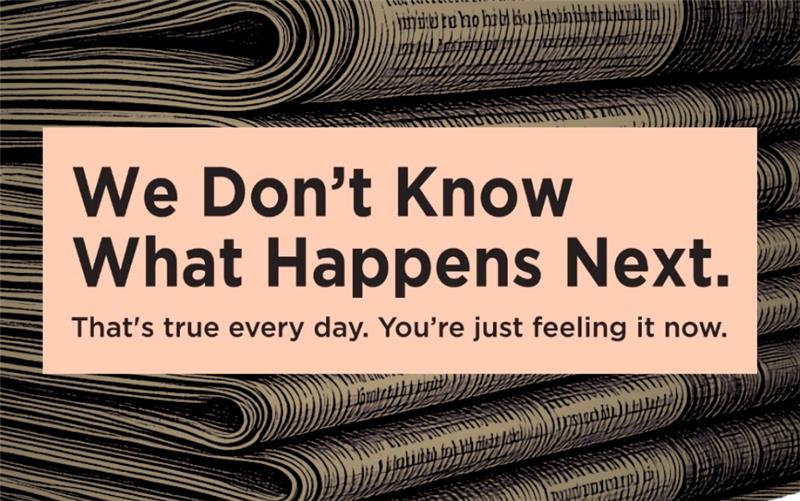
Boring?
Too long?
No stats?
No clarity?
Too honest?
That was a reasonable list of objections to a full-page print ad we were about to run in the top business newspapers in India in early April. Markets were bleeding. Tariffs were back. West Asia was in troubled times. Indian investors were on the verge of panic.
And we wanted to publish 700 words of prose that opened with “We Don’t Know What Happens Next.”
My CEO, Kalpen, thought it wouldn’t work.
He told me so, in as many words. In that calm, measured, twenty-eight-years-of-asset-management voice that he uses when he’s about to be right about something.
“It’s a challenge,” he said.
“We have great intent.”
“Yet it’s too long.”
“It won’t work.”
“It’s your call, but you will lose the bet.”
I took the bet.
ONE MORE WEEK NOBODY HAD ANY ANSWERS
It was one of those weeks. You know the kind. Investors in confusion. Money managers doing what money managers do. Taking shots in the dark, offering clarity when none existed, pitching product categories that should have been pitched before crises times, not in it. The same, seemingly cheerful 'start investing now / why not try SIPs' graphics, quietly implying that their specific fund was the answer to the tariff shock, the oil spike, the war, your indigestion, and the heat death of the universe.
Meanwhile, I kept thinking about the person on the other side. Actually no, I wasn’t that magnanimous- I was thinking close to home. What would my 74-year old mom be thinking? My wife? My friend Jatin in Delhi, the one who calls me every few months asking for advice? Or Dhruv, who opens his investment app every single day before brushing his teeth.
Real people. Real emotions. The ones feeling it in their stomach before they’ve even seen their portfolio values on their app.
These people don’t need charts and explanations.
They need someone to acknowledge, out loud, that they are having a genuinely rough morning and that no forward-looking 20-year graph is going to fix that.
Over an internal WhatsApp chat, I decided to take the risk, and said: let’s try to write the thing a mutual fund would write if mutual funds were simply allowed to sound like human beings in such times.
I wrote something, then read it three times, edited it a few times before I trusted it enough, and then forwarded to Kalpen in the anticipation of a generous pat-on-the-back.
AN ARGUMENT FOLLOWED
Kalpen’s objection, to be fair, wasn’t an objection to honesty, or to my desire to communicate. It was an objection to length.
Attention spans are shrinking. A full-page ad with no visuals, no data, no creativity in the traditional sense, just lines that read like code, breaks roughly every rule in the consumer finance marketing playbook.
My case was this: Length isn’t the real enemy. Something else is.
People don’t read most financial ads because most financial ads aren’t worth reading. They’re performances of hope, optimism and concern. Of course nobody stays. Why would they?
But when the chips are down, pay authentic respect to what the reader is feeling, instead of trying to sell them a solution to it. Only then they might read more words than usual on a morning when their portfolio is bleeding. Not because they’re suddenly patient. Because they’re finally being spoken to like adults.
Kalpen wasn’t sold. But here’s the thing about Kalpen: he doesn’t merely approve work. He stress-tests it.
He pushed back. We rewrote. He pushed back again. We rewrote again. Over six days and roughly twenty-three iterations, the ad got tighter, cleaner, and better than the version I’d been defending a week earlier.
By the time it went to print for the Saturday editions, he was still skeptical. I wasn’t.
His “Koi farak nahi padega, log nahi padenge” remained.
We shook hands on the bet.
WHAT HAPPENED NEXT
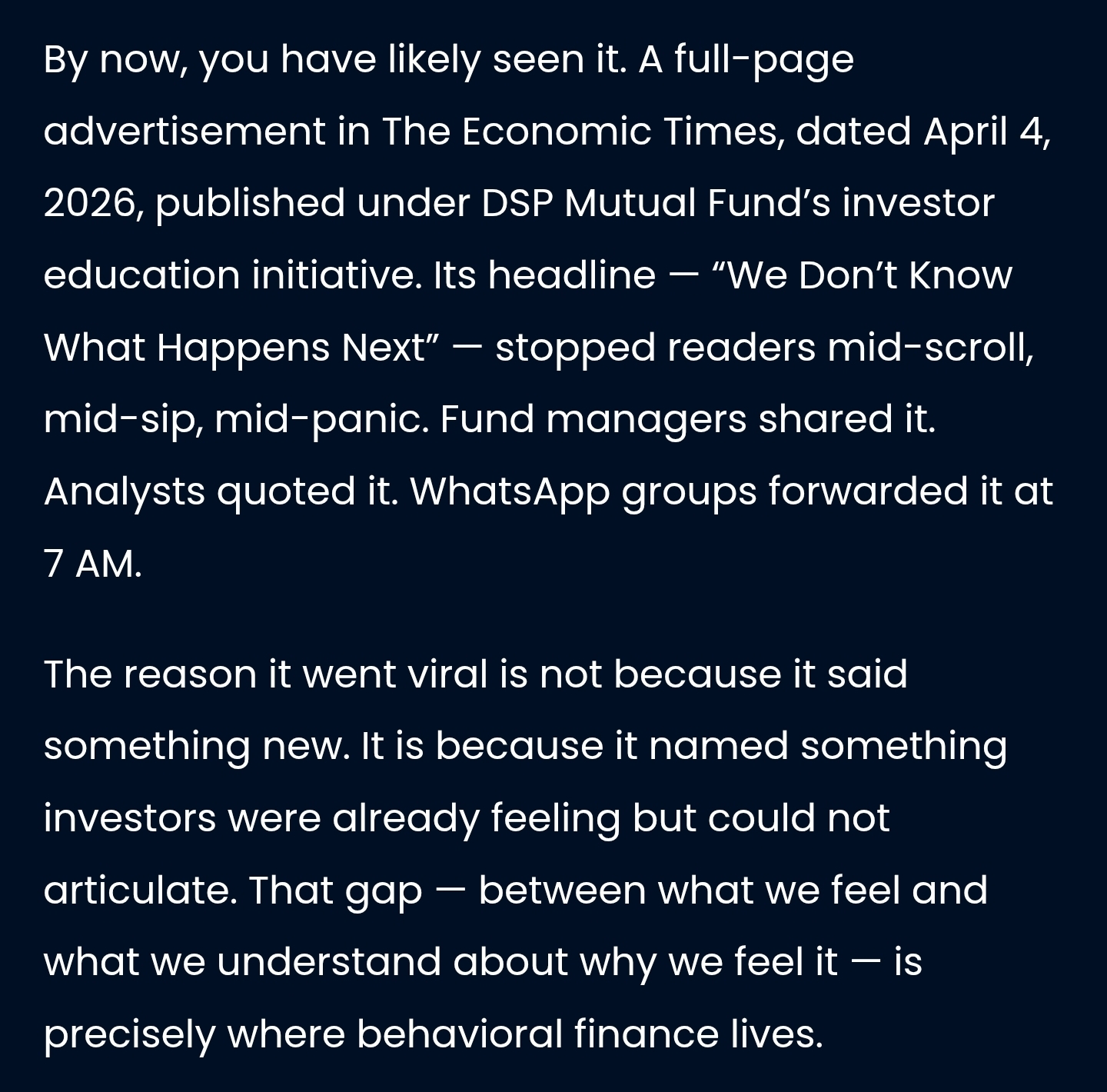
The ad ran on Apr 4, 2026. Saturday morning.
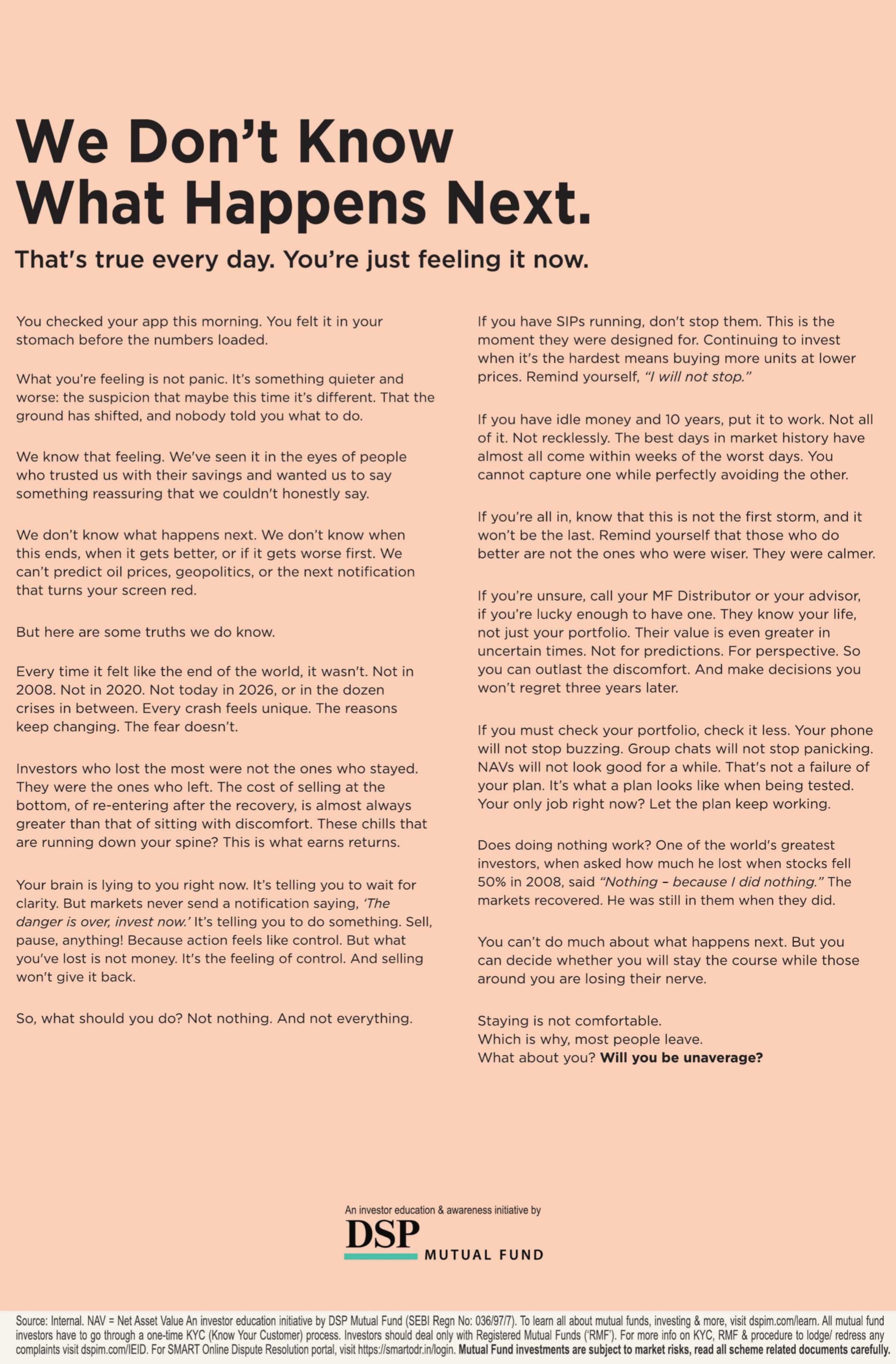
By late morning, it was on LinkedIn. From readers. People were photographing the newspaper and posting the ad with their own captions.
“Finally, an AMC ad that doesn’t talk down to me.”
“Read every word.”
“My father read this aloud to us at breakfast.”
“This kind of transparency resonates deeply. Authenticity & empathy during uncertainty build trust far more than polished promises.”
“This kind of honesty from an institutional voice, is rare. And timely.”
Gajendra Kothari, one of India’s leading wealth distributors and Founder & CEO of Etica Wealth, shared this
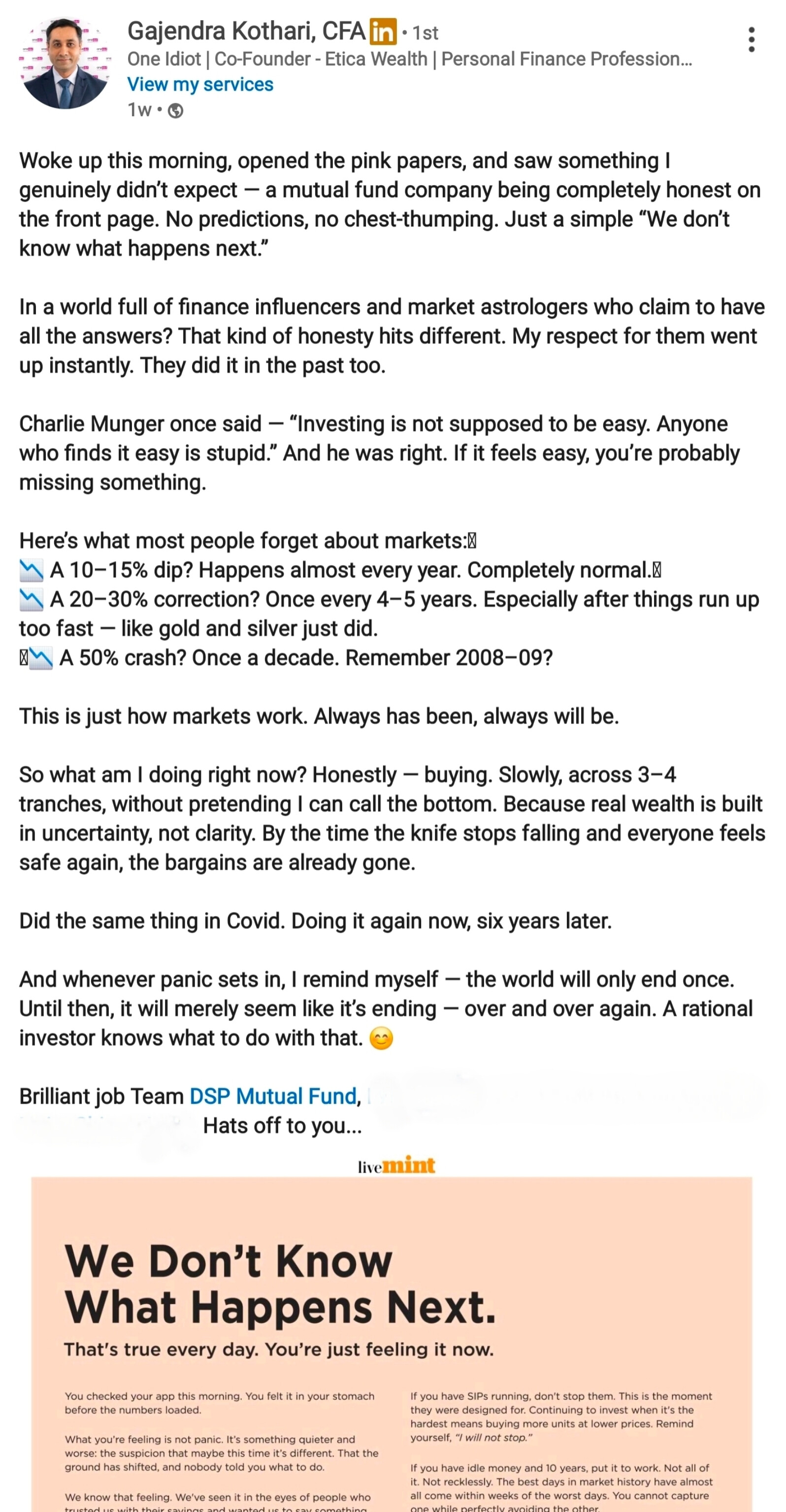
Infact, many distributors sent it to nervous clients in their own personal ways. One advisor told us they framed it and taped it to the office wall. Fund managers, CEOs from other AMCs shared it. Somewhere in Bangalore, an engineering student who had never read a mutual fund ad in his life messaged us to say he’d read the whole thing twice.
Kalpen posted on LinkedIn later that day. In his usual terse, line-by-line style. The last three lines said what this story needs to say:
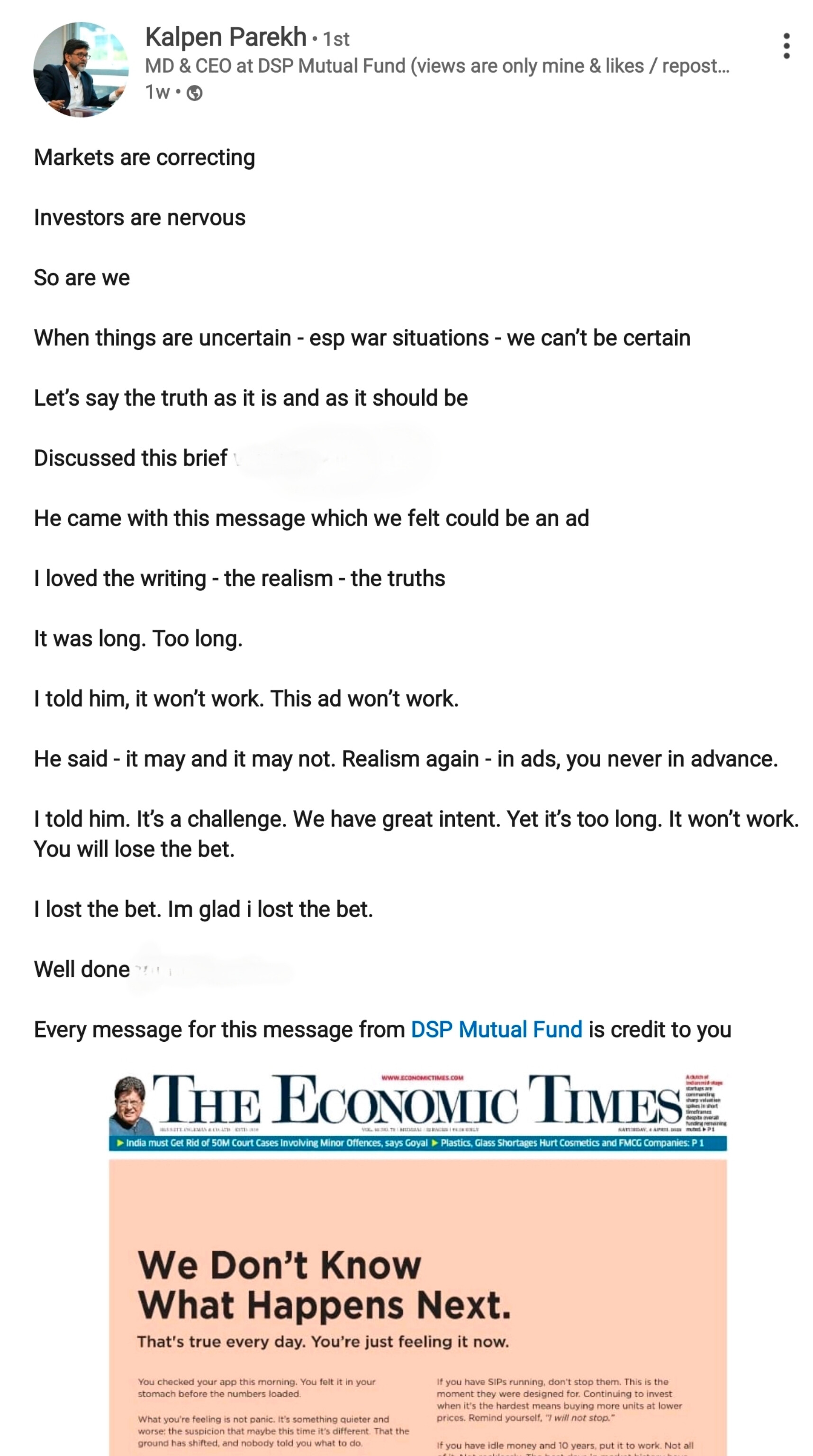
That’s my CEO. That’s one of the reasons why I’m still at DSP after 20 years.
THE UNEXPECTED VALIDATION
A week later, Dr. Meghna Dangi (chartered accountant, cost accountant, PhD in behavioural finance, two decades of research behind her, unknown to us before her post) read the ad and wrote an entire academic breakdown of it. She mapped every paragraph to a specific cognitive bias.
Availability heuristic.
Loss aversion.
The disposition effect.
Action bias.
Somatic marking.
Her conclusion: “The ad is not just good communication. It is an almost clinically precise map of how retail investors mentally collapse during market stress.”
I’ll take that as validation.
But here’s the uncomfortable part of that compliment: We didn’t set out to write a behaviourally precise ad. We set out to be honest. That these turned out to be the same thing says more about honesty than it does about our process.
WHAT THIS EPISODE TAUGHT ME
One. The industry underestimates investors. Badly. The “attention span is ten seconds” statistic is true, but the blame is on us. Most of what we give people to consume maybe doesn’t deserve more than ten seconds. Give a reader something that respects them and they are more likely to stay until the last line.
Two. Honesty is almost always the shortest path, even when it looks like the longest. Our instinct in financial services is to reach for the surface level. For the story. For the charts. For the comfortable message. “How it’s always been done” feels safer. It isn’t. People can smell a sales pitch from across the page, and their instinct is to distrust it. An ad that says “we don’t know” paradoxically can be more credible than the ad that pretends to.
Three. The best CEOs don’t expect you to ‘seek their approval’. They help improve your thinking until they no longer can. The version we published was better than the version Kalpen nearly killed. He wasn’t a reluctant yes. He was a productive no. That’s a feature in the process, not a bug. After that, the next lesson matters most.
Four. Make the bet. Take the risk. Put the message out. Let it be seen. Two people who disagree can decide to put their conviction where their mouth is and let reality settle it. I won this one. I’ve lost many more times. These wins and losses matter less than the habit of making the bet in the first place. It forces clarity. It separates the opinions you’ll defend till you’re standing from the opinions you’re just trying out.
WHAT I KNOW NOW
It’s been two weeks since the ad.
I still don’t know what happens next with the markets.
Neither do CEOs. Neither do behavioral finance experts. Neither do fund managers or economists that spent last few weeks publishing charts, trying to deliver some clarity.
But back then, on that one day, we had the courage to say it out loud.
Somewhere in India on April 4th, somebody read those 700 words from DSP Mutual Fund and felt less alone.
Somebody’s advisor had an easier conversation than they’d been expecting.
Somebody kept their SIP running because the ad reminded them that discomfort is the point, not the problem.
If that happened even once, the ad did its job.
If it happened more than once, then maybe we have some evidence. The industry can start talking to investors like adults.
I’m betting it can.
Kalpen, just for the record, let’s place a bet on that one, too? :)
PS: A week later, while the team was still basking in the afterglow, I went for dinner at my brother's. The same brother who co-founded one of India's largest direct investing platforms. If anyone in my family was going to notice a mutual fund ad, it would be him. He, my Mom, and his wife were deep in a debate about the kids and their funny-but-demonic habits at school.
I casually asked what they thought of my wonderful ad from last week.
Blank stares. All three of them.
None had seen it. None had investing problems or portfolio shocks anywhere near the top of their minds. They had school admissions, an upcoming move to another house, and a child who had recently discovered the massive power in the small word "no."
I made the same mental note I often need to make:
There are real things that matter more. Mutual funds, stocks, market volatility are not front and center for 99% of people. Real life is.
Industry insights you wouldn't want to miss out on.
Written by

Disclaimer
All content on this blog is the intellectual property of DSPAMC. The user of this site may download materials, data etc. displayed on the site for non-commercial or personal use only. Usage of or reference to the content of this page requires proper credit and citation, including linking back to the original post. Unauthorized copying or reproducing content without attribution may result in legal action. The user undertakes to comply and be bound by all applicable laws and statutory requirements in India.
Mutual Fund investments are subject to market risks, read all scheme related documents carefully.














 .
.

Write a comment