 Account Statement
  Capital Gain Statement
  Key Information Memorandum
  PAN Updation
  Register / Modify KYC Online
  Nominee Registration
  Email / Phone Updation
  OTM / eNACH Registration
  Voluntary Lock-in for Mutual Fund Folios
  FAQs
FAQs Reach us







There's an old bit of office folklore about the bike-shed effect. Put a nuclear reactor and a bicycle shed on the same meeting agenda, and the shed usually gets more airtime. A reactor might get ten minutes of discussion, while the shed's paint colour gets an hour, simply because everyone has an opinion on paint and far fewer people understand reactor physics.
Markets tend to work the same way. The newest theme, the fastest-growing technology, or a new explosive story dominating the headlines this week draws most of the attention and debate, regardless of what it will eventually mean for revenue or profit. Meanwhile, large and familiar businesses that are quietly generating consistent cash profits and defending solid business moats often get overlooked.
India's largest companies may be exactly that reactor everyone is reluctant to discuss.
This might be the beginning of a new market cycle. Sir John Templeton said:
“Bull markets are born on pessimism, grow on scepticism, mature on optimism, and die on euphoria."
Disbelief is apparent in numbers today.
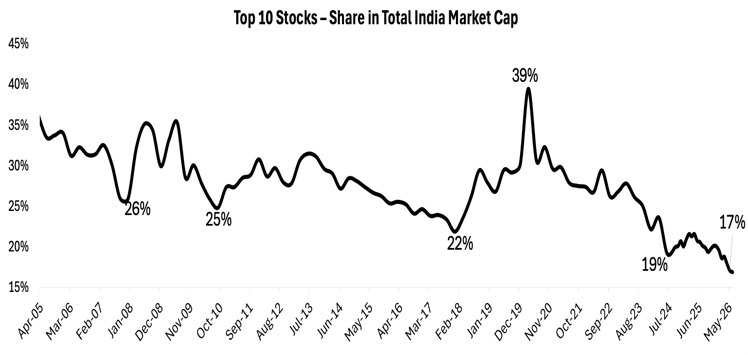
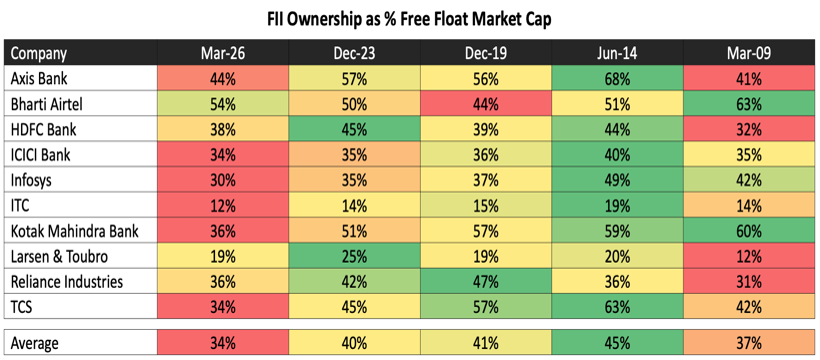
India’s top ten companies by market capitalisation now account for only about 17% of the country’s total market cap, their lowest share on record in over 2 decades. Foreign institutional holdings in these companies have fallen to 34% of free-float market cap, beating the lows reached during the 2008 Global Financial Crisis.
Source: NSE, Bloomberg, Capitaline, DSP. Data as of June 2026
The old favourites are the new wallflowers.
But this does not automatically make them bargains. Just because they are large and perhaps the cheapest in a long while doesn’t make for an investment case. But strong balance sheets, formidable market positioning in respective sectors and strong profitability are ingredients for a brilliant opportunity. And combined with a lack of ownership and throwaway valuations, the odds are mind-boggling.
India’s Big Four Banks & the Big IT firms are sailing the same boat.
India Top 10: The pendulum has moved away from ‘Quality’
As the legendary Benjamin Graham suggested, “Mr Market behaves like a voting machine in short term (sentiment is supreme) and a weighing machine only in the long term (back to fundamentals)”; it seems like right now the market pendulum is clearly swinging away from ‘Quality’.
For much of the previous decade, India’s best-known businesses commanded premium valuations. Quality became fashionable, then crowded, and then eventually expensive.
Source: Capitaline, Internal. Data as of 30th June 2026
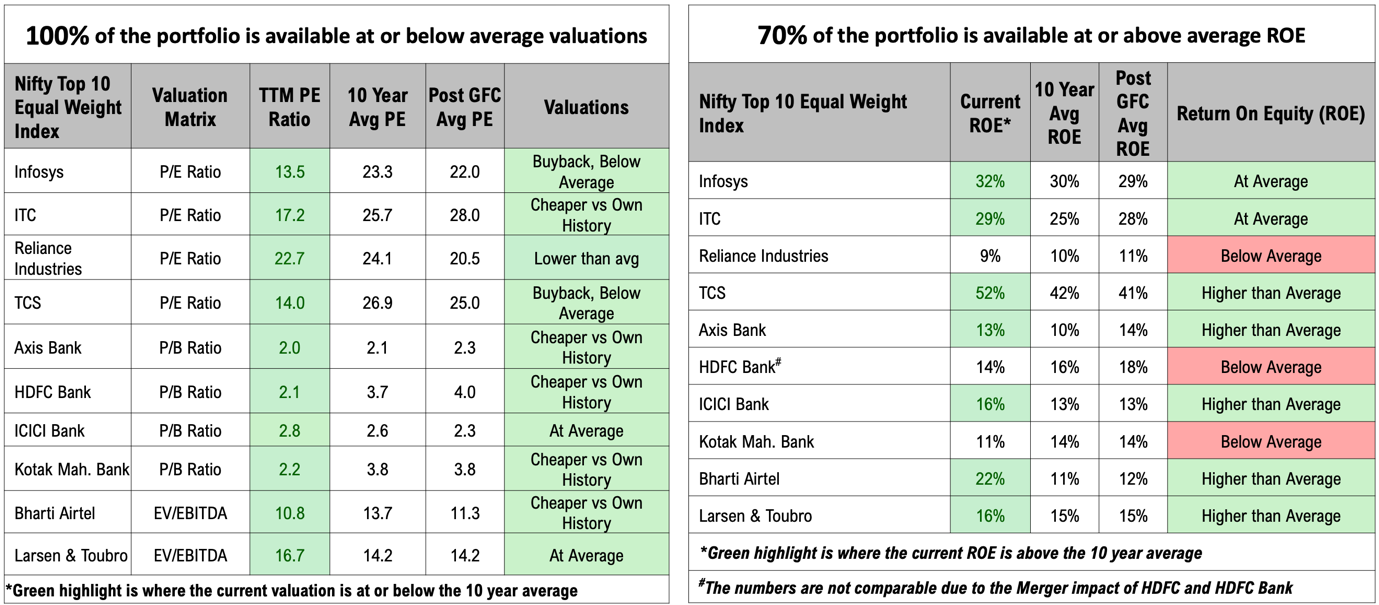
But today, every constituent of the Nifty Top 10 Equal Weight basket is available at or below its long-term average valuation. More importantly, 70% of the basket is generating return on equity at or above its ten-year average. Prices have become more modest, but business quality has not deteriorated in equal proportion.
Investors often confuse lower popularity with lower quality. Sometimes the crowd leaves because the theatre is burning. At other times, it leaves because a more fashionable production has opened next door.
Knowing the difference is the work.
Private Banks: Repaired houses, old reputations
The sector spent years recognising bad loans, raising capital, improving underwriting and rebuilding profitability. The repair work was expensive, uncomfortable and extensive.
But it worked.
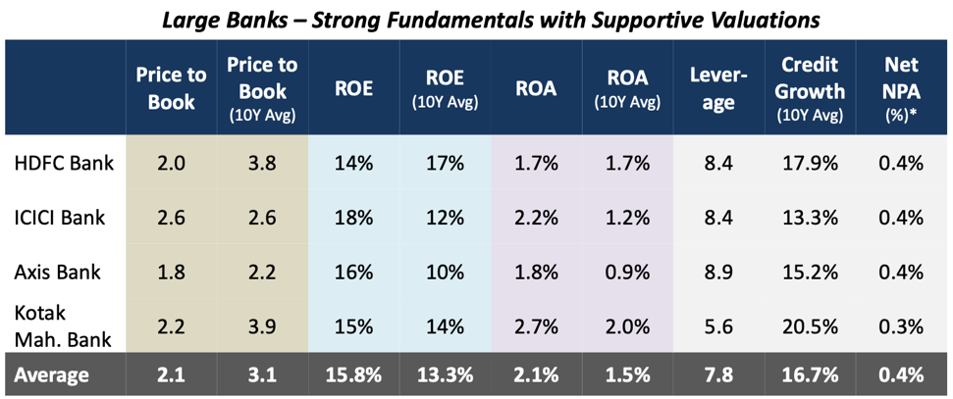
For the Big 4 Indian Private Banks, Credit growth has accelerated to around ~17%, nearly 1.7 times nominal GDP growth. Net NPAs are near historical lows at roughly 0.4%. Average ROE is approximately 15.8%, above their ten-year average of 13.3%.
Source: KIE, Bloomberg, DSP. Data as of June 2026
Yet the group trades at about 2.1 times book value, compared with a 10-year average of about 3.1 times.
Banks remain leveraged institutions. Deposit competition, regulation, margins and future credit costs matter. But the starting point is unusual: investors are not being asked to pay euphoric prices for fragile balance sheets.
It resembles buying a solid house after the roof has been repaired and the foundation strengthened, but before the neighbourhood has recovered its reputation.
There is uncertainty. But ‘uncertainty’ cannot be confused for weakness of character, or of fundamentals. It's only perception, and perceptions change.
Large-cap IT: cheap, cash-rich and complicated
Information Technology sector is experiencing a different kind of pain. Despite its size and profitability, it is perhaps the most neglected sector by investors today!
The big 4 IT pack trades at roughly a 36% discount to its 10-year average P/E multiple. They still generate substantial free cash flow, carry net cash balance sheets, and return capital through dividends and buybacks. Their free cash flow yield is around 6.7%, while their shareholder yield is close to 5.7%.
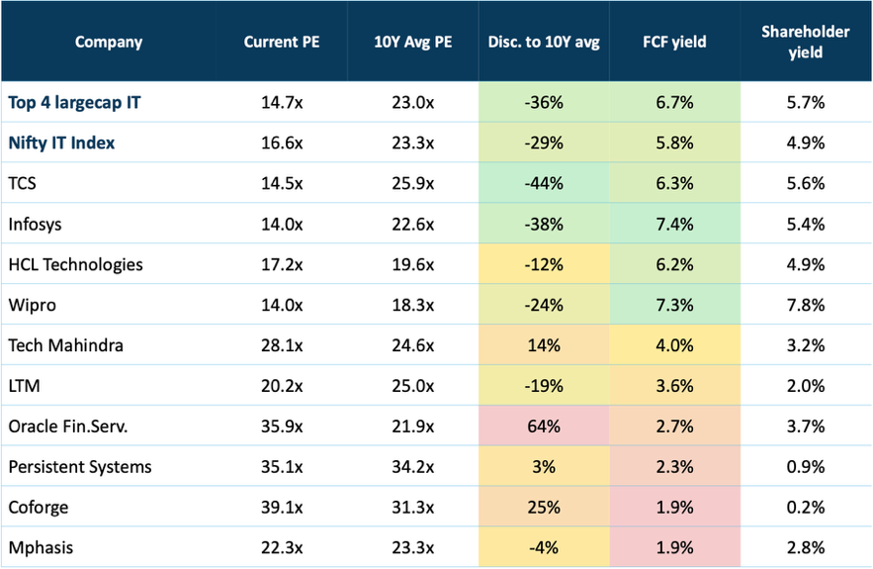
Source: Bloomberg, Capitaline, DSP. Data as of June 2026
But here’s the catch.
Revenue growth among leading listed IT companies has slowed despite faster growth in software-services exports. Private firms and GCC’s are stealing share. Artificial intelligence may amplify parts of the sector, disrupt others and create a small group of AI-native winners.
Large IT companies are blessed with an excellent, trained workforce led by very competent leadership but are currently lost for vision – clueless about the next arena of growth.
Some firms will adapt brilliantly, yet others may have to hand over productivity gains straight to customers. Low valuations indicate low expectations but don’t guarantee future relevance.
The sector may be cheap. ‘Winners’ are much more likely, but the distribution of gains is unlikely to be even.
The deeper lesson is not only about investing
Market lessons often travel well beyond markets. It is easy to confuse reduced visibility with reduced value. But maturity often compounds underground.
A business that has survived multiple crises may possess systems invisible during easy times. A portfolio built around resilience can look boring, until resilience becomes scarce.
The challenge is to distinguish maturity from stagnation.
Private banks show what can happen when institutions complete the hard work before sentiment returns. Large-cap IT reminds us that a glorious past does not exempt anyone from reinvention. India’s largest companies demonstrate that basics remain the same, lack of ownership only sweetens the investment opportunity when size meets fundamentals.
This is a reason for investors to revisit their investment thesis and toolkit.
In summation
India’s largest 10 companies, Big 4 Banks & Big 4 Tech are not one uniform opportunity. Their origins, risks, growth paths and need for reinvention are all different. But the connecting thread is clear – Investors’ attention has moved elsewhere.
Their expectations have fallen (perhaps to the lowest point in recent memory) and current valuations pack a significant amount of margin of safety. All in all, a solid investment case to reconsider perhaps?
The bike-shed analogy isn’t meant to say that the shed is irrelevant. But it is to remember what powers the building and what’s more important to focus on!
In markets, the most discussed opportunity may not always the most relevant one. Sometimes investing begins when we stop debating the colour of the shed and look again at the reactor.
Disclaimer
All content on this blog is the intellectual property of DSPAMC. The user of this site may download materials, data etc. displayed on the site for non-commercial or personal use only. Usage of or reference to the content of this page requires proper credit and citation, including linking back to the original post. Unauthorized copying or reproducing content without attribution may result in legal action. The user undertakes to comply and be bound by all applicable laws and statutory requirements in India. Large caps are defined as top 100 stocks on market capitalization, mid caps as 101-250 small caps as 251 and above. Past performance may or may not be sustained in the future and should not be used as a basis for comparison with other investments. The sector(s)/stock(s)/issuer(s) mentioned in this document do not constitute any recommendation of the same and the Fund may or may not have any future position in these sector(s)/stock(s)/issuer(s). The statements contained herein may include statements of future expectations and other forward looking statements that are based on prevailing market conditions / various other factors and involve known and unknown risks and uncertainties that could cause actual results, performance or events to differ materially from those expressed or implied in such statements. The recipient(s) before acting on any information herein should make his/their own investigation and seek appropriate professional advice.
DSP Mutual Fund: SEBI Registration No: MF/036/97/7
Mutual Fund investments are subject to market risks, read all scheme related documents carefully.
Subscribe to DSPIM #InvestForGood Blog
Investment Insights, Evidence & Stories that matter
Read over 6 million+ times














 .
.

Write a comment