 Account Statement
  Capital Gain Statement
  Key Information Memorandum
  PAN Updation
  Register / Modify KYC Online
  Nominee Registration
  Email / Phone Updation
  OTM / eNACH Registration
  Voluntary Lock-in for Mutual Fund Folios
  FAQs
FAQs Reach us







Summary
Volatility has a way of making every data point feel like a signal and every headline feel urgent. The more useful conversation, as ever, sits underneath the noise. This month, Netra looks at three things quietly worth paying attention to: what thirty years of global SIP data says about staying the course, where relative value sits between large caps and SMIDs, and what India's earnings picture looks like beneath the surface
SIP is not magical. It’s Methodical.
There is a version of SIP that gets sold as magic. The data suggests something more useful: it is method.
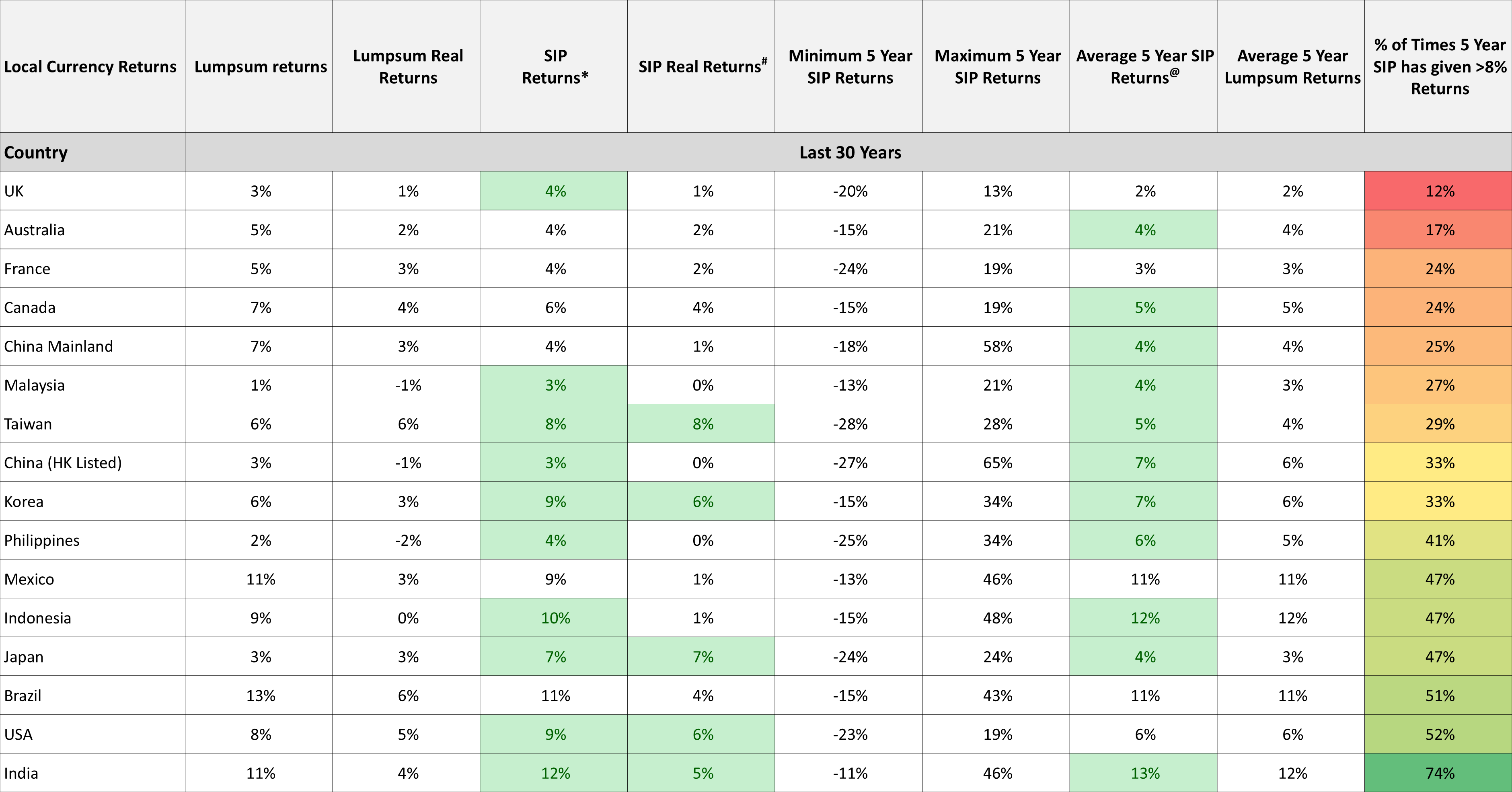
Across sixteen countries over the last thirty years, SIP investors have generally generated positive real returns. In most markets, SIP returns were higher than lump sum returns. In markets where real returns were negligible, lump sum returns were negative, making systematic investing the more resilient approach simply by staying in and removing the pressure of timing.
India stands out in this dataset. SIP has delivered 12% returns and real returns of 5% over the period. In 74% of all rolling five-year windows, a SIP in India has returned more than 8%. It is not a promise of what comes next. It is a statement about what disciplined, uninterrupted investing has historically delivered across full market cycles.
The reason SIP works is not financial. It is behavioural. It removes the investor from the decision of when to enter. It accepts long-term average outcomes rather than chasing exceptional ones. It lets the structure do the work that emotion would otherwise disrupt. A SIP once started, the data suggests, should go on for decades. Ideally, it never stops.
Source: Bloomberg, DSP. Data as of April 2026.
*Green Highlight is where SIP returns are higher than Lumpsum returns. #Green Highlight is where SIP real returns are higher than 5%. @Green Highlight is where Average 5 Year SIP returns are higher than Average 5 Year Lumpsum Returns. Respective countries major indices have been considered. PRI indices are considered for all the countries to keep consistency.
Where relative value sits today
Not all parts of the market are equally priced. Large-cap valuations are broadly in line with long-term averages. The one-year forward PE stands at 19 against a historical average of 17. Relative to US large caps, Indian large caps trade at a 14% discount, compared to near parity historically. Earnings growth expectations of 11% are consistent with historical norms.
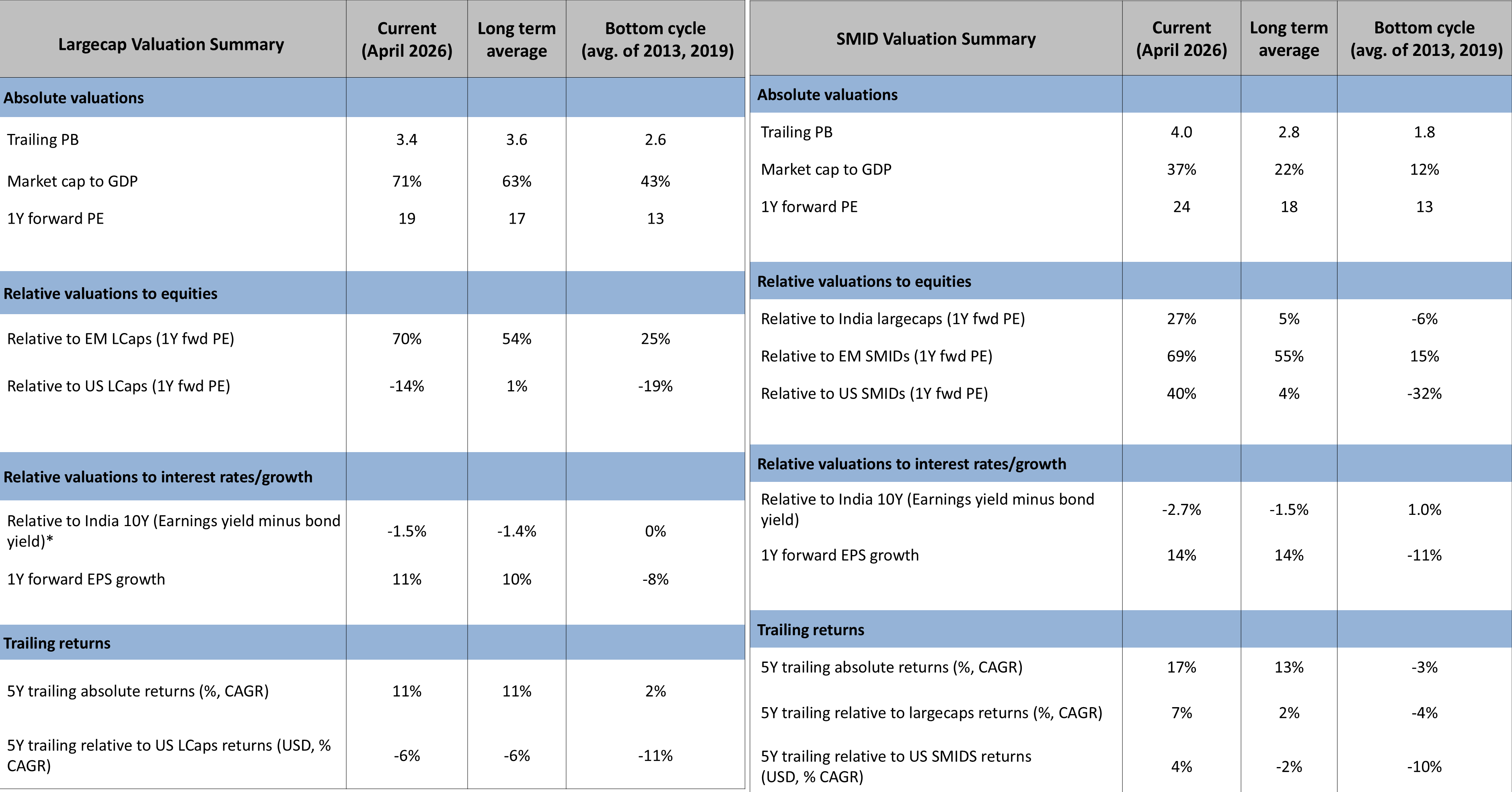
SMIDs tell a different story. Their forward PE of 24 sits well above a long-term average of 18. Their premium to large caps has expanded and their earnings yield relative to bond yields has turned deeply negative. The compensation for risk, relative to history, is thinner.
In select pockets of large-cap India, the valuation case is more grounded than the broader market narrative suggests.
Source: Nuvama, DSP. Data as of April 2026. Earnings Yield (5.4%) – Bond Yield (6.9%) = -1.5%*
The earnings engine and what it still needs
India's corporate return on equity currently sits at 15%, recovered from a low of 12% yet still below the last peak of 22%. The gap is explained by how the two cycles differ.
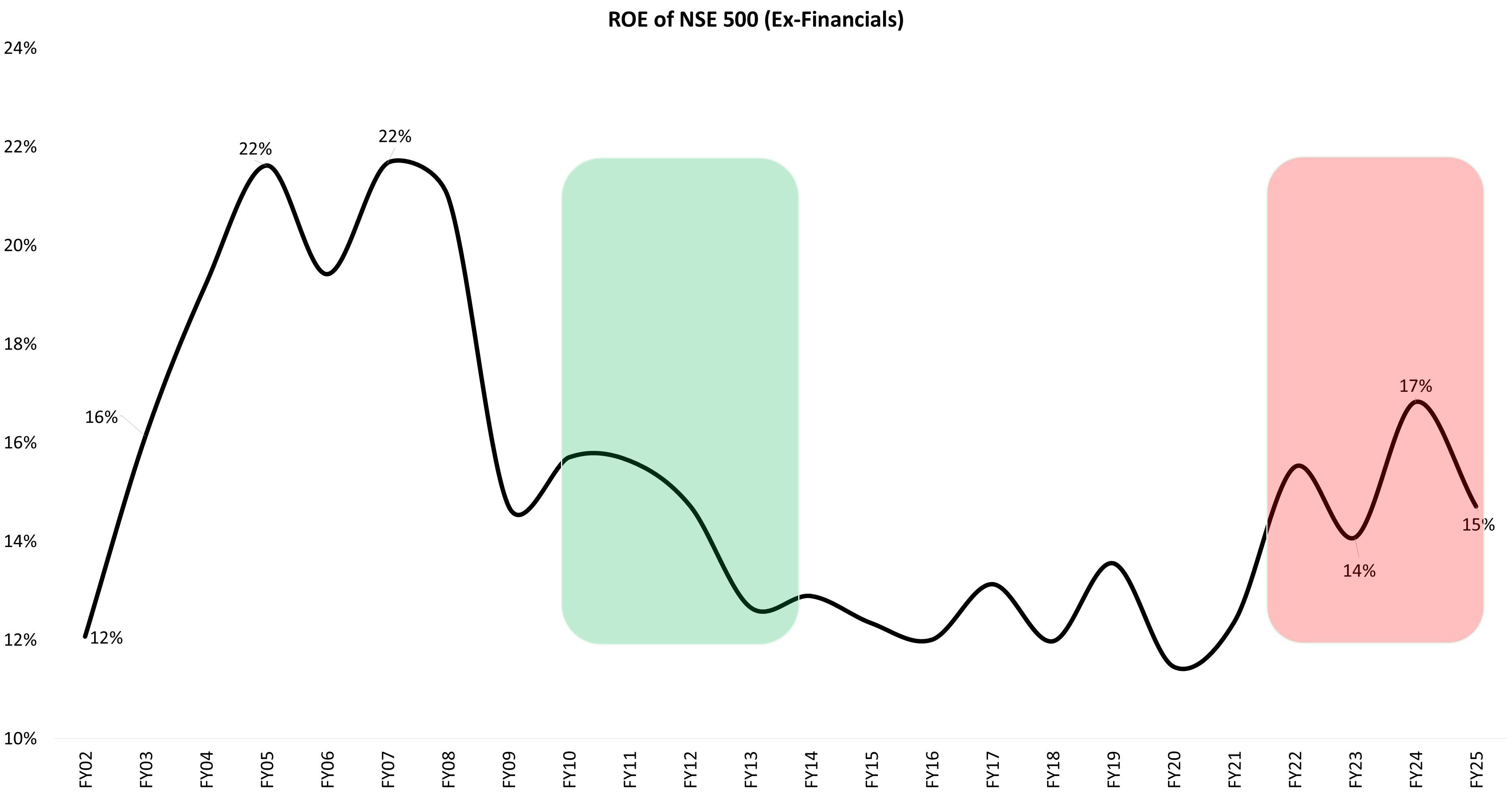
The previous peak was a three-engine cycle: margins expanded, assets turned faster, and leverage amplified returns.
The current cycle has run on one and a half: margins and operating leverage have helped, with asset turns and financial leverage staying subdued. Companies chose to repair balance sheets over aggressive expansion, a cleaner cycle, though a less powerful one.
For ROEs to close the gap, India needs private consumption to broaden, capacity utilisation to rise, and corporate balance sheets to expand again. Until then, valuations need earnings momentum to justify themselves.
Source: DSP, Investec Research. Data as of April 2026. Data is of NSE 500 using historical constituents.
A closing perspective
Volatile markets tend to reward the ones who stay with a structure rather than the ones who keep adjusting to the noise. Thirty years of SIP data across sixteen countries makes that case plainly. Valuation gaps between large caps and SMIDs suggest that positioning still matters, even when everything feels equally uncertain. The ROE story tells us that India's corporate fundamentals are sound, if not yet complete. The recovery in earnings quality is real. The next leg simply needs more of the economy to participate. That is not a reason for caution, but a reason to stay the course.
Disclaimer
All content on this blog is the intellectual property of DSPAMC. The user of this site may download materials, data etc. displayed on the site for non-commercial or personal use only. Usage of or reference to the content of this page requires proper credit and citation, including linking back to the original post. Unauthorized copying or reproducing content without attribution may result in legal action. The user undertakes to comply and be bound by all applicable laws and statutory requirements in India. Large caps are defined as top 100 stocks on market capitalization, mid caps as 101-250 small caps as 251 and above. Past performance may or may not be sustained in the future and should not be used as a basis for comparison with other investments. The sector(s)/stock(s)/issuer(s) mentioned in this document do not constitute any recommendation of the same and the Fund may or may not have any future position in these sector(s)/stock(s)/issuer(s). The statements contained herein may include statements of future expectations and other forward looking statements that are based on prevailing market conditions / various other factors and involve known and unknown risks and uncertainties that could cause actual results, performance or events to differ materially from those expressed or implied in such statements. The recipient(s) before acting on any information herein should make his/their own investigation and seek appropriate professional advice.
Mutual Fund investments are subject to market risks, read all scheme related documents carefully.















 .
.

Write a comment