 Account Statement
  Capital Gain Statement
  Key Information Memorandum
  PAN Updation
  Register / Modify KYC Online
  Nominee Registration
  Email / Phone Updation
  OTM / eNACH Registration
  Voluntary Lock-in for Mutual Fund Folios
  FAQs
FAQs Reach us







Summary
This month's Netra looks at three distinct but connected stories shaping the investment landscape: the quiet but real threat that oil prices pose to India's external accounts, the jaw-dropping scale of AI capital expenditure globally, and a domestic sector - Indian IT, that has been so thoroughly ignored that it may now be the most interesting contrarian opportunity in the market.
Oil: A Tail Risk India Can't Ignore
India imports roughly 85% of its crude oil needs, consuming 5.3–5.5 million barrels per day while producing only about 0.6 mbpd. Every $10 rise in crude prices adds $12–15 billion to India's annual import bill. That alone makes oil the single largest macro variable outside India's control.
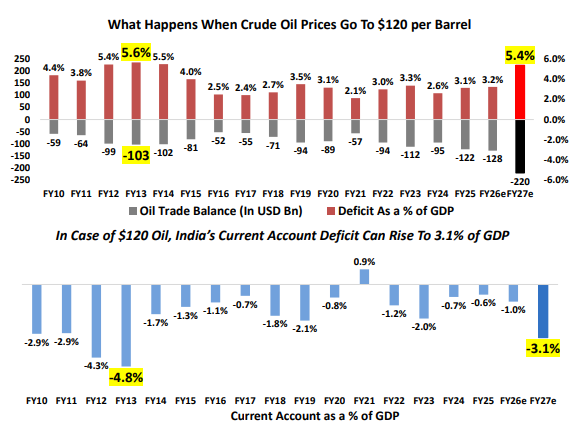
The real concern emerges at $120 per barrel. If crude stays at that level through all FY27, India's oil trade deficit could balloon to $220 billion pushing the current account deficit beyond 3.1% of GDP. Historically, deficits of this magnitude have triggered rupee depreciation of more than 10%, higher inflation, and liquidity stress.
There's a silver lining: India's services exports and remittances have grown substantially, which means the current account deficit wouldn't reach the alarming 4.8% of GDP seen during past oil shocks. Large FDI and FPI inflows can also cushion the blow. But the direction of risk is clear: if oil spikes, it bites.
Source: Bloomberg, DSP. Data as of Feb 2026. mbpd – Million Barrels Per Day
AI Capex: The World's Biggest Bet
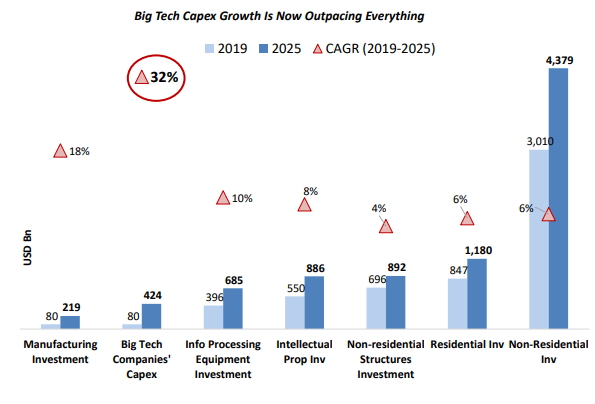
The numbers around AI capital expenditure have moved from impressive to genuinely staggering. Big Tech: Apple, Meta, Alphabet, Amazon, and Microsoft has collectively crossed $1 trillion in capex over the last five years, growing at a 32% CAGR since 2019. That pace of spend is outrunning every other major investment category in the US economy.
Source: DSP, Bloomberg, Data as of Feb 2026. Big Tech Companies include – Apple, Meta, Alphabet, Amazon & Microsoft
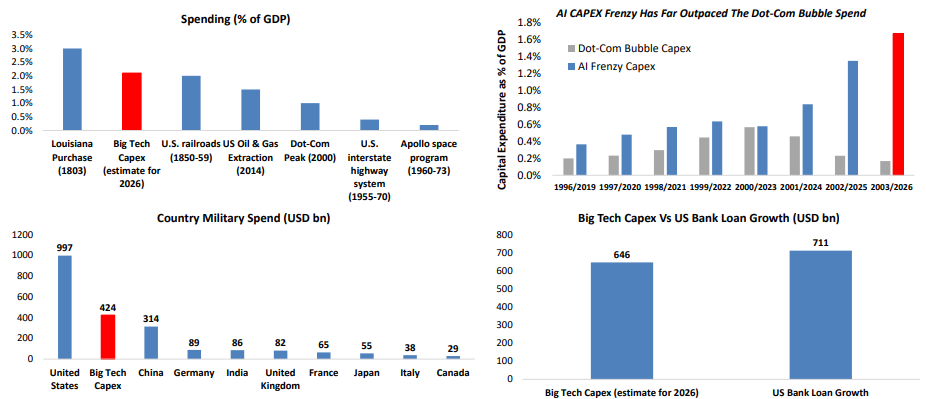
To put it in perspective: Big Tech's estimated 2026 capex of $424 billion is already larger than the entire defence budgets of every country on earth except the United States. It's eight times the peak capex seen during the Dot-Com era on an annual basis. As a share of GDP, this AI investment frenzy has now surpassed the Dot-Com bubble spend and it is still accelerating.
Source: DSP, Bloomberg, Data as of Feb 2026. AI Frenzy Capex is Big Tech Companies which includes – Apple, Meta, Alphabet, Amazon & Microsoft
AI-related companies (listed alone) command a market cap of over $25 trillion roughly 23% of world GDP. Add in unlisted AI firms at indicative valuations and the total approaches $27–28 trillion, or close to one-fourth of global GDP. The world is, as the slide puts it simply, 'All-In' on this trade.
Indian IT: Unloved, Undervalued, and Worth a Second Look
While global AI excitement runs hot, Indian IT has quietly fallen out of favour. The sector's weight in the Nifty 50 has dropped to 8.8, close to an all-time low down from peaks of 52% in early 2012. Indian IT stocks are now underperforming the Nasdaq by 57% on a rolling three-year basis. That's not a blip; that's a decade of relative underperformance erased.
Source: Bloomberg, DSP. Data as of Feb 2026. Green highlight means where the stock is currently trading at below 33rd percentile of valuation, #Green highlight is where cash as a % of Mcap is greater than 5%, @ Green highlight is where the company is generating FCF Yield of higher than 3%.*
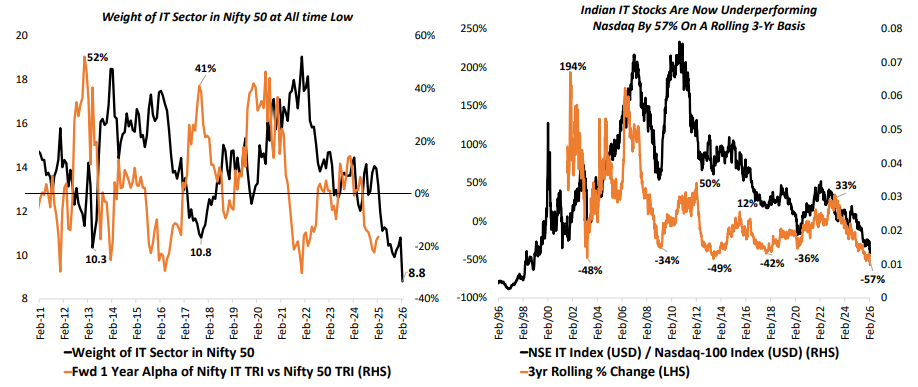
Source: Bloomberg, NSE, DSP. Data as of Feb 2026
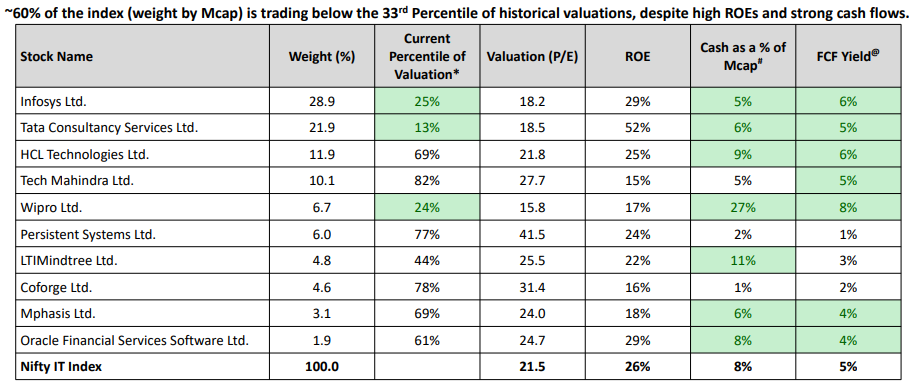
Yet the fundamentals tell a different story. About 60% of the Nifty IT index (by market cap) is trading below the 33rd percentile of its historical valuation range. Even as companies maintain high ROEs (26% for the index as a whole), strong cash flows (5% FCF yield), and cash-heavy balance sheets (8% cash as a percentage of market cap). TCS trades at the 13th percentile of its historical valuation. Infosys at the 25th. These are not distressed businesses. They are well-run companies being priced as if the worst is certain.
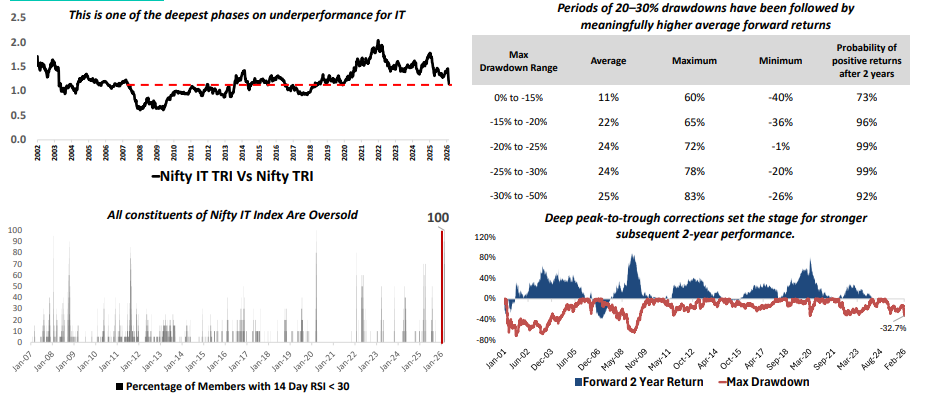
Source: DSP Data as of Feb 2026
History offers useful context here. When the Nifty IT index has seen drawdowns in the 30–50% range as it has now forward two-year returns have averaged 25%, with a 92% probability of being positive. All constituents of the index are currently oversold on a 14-day RSI basis. That's a rare and historically meaningful signal
The thread connecting all three themes is asymmetry.
Oil is a risk that's easy to dismiss until it isn't. AI capex is a structural shift that investors globally are pricing in aggressively. And Indian IT sits at the other end,SS a sector where pessimism may have overshot, and where patience could be rewarded. As always, Netra isn't about making bold calls. It's about seeing what the data is quietly saying before the market catches up.
Disclaimer
All content on this blog is the intellectual property of DSPAMC. The user of this site may download materials, data etc. displayed on the site for non-commercial or personal use only. Usage of or reference to the content of this page requires proper credit and citation, including linking back to the original post. Unauthorized copying or reproducing content without attribution may result in legal action. The user undertakes to comply and be bound by all applicable laws and statutory requirements in India. Large caps are defined as top 100 stocks on market capitalization, mid caps as 101-250 small caps as 251 and above. Past performance may or may not be sustained in the future and should not be used as a basis for comparison with other investments The sector(s)/stock(s)/issuer(s) mentioned in this document do not constitute any recommendation of the same and the Fund may or may not have any future position in these sector(s)/stock(s)/issuer(s). The statements contained herein may include statements of future expectations and other forward looking statements that are based on prevailing market conditions / various other factors and involve known and unknown risks and uncertainties that could cause actual results, performance or events to differ materially from those expressed or implied in such statements. The recipient(s) before acting on any information herein should make his/their own investigation and seek appropriate professional advice.
Mutual Fund investments are subject to market risks, read all scheme related documents carefully.














 .
.

Write a comment