 Account Statement
  Capital Gain Statement
  Key Information Memorandum
  PAN Updation
  Register / Modify KYC Online
  Nominee Registration
  Email / Phone Updation
  OTM / eNACH Registration
  Voluntary Lock-in for Mutual Fund Folios
  FAQs
FAQs Reach us





People often say:
The Nifty has delivered around 12% CAGR over the long term. So, investors should also expect 12%?
But then why are average returns are so hard to earn.
That statement sounds simple.
But it hides three big problems.
The average return of the market is not the same as the return earned by the investor.
There are three reasons.
1. The long-term average belongs to the past
A 12% CAGR is a historical geometric return.
It is an ex-post number.
It tells us what happened in the past.
It is not an ex-ante guarantee.
It does not tell us what must happen in the future.
The future can be better.
The future can be worse.
The future can also deliver the same long-term CAGR through a very different path.
This is the first mistake investors make.
They take history.
Then they convert it into expectation.
Then they convert expectation into entitlement.
That is wrong.
A historical return is a reference point.
It is not a promise.
NSE’s own long-term material shows that Nifty returns have varied sharply depending on the period chosen. For example, NSE’s 25-year Nifty 50 note showed Nifty 50 Total Return Index annualised returns of 14.2% since June 30, 1999, but lower or higher returns over other rolling windows. The point is simple: the long-term number changes with the start date, end date, index version, and reinvestment assumption. (NSE Search Archives)
So the first principle is:
Past average return is history. It is not destiny.
2. The average is not equally distributed
The second problem is distribution.
Even if the market delivers a long-term average return, it does not mean every investor earns that return.
This is where the Pareto principle or power-law distribution helps.
The Pareto principle says that outcomes are often unevenly distributed. A small number of participants may account for a large share of the total outcome. The classic version is the 80/20 rule.
Assume the total return captured by all investors is represented by ₹100.
Under a simple 80/20 distribution:
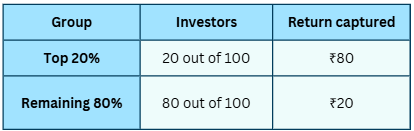
Now apply the 80/20 rule again to the successful 20 investors.
20% of 20 investors = 4 investors.
80% of ₹80 = ₹64.
So the result becomes:
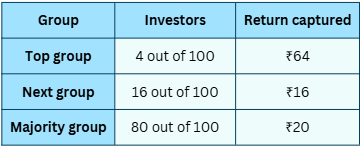
This is the key point.
The average is ₹1 per investor.
But the average does not describe most investors.
The top 4 investors capture ₹64.
The next 16 investors capture ₹16.
The remaining 80 investors capture only ₹20.
So the average exists.
But the experience is unequal.
Now convert this into CAGR terms.
Assume 100 investors each invest ₹1.
Total investment = ₹100.
At 12% CAGR for 25 years, ₹1 becomes almost ₹17.
So the total corpus becomes around ₹1,700.
Total gain = around ₹1,600.
Now apply the same power-law split to the ₹1,600 gain pool.
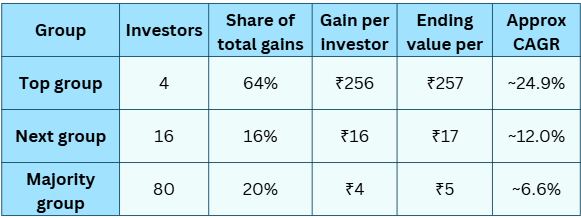
This is why averages mislead.
The market can deliver 12%.
A few investors can earn far more.
Many investors can earn far less.
If realised investor outcomes follow a power-law pattern, 4 out of 100 investors may capture ₹64 of every ₹100 of return captured.
Realised investor outcomes can be highly unequal.
SEBI’s strongest evidence of lopsided outcomes comes from equity derivatives, although not long-term SIP investing. SEBI’s 2024 study found that 93% of individual equity F&O traders incurred losses between FY22 and FY24, with aggregate losses exceeding ₹1.8 lakh crore. Similar numbers can be gauged from study of investor longevity in mutual funds and duration of SIPs.
Most investors don’t stay beyond a few months or few years.
So the second principle is:
The market average is not the average investor’s experience.
3. The investor’s journey is non-ergodic
The third problem is ergodicity.
This is the most important idea.
A process is ergodic when the average outcome of a group is the same as the average outcome of one individual over time.
In simple words:
Group average = individual time experience.
But investing is often not like that.
In investing, the market’s return is an ensemble average.
It is the average of a broad system.
Your return is a time average.
It is what happens to you through your own sequence of decisions, cash flows, emotions, needs, and mistakes.
These two are not the same.
Ole Peters’ work on ergodicity economics highlights this exact problem: many economic models assume that expectation values and time averages are interchangeable, but that assumption is restrictive and often fails in wealth processes.
Image this in your mind.
Imagine 50 people trying to walk on a rope between two high-rise buildings.
If one person falls, the group loses 2%.
The experiment continues.
Now imagine one person trying to walk the same rope 50 times.
The odds may look similar on paper.
But the lived experience is completely different.
If that one person falls even once, the game is over.
That is the risk of ruin.
In technical language, ruin is an absorbing barrier.
Once you hit it, you cannot continue the game.
This is why sequence matters.
The market may recover from a crash.
But the investor may not.
The index can survive 2008.
The index can survive Covid.
The index can survive a 40% drawdown.
But an investor may panic and sell.
He may lose his job.
He may need liquidity.
He may be overleveraged.
He may stop investing.
He may exit after a fall and re-enter only after the recovery.
The market’s average return survives the full journey.
The investor’s return depends on whether he survives the journey.
This is called sequence risk.
It means the order of returns matters.
A 50% fall followed by a 100% rise is very different from a 100% rise followed by a 50% fall if the investor’s behaviour, cash flow, or survival is affected in between.
So the third principle is:
The market’s average return is an ensemble average. The investor’s realised return is a time average. In a non-ergodic system, these are not the same.
Then why does SIP work?
A SIP helps because it attacks the real problem.
The real problem is not mathematics.
The real problem is behaviour.
A SIP does not guarantee 12%.
It does not remove equity risk.
It does not make markets smooth.
It does not ensure that future returns will match past returns.
But it does something very powerful.
It keeps the investor participating.
A SIP is a disciplined method of investing a fixed amount at regular intervals. So SIP helps in four ways:
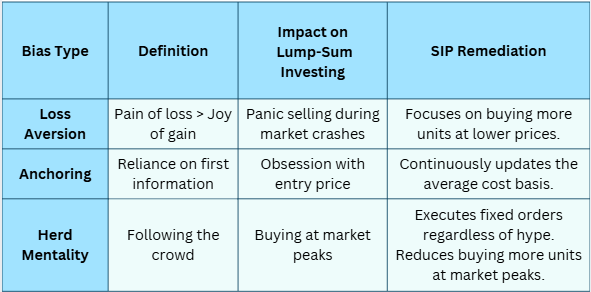
This is why SIP is powerful.
Not because it guarantees the historical average.
But because it improves the odds of capturing market-linked returns over time.
The mathematical power of SIP is not that it always beats lump sum.
The mathematical power is that it creates a repeatable process.
It turns investing from an event into a habit.
And that habit helps investors survive volatility.
Finally
Average returns are hard to earn for three reasons.
First, the long-term average belongs to the past.
It is history, not a guarantee.
Second, returns are not equally distributed.
If outcomes follow a power-law pattern, then 4 out of 100 investors may capture ₹64 of every ₹100 of return captured, while the majority earns far less than the average.
Third, investing is non-ergodic.
The market’s average return is not the same as one investor’s lived return over time. The index can survive every crash. The investor may not.
That is why average returns are hard.
Not because the formula is difficult.
Because the behaviour required is rare.
A SIP is one of the best tools we have to fight this.
It does not promise the market average.
It does not eliminate risk.
But it creates discipline, continuity, and participation.
So the problem is not SIP.
The problem is interruption.
The market offers returns over time.
Most investors break the process before time can do its work.
Nifty 50 Total Returns Index has delivered 13.9% returns over the past 25 years. The past shows the beauty of discipline. It by no means is the window to the future.
It indeed is the window to our behaviour.
It tells us how to behave.
To be disciplined and systematic.
Industry insights you wouldn't want to miss out on.
Written by

Disclaimer
All content on this blog is the intellectual property of DSPAMC. The user of this site may download materials, data etc. displayed on the site for non-commercial or personal use only. Usage of or reference to the content of this page requires proper credit and citation, including linking back to the original post. Unauthorized copying or reproducing content without attribution may result in legal action. The user undertakes to comply and be bound by all applicable laws and statutory requirements in India. In this blog, DSP Asset Managers Private Limited (“the AMC”) has used information that is publicly available, including information developed in-house. While utmost care has been exercised while preparing this blog, neither the AMC nor any person connected warrants the completeness or accuracy of the information and disclaims all liabilities, losses and damages arising out of the use of this information. The recipient(s), before acting on any information herein, should make his/her/their own assessment and seek appropriate professional advice. Past performance may or may not be sustained in future and should not be used as a basis for comparison with other investments. These figures pertain to performance of the index and do not in any manner indicate the returns/performance of any scheme.The statements contained herein may include statements of future expectations and other forward-looking statements that are based on prevailing market conditions / various other factors and involve known and unknown risks and uncertainties that could cause actual results, performance or events to differ materially from those expressed or implied in such statements. For index disclaimer, Click here.
Mutual Fund investments are subject to market risks, read all scheme related documents carefully.















 .
.

Write a comment