Account Statement
  Capital Gain Statement
  Key Information Memorandum
  PAN Updation
  Register / Modify KYC Online
  Nominee Registration
  Email / Phone Updation
  OTM / eNACH Registration
  Voluntary Lock-in for Mutual Fund Folios
  FAQs
FAQs Reach us


DSP Converse December 2023
Our Framework
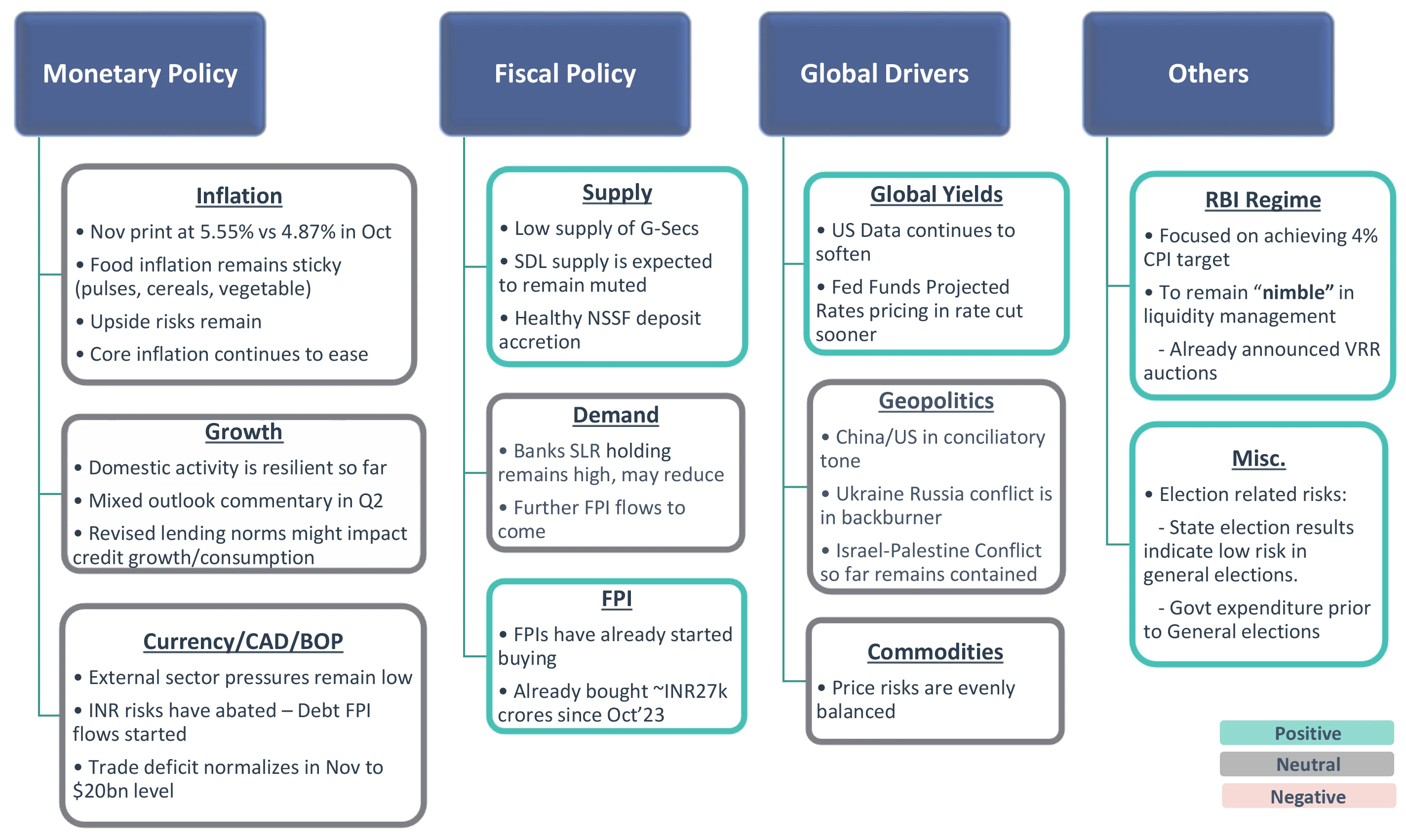
Takeaway:
Domestic environment steady, US pricing of rate cut expectations to drive bond yields
CAD – Current Account Deficit; BoP – Balance of Payment; SLR – Statutory Liquidity Ratio; SDL – State Development Loans; RBI: Reserve Bank of India; G-Sec: Government Securities; FPI: Foreign Portfolio Investment; NSSF: National Small Savings Fund; VRR: Variable Repo Rate
Still Long! Why?
Rate cycle has probably turned around
Globally the data has softened
Let’s revisit our rates call trajectory

Source – Bloomberg, Internal
To start with,
Recap of events since last release.
RBI's “nimble” stance on liquidity (change from hawkish liquidity stance in Oct policy)
US Data continues to soften
Fed finally talks about rate cuts
RBI’s not-so-status quo policy
Key highlight
- ✓ To remain “nimble” in liquidity management vs considering OMO-sales to manage liquidity in the previous policy
-
REPO rate unchanged at 6.5%
Stance retained at “focused on withdrawal of accommodation”
- ✓ By a majority of 5 out of 6 members
Inflation Projections unchanged
- ✓ Adequate bufferstocks, moderation in international food prices and GoI’s supply side interventions to keep a check
- ✖ El-Nino weather conditions need to be monitored
- ✖ Re-iterated working towards a 4.0% inflation target
FY24 Growth Projections revised up
- ✓ To 7.0% vs 6.5% in the previous policy
- ✓ Buoyancy in services, gradual revival in rural demand, Govt’s thrust on capex and healthy corporate & bank B/S
- ✖ Headwinds from geopolitical tensions and volatile financial markets
RBI: Reserve Bank of India; GDP: Gross Domestic Product; B/S: Balance Sheet; OMO: Open Market Operations
US data has finally weakened/Dovish fed policy
-
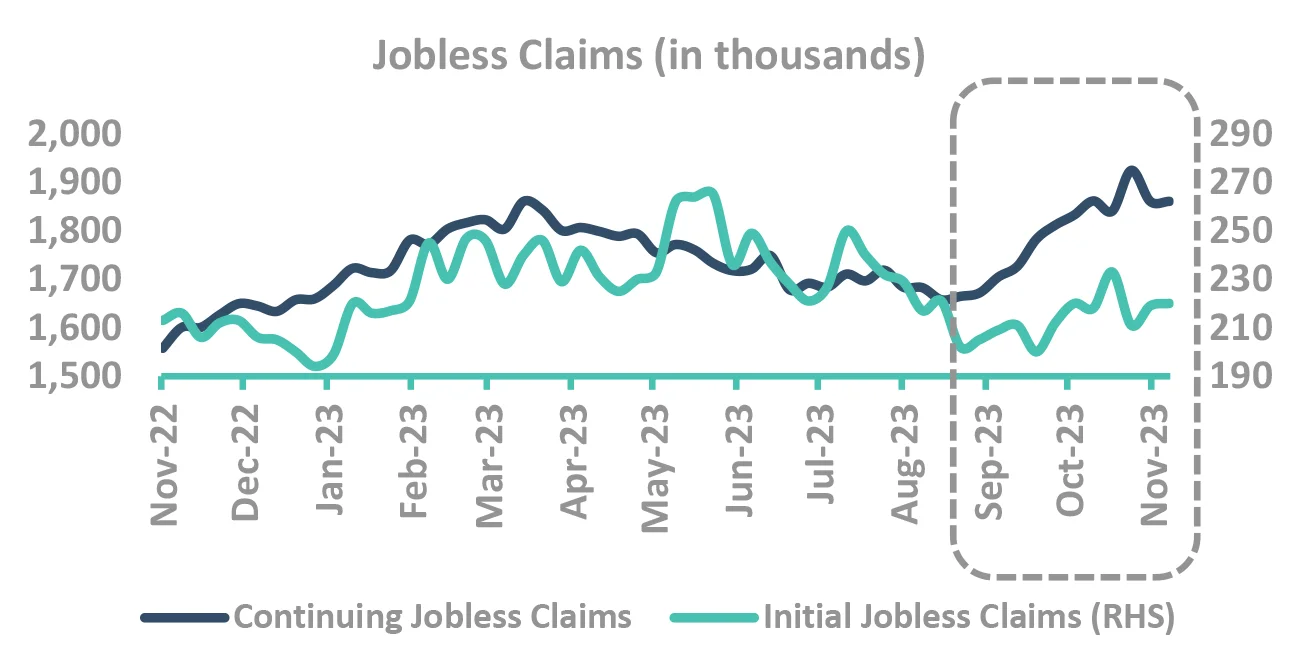
The US job market has weakened
-
And is now percolating to inflation

-
Dovish-than-before FOMC
- Noted that growth of economic activity has slowed
- Discussions on when it would be appropriate for it to begin rate cuts
- Median projections now indicate 3 rate cuts for 2024
- Fed fund projected rates pricing-in rate cuts sooner
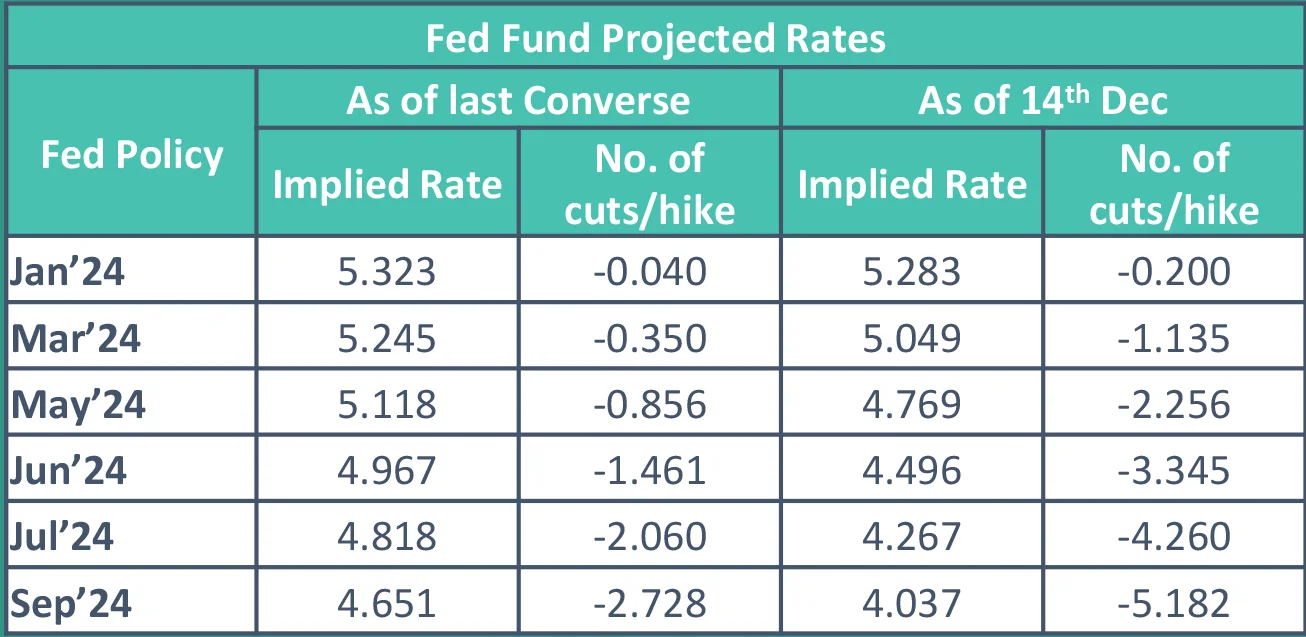
Takeaway:
Fed finally talks about rate cuts “coming into view”
Source – Bloomberg, Federal Reserve CPI: Consumer Price Index; FOMC: Federal Open Market Committee
Now our framework
And
What we track
Our Framework

Takeaway:
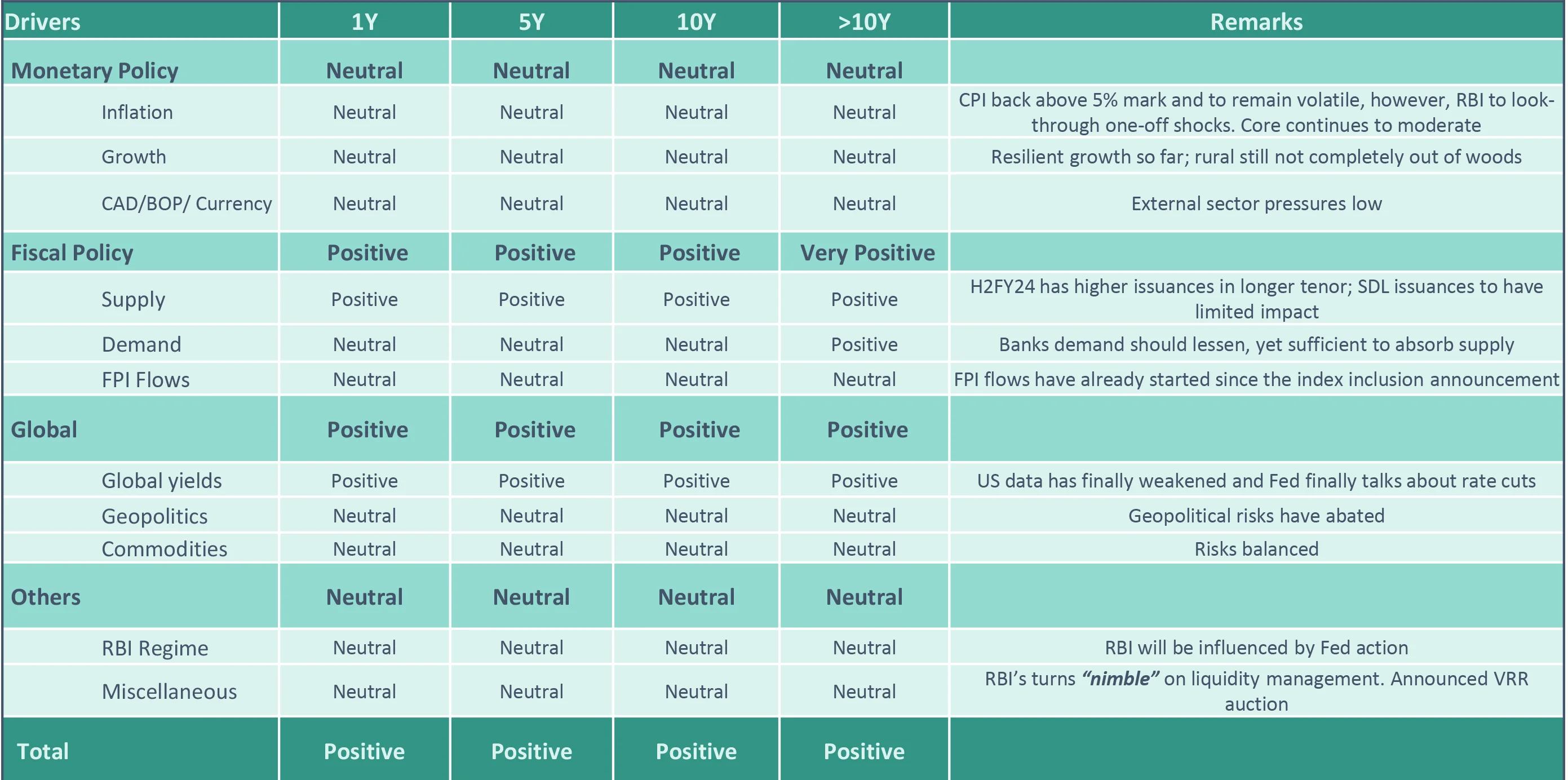
Domestic environment steady, US pricing of rate cut expectations to drive bond yields
CAD – Current Account Deficit; BoP – Balance of Payment; SLR – Statutory Liquidity Ratio; SDL – State Development Loans; RBI: Reserve Bank of India; G-Sec: Government Securities; FPI: Foreign Portfolio Investment; NSSF: National Small Savings Fund; VRR: Variable Repo Rate
Resilient domestic economic activity so far
Expansion in urban demand while rural still not completely out of woods
CPI to remain volatile, however, RBI to look through
RBI to be nimble in liquidity management
Inflation above 5% mark. Risks remain, but RBI to look through
-
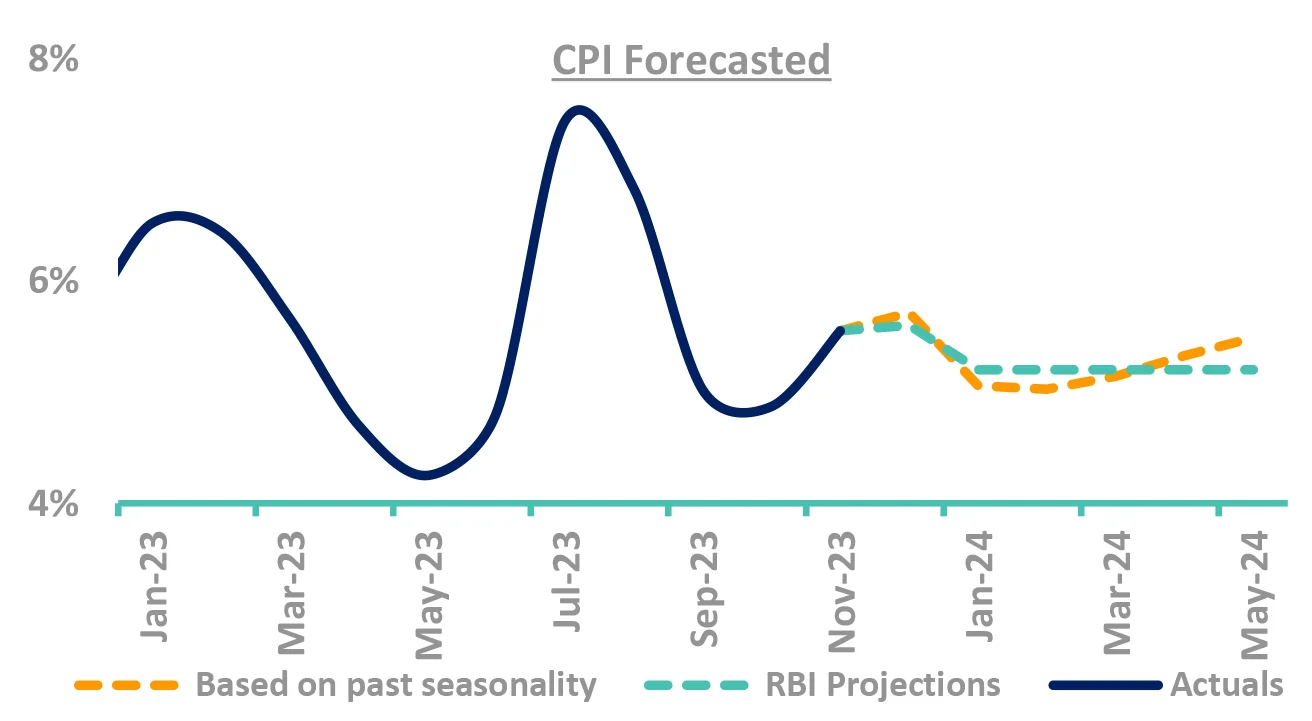
CPI rose sharply but lower than expectations
- Nov print came in at 5.55% vs 4.87% in Oct
- Led by sequential uptick in food prices
- ✓ Vegetables, pulses and cereals
-
Risks remain due to
- ✓ High vegetable prices and low reservoir levels
- However, RBI to look-through such intermittent shocks unless price pressures become generalised
Core CPI eased further
- From 4.3% in Oct to 4.1% in Nov
-
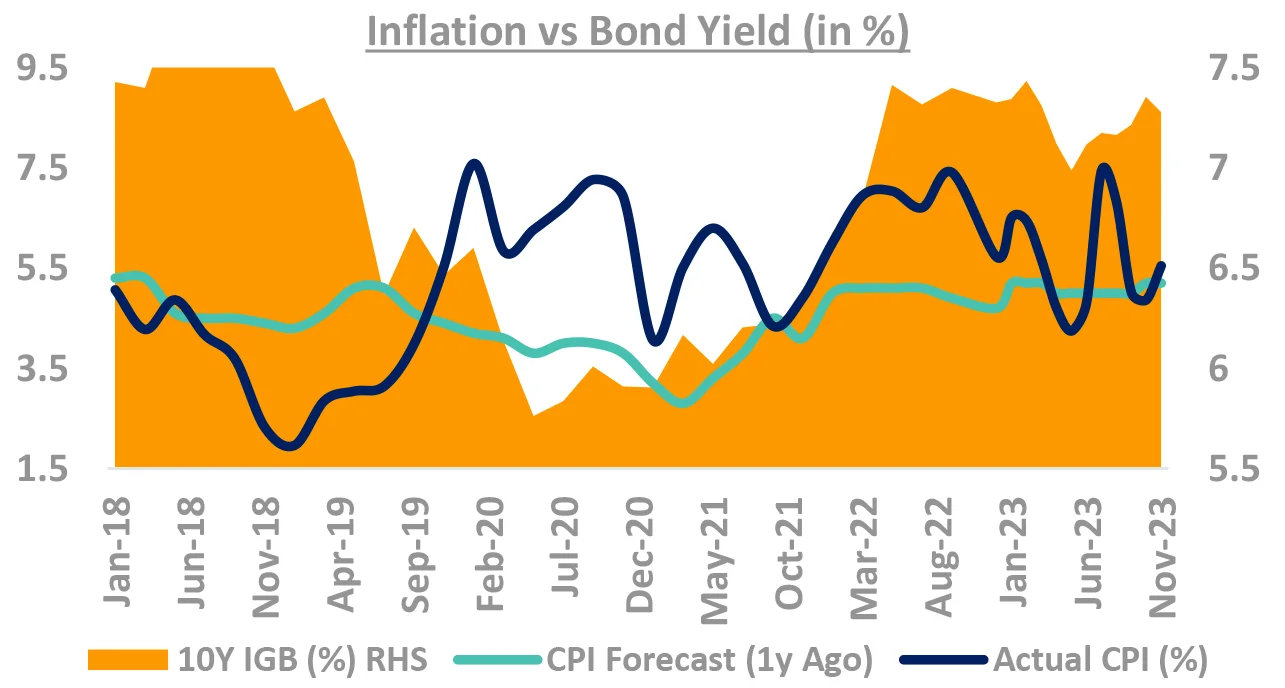
Do yields track inflation projection? No.
- Orange area (chart) is 10Y yields, Blue line is CPI
Can forecasters predict Indian CPI? No.
- Green line is forecasters CPI 1-Yr ahead prediction
- Blue line is where inflation actually came
- Guess the error of margin!
CPI forecast corelated (not causality) to yields
- Low predictive power, high current corelation
Takeaway:
Watch out for uncertainties even though core provides comfort. However, volatility in CPI has not impacted yields (especially in 2023)
Source – Bloomberg, RBI, Internal CPI: Consumer Price Inflation; RBI: Reserve Bank of India; IGB: India Government Bond
Domestic growth resilient so far: But watch out for trends
-
Watch out for domestic growth
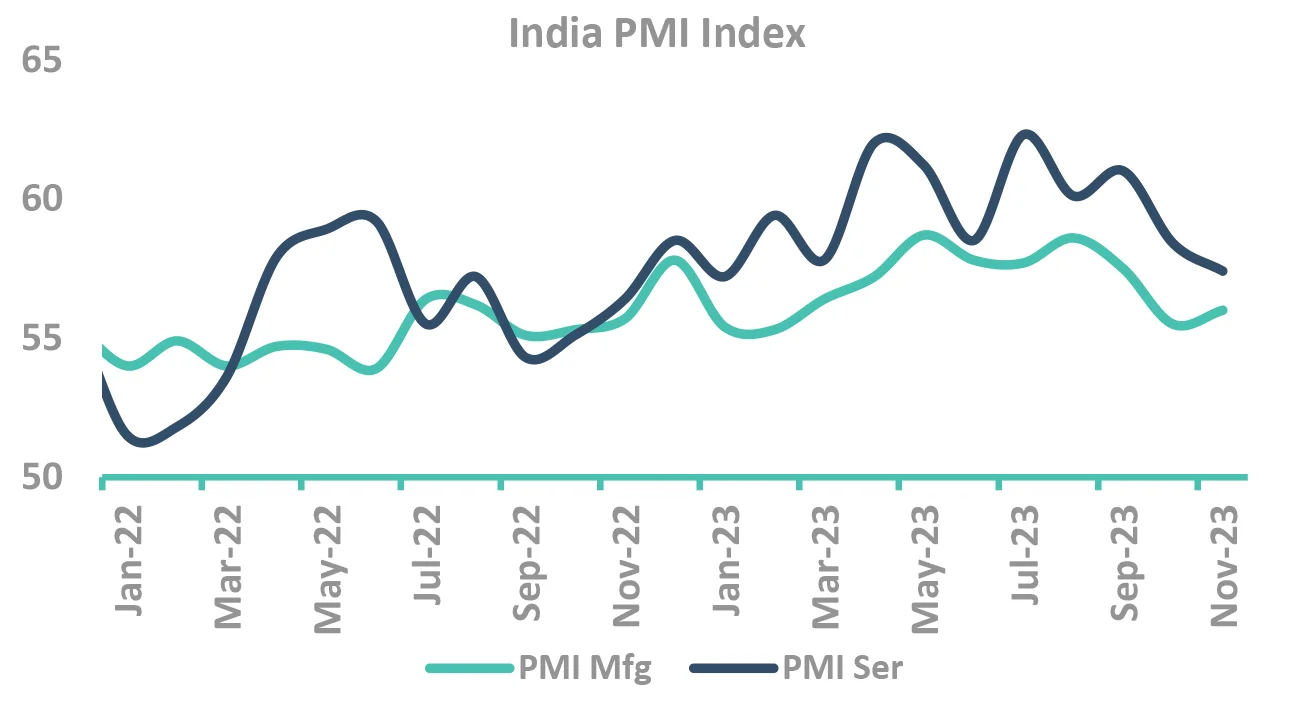
- PMI is in expansionary mode, however….
- ✓ 2nd consecutive month of slowdown in services PMI
- GST collections at ₹ 1.68tn; up 15% YoY
- Outlook commentary in Q2 was mixed
- PMI is in expansionary mode, however….
Impact of revised lending norms still to play out
- Early signs of slowdown already visible (e.g. Paytm putting low ticket postpaid accounts on hold)
- Large corporate credit growth further moderated (5% in Oct from 6% in Sep)
-
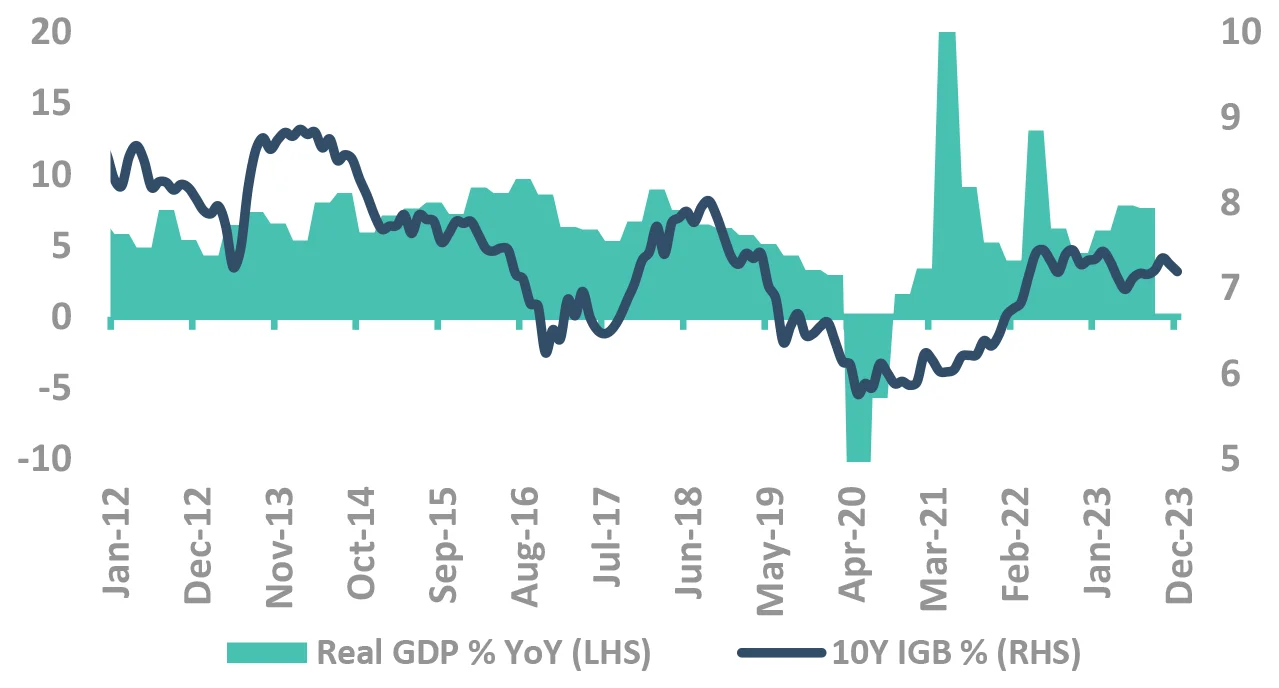
How closely do yields track growth?
- Yields have usually tracked GDP growth, with correlation stronger when growth slows, barring
- ✓ 2013, rupee depreciation and debt outflows
- ✓ 2017, during demonetization
- Yields have usually tracked GDP growth, with correlation stronger when growth slows, barring
FY24, growth may not be big driver for yields
- FY23 GDP growth at 7.2% -in line with RBI projections.
- Q2FY24 GDP Growth came in at 7.6%.
Takeaway:
Domestic growth seems to be resilient so far but watch out for emerging trends
Source – Bloomberg, PIB, Internal GDP: Gross Domestic Product; PMI: Purchasing Managers’ Index; GST: Goods and Service Tax; IGB: India Government Bond
What makes RBI Cut Rates?
Waiting for more conclusive evidence from Fed
-
Checklist for cut:
- Fed Pause/Cut
- Stable Rupee
- CPI less than 6% (except in 2013 when RBI didn’t have 6% target)
-
How is the Checklist now:
- Fed has turned dovish
- Given the FPI flows, forex reserves at $600bn+ and normalization of trade deficit, rupee to remain stable
- Inflation (although expected to remain volatile), RBI to look-through one-off shocks
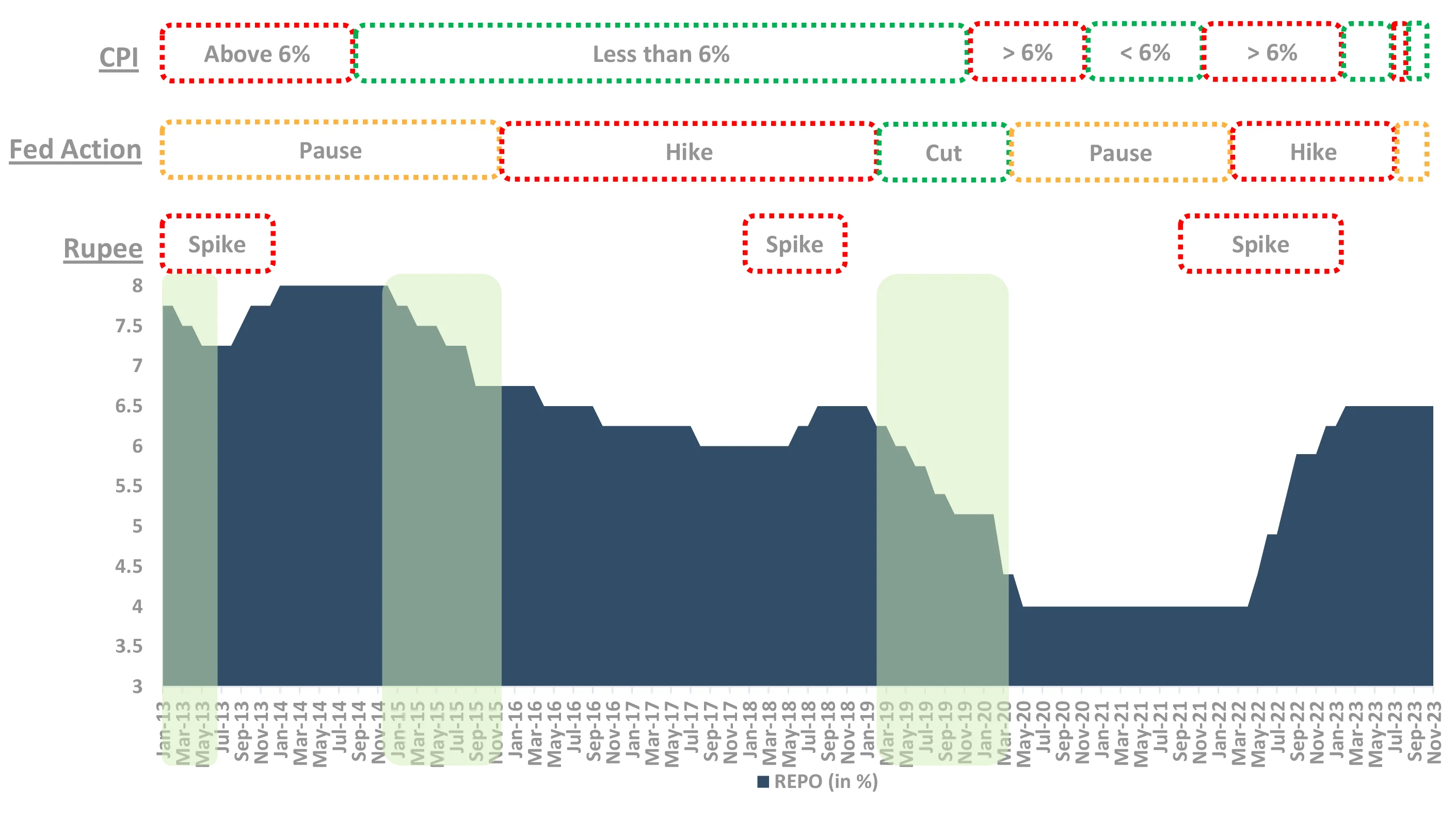
Source – Bloomberg FPI: Foreign Portfolio Investment; CPI: Consumer Price Inflation; Fed: Federal Reserve; RBI: Reserve Bank of India
CPI back above 5% mark, but core moderates
Growth remains resilient
FPI flows to support INR
State election results indicate low risk in general elections
Let’s turn to Fiscal policy
Generally, it drives the long bond yields
It is reflected in demand/supply mismatch.
Fiscal policy is favouring bonds right now
Only a small part of bond buyers are discretionary buyers
They drive yields
Supply fluctuation is borne by these buyers
Gsec market is still driven by lumpy institution purchases
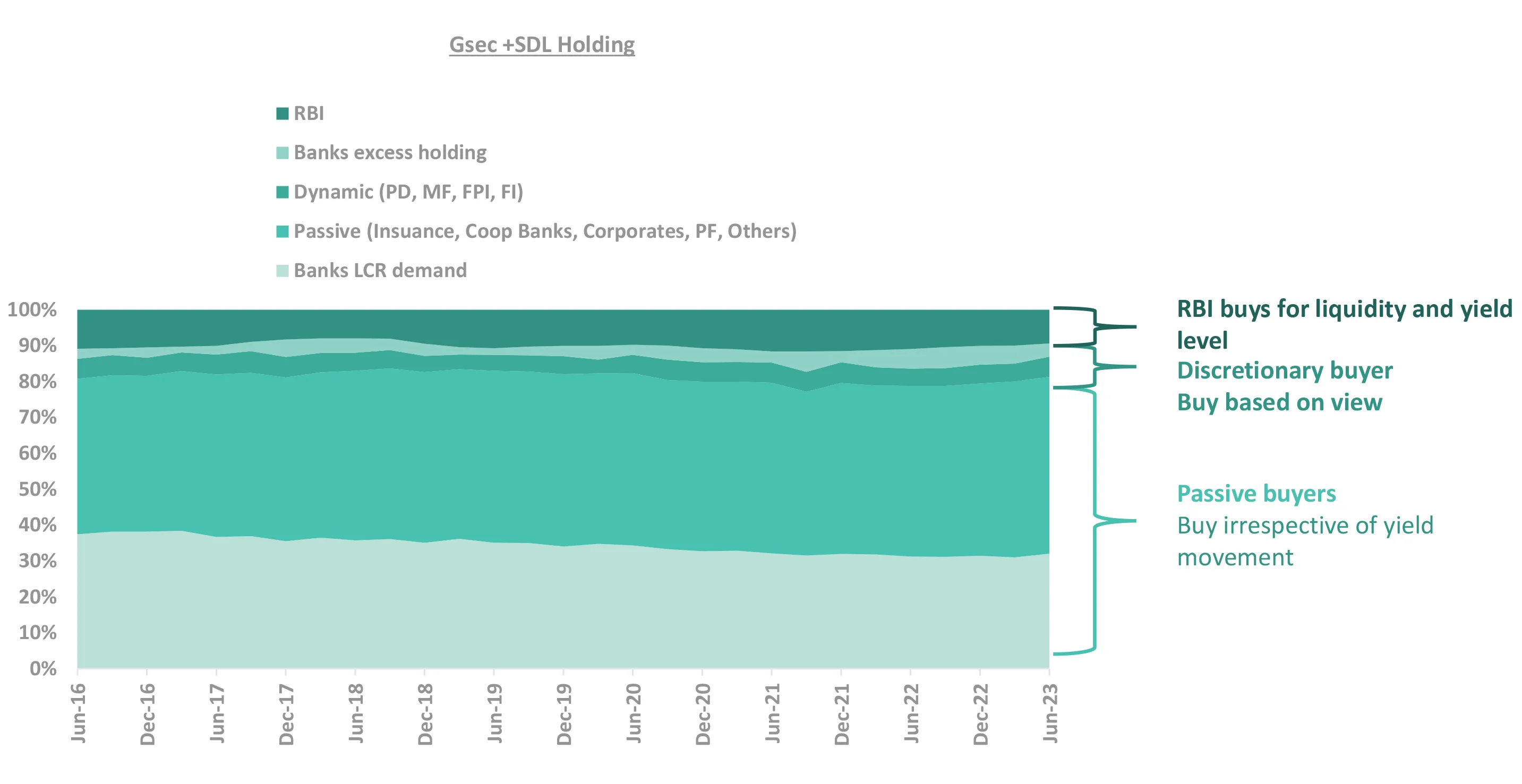
Takeaway:
Increase in supply impacts the discretionary buying. Banks excess holding, passive buyers have been absorbing the supply
Source – DBIE LCR – Liquidity Coverage Ratio; SDL – State Development Loans; PF – Provident Funds; PD – Primary Dealerships; MF – Mutual Funds; FPI – Foreign Portfolio Investors; FI – Financial Institutions; RBI: Reserve Bank of India; GSec: Government Securities
Why FPI inflow is the big thing: Look at the right metrics
-
FPI demand seem insignificant to total supply
- Assuming higher supply by just 6-7%
- ✓ Assuming Centre plus State fiscal deficit of 8.3%
- Non-discretionary buying growth at 14-15%
- ✓ Non-discretionary => need to buy for regulation and ALM (Insurance/PF/NPS/Bank-LCR) no matter the yield
- $25billion FPI flow ($20bn non-discretionary and ~5 billion discretionary) may seem pittance in front of INR19 lac crores of supply
- Assuming higher supply by just 6-7%
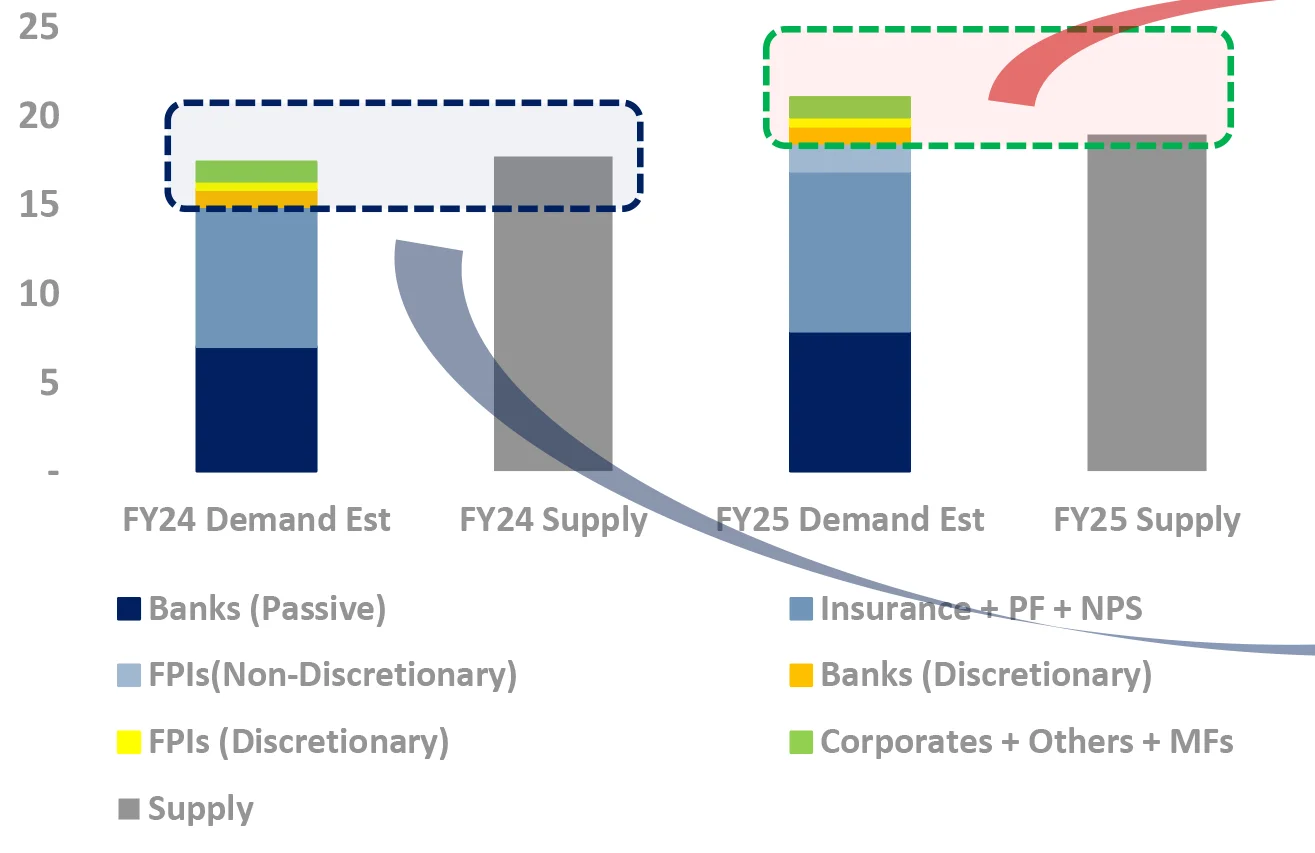
-
… yet FPI inflow is mammoth
- Supply available for discretionaries is less in FY25
- ✓ Bank non-discretionary demand growing faster
- But the demand from discretionary will increase
- ✓ Discretionary = Look at yields to buy
- Supply available for discretionaries is less in FY25
It’s not share of supply that matters
- It’s the share of residual supply
- That’s why, OMO fear of < 1 lac cr rose yield by 20bp
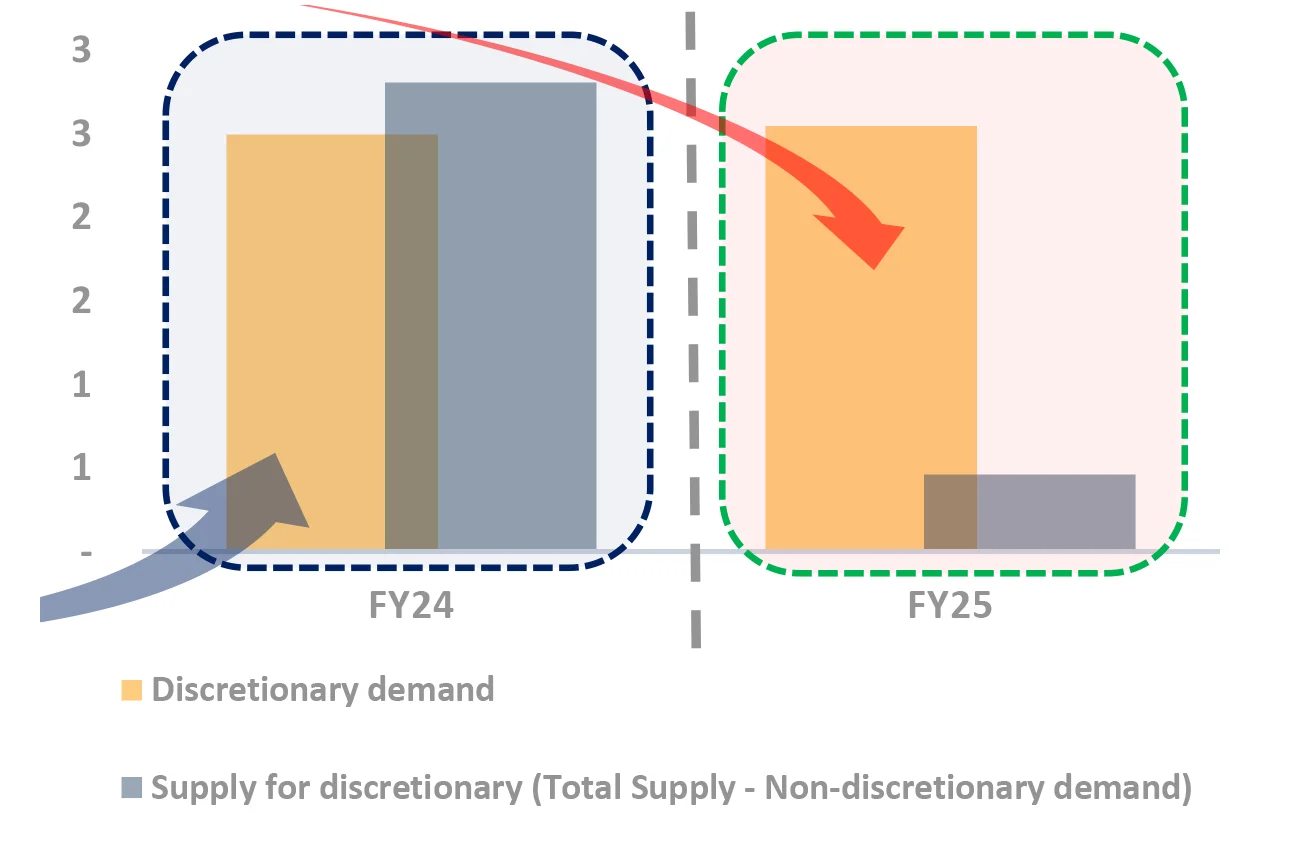
Takeaway:
Additional FPI demand to compete with discretionary buyers
Source – Internal SDL – State Development Loans; PF – Provident Funds; PD – Primary Dealerships; MF – Mutual Funds; FPI – Foreign Portfolio Investors; G-Sec: Government Securities; OMO: Open Market Operations
Comfortable supply/demand dynamics for FY24
But it will be bumpy ride
Last 8 months demand/supply has been rosy (latent purchases, low SDL issuances)
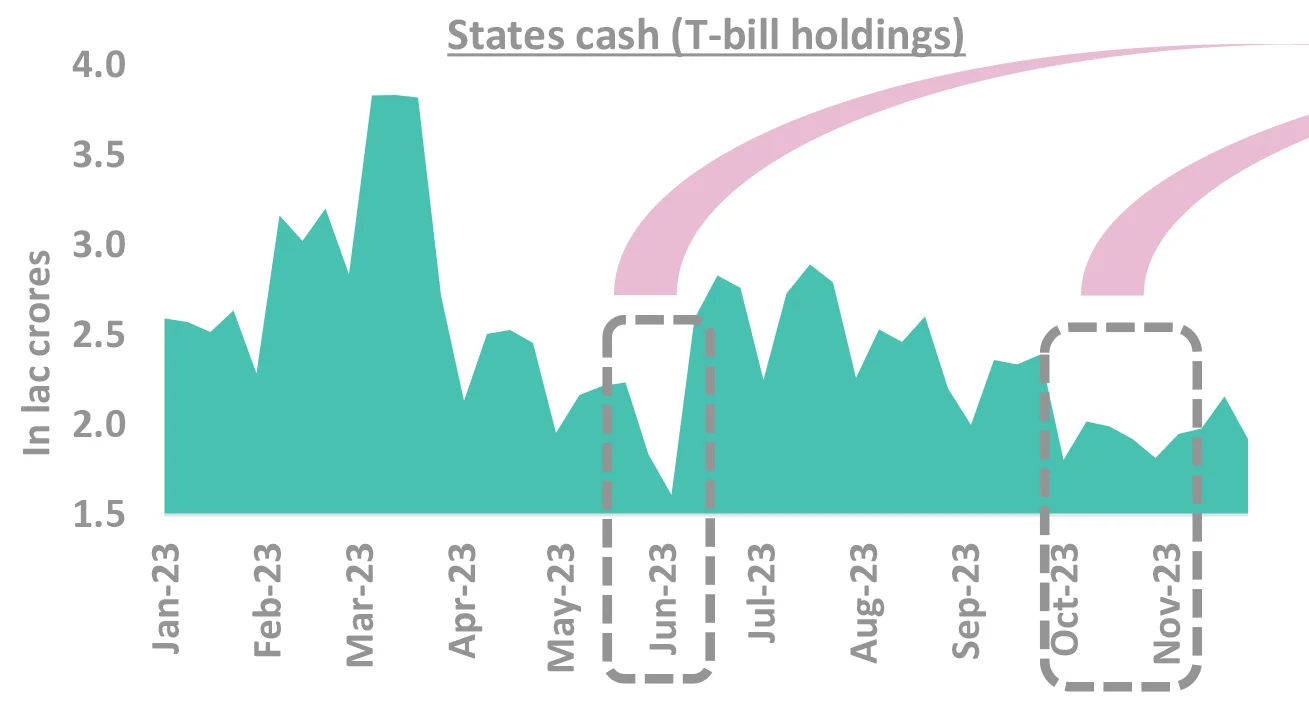
SDL supply only increases when states cash dip
-
State cash balance hovers around 2tn mark
-
Center has front-loaded devolution of tax
Issuance is expected to be in line with the calendar /marginally lower at best
-
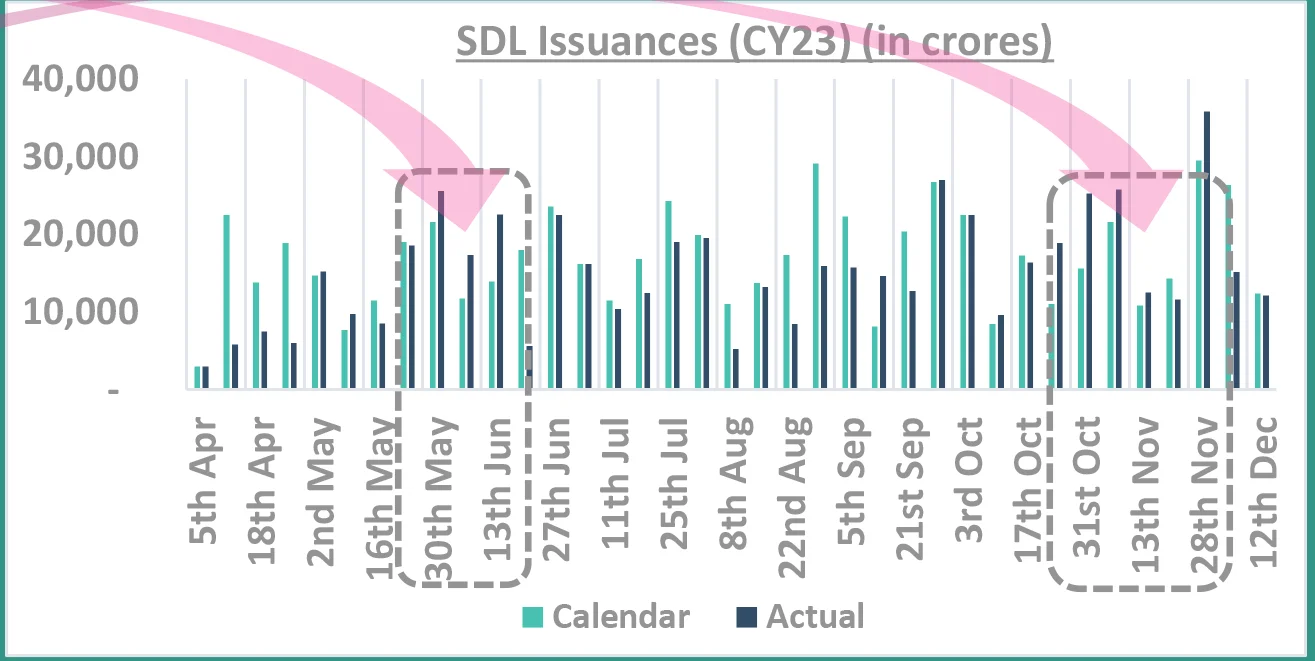
Actual SDL borrowing in line with expectations
- Higher than the calendar only when state cash balances dipped below 2 trillion
- 8mFY24 issuance now just 9% lower vs the calendar amount (vs 12% lower in our last converse)
- ✓ 2nd consecutive month of higher issuance vs the calendar
-
SDL issuance impact is expected to be limited
Takeaway:
SDL supply may remain muted in FY24
Source – DBIE, RBI T-bill: Treasury Bill; SDL: State Development Loans
Banks will continue to buy.
-
Banks SLR holdings has risen sharply
- Banks SLR holding remains high (>30%)
-
Banks have bought nearly ₹ 6 tn in 8mFY24
- But this includes bump of HDFC merger
And the same pace is expected to continue
- As natural NDTL growth will still lead to demand

-
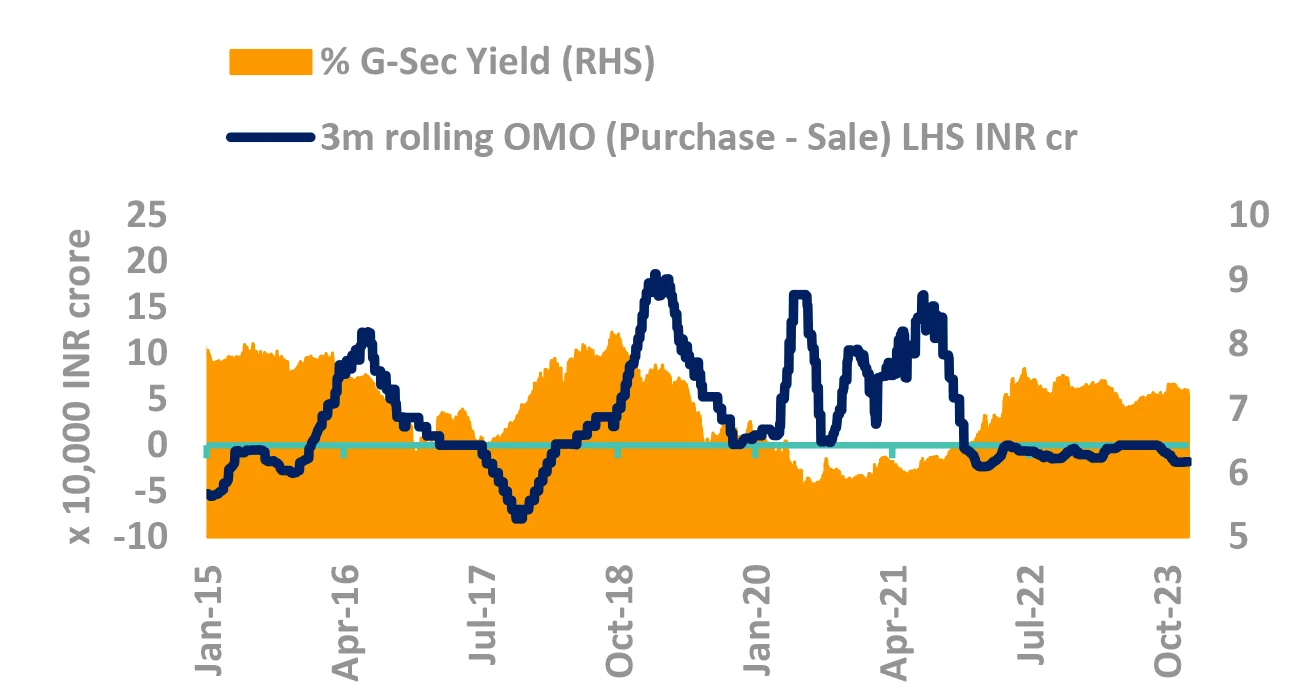
Yields usually track RBI OMO purchases
- Yields have strong correlation with RBI OMO
- Demand/Supply mismatch is filled in by RBI
-
RBI softened its liquidity management stance. However,
- Liquidity will remain tight till Dec mid
- Yet, by Jan, liquidity will be in surplus as Govt will have less need to keep cash post maturities
Takeaway:
Banks’ demand for SLR investments to continue
Source – Bloomberg, DBIE, Internal OMO – Open Market Operations, SLR – Statutory Liquidity Ratio; G-Sec – Government Securities; RBI: Reserve Bank of India; SCB: Scheduled Commercial Bank; CIC: Currency in Circulation
How much is the excess supply
-
Excess supply can be matched
- ✓ G-sec supply is higher only by 7% over FY23, however demand is expected to rise much more
- ✓ Continuing strong demand from long end investors like EPFO, Insurance and PFs
- ✓ Healthy NSSF deposit accretion

Takeaway:
Estimated excess supply of ₹ 0.68 tn is not very significant. Banks may sustain a higher SLR ratio (we have taken 29.5%)
Source – Internal, CGA G-Sec: Government Securities; OMO: Open Market Operation; RBI: Reserve Bank of India; FPI: Foreign Portfolio Investment; NPS: National Pension System; MF: Mutual Fund; SDL: State Development Loans; SLR: Statutory Liquidity Ratio; PF: Provident Fund; EPFO: Employees’ Provident Fund Organisation; NSSF: National Small Savings Fund
Indian yields tracking Global yields
Except for two instances
RBI’s stance on liquidity change led to correlation again
Indian yields – Dancing to the tune of US Yields
-
FOMC rate at 5.50% - more hikes unlikely
- Fed Fund projected rates indicate sooner rate cuts
- Data has continued to soften
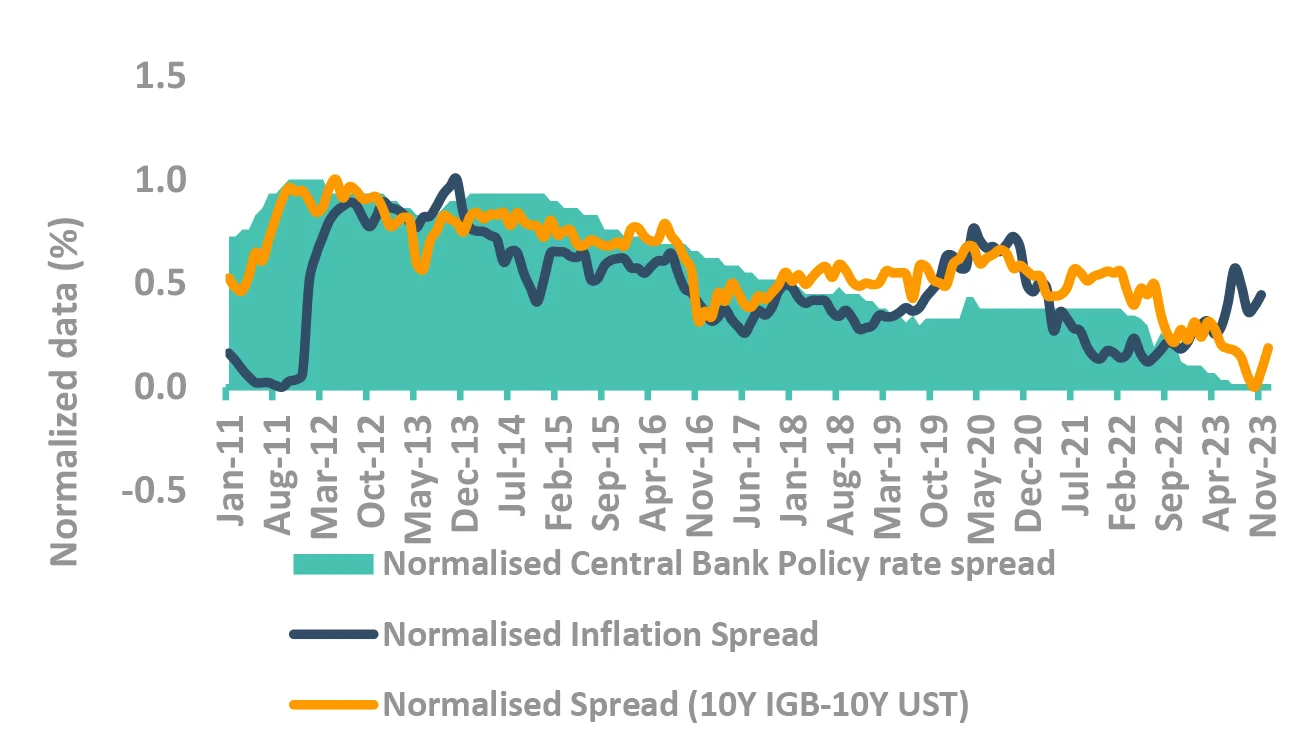
Are spreads of US Treasury and Indian Govt. Bonds low?
- Yields spread mimics inflation and policy rate spread.
- ✓ Currently divergence with inflation spread.
- ✓ US CPI is falling so correction may come from fall in US yields rather than rise in India yields.
- Yields spread mimics inflation and policy rate spread.
-
Are Indian yields tracking US Rates? Yes
- Except for two instances (dotted lines)
-
What led to correlation again?
- RBI OMO announcement (Oct’23)
- RBI’s nimble liquidity stance (Dec’23)

Takeaway:
With domestic data being stable, India yields incrementally tracking US yields
Source – Bloomberg, Internal Fed: Federal Reserve; CPI: Consumer Price Inflation; RBI: Reserve Bank of India; IGB: India Government Bond; FOMC: Federal Open Market Committee; UST: US Treasury
Money Market Assessment Framework
Takeaway:
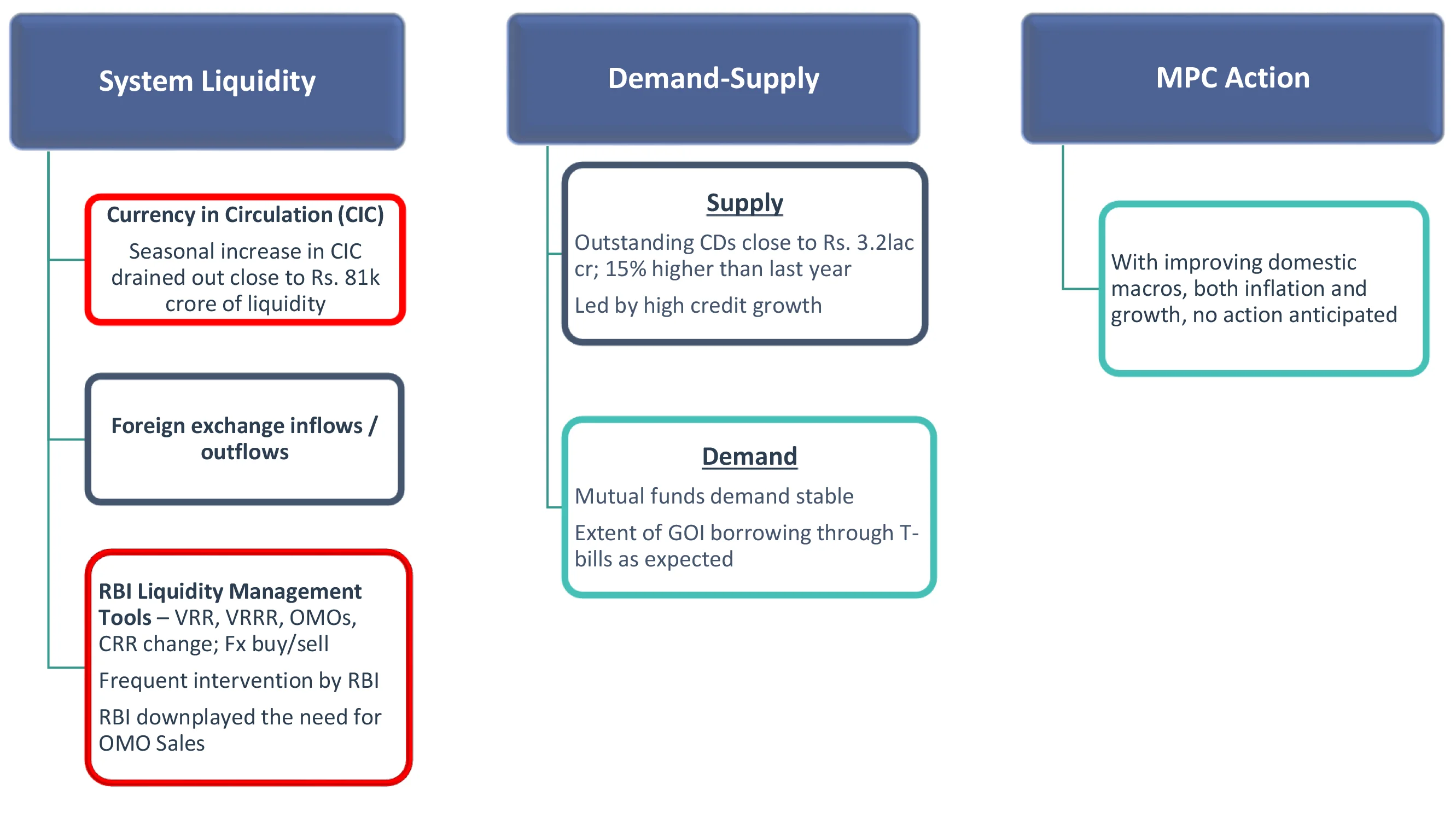
With surplus durable liquidity, stable domestic macros and well-matched demand-supply dynamics expect money market rates to remain range bound. We will remain long in our funds to gain accrual at existing spreads.
CIC: Currency in Circulation; CD: Certificate of Deposits; OMO: Open Market Operations; VRR: Variable Rate Repo; VRRR: Variable Rate Reverse Repo; RBI: Reserve Bank of India: GOI: Govt of India
Liquidity to have opposite drivers: Festive season and G-sec redemption
-
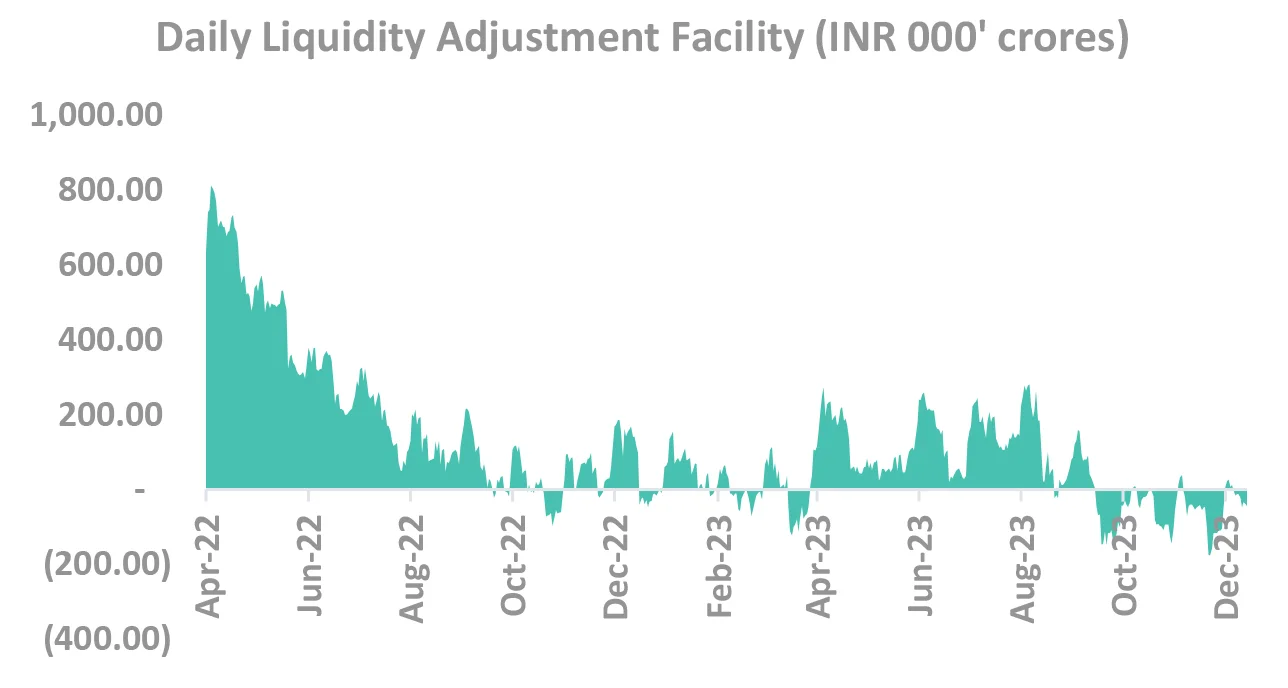
Durable liquidity is sufficient at ~₹ 2.4* tn
- However, banking system liquidity remains in deficit
- ✓ Advance tax and GST outflows will offset large Gsec maturity in December
- ✓ RBI’s VRR operation likely to ease some pressure
- Month-end spending will provide respite
- However, banking system liquidity remains in deficit
-
CIC is typically higher in October and November due to festive demand
-
We saw a CIC drag of ₹ 81k crore from October onwards
- Pattern is in line with historical trends

Takeaway:
Banking liquidity expected to remain tight fuelled despite G-sec redemption
Source – Bloomberg, RBI, *Internal Estimates G-Sec – Government Securities; CIC: Currency in Circulation
Well matched demand supply has money market rates range bound so far
-
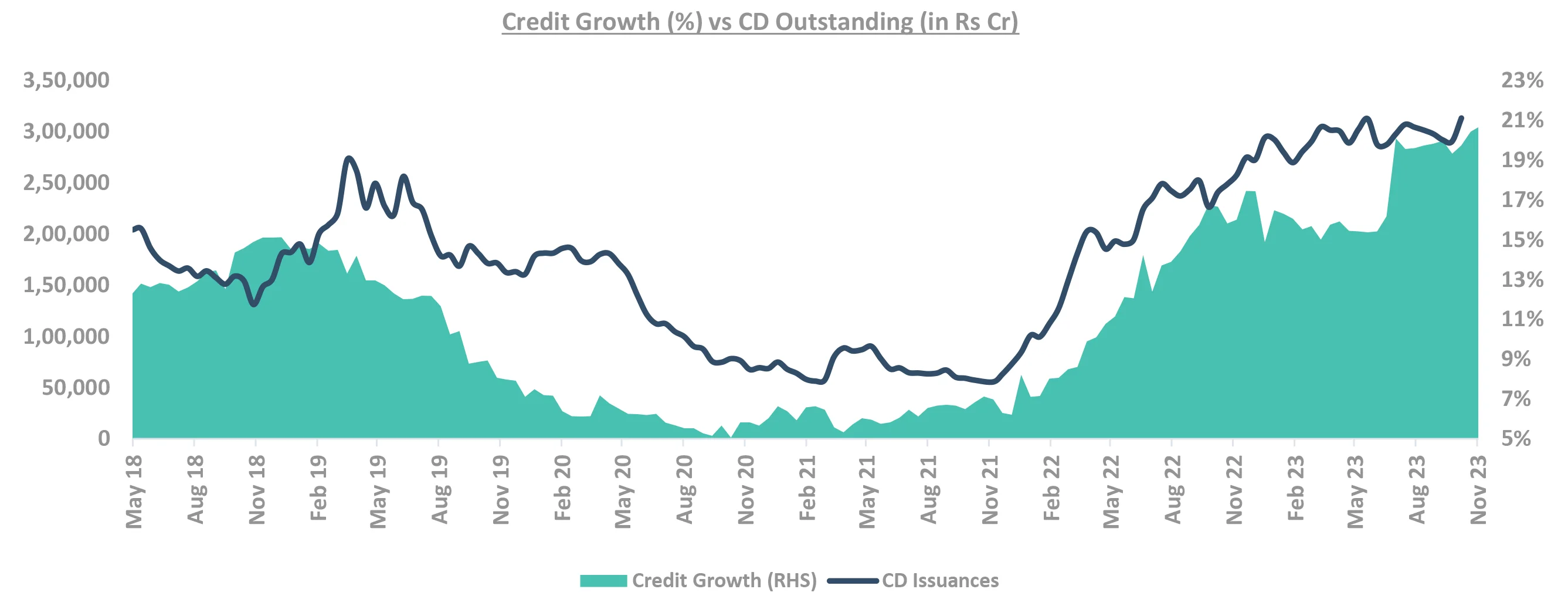
High credit growth has contributed to increase in Certificate of Deposits issuances over the last year
-
Nearly ₹ 3.2tn CDs are outstanding; up 15% YoY. 1-year CD rates have moved up to ~7.85% – 7.90%
Quarter-end redemptions will likely put pressure on money market rate, though RBI’s VRR auction will provide some respite
Takeaway:
With supply expected to be at current levels, demand from mutual fund participants to be the key determinant of money market yields
CD: Certificate of Deposits
With money market rates anchored, play for accrual
-
Durable liquidity comfortable at ~₹ 2.4* tn, nonetheless banking system liquidity remains in deficit
-
Money market rates are closely linked to banking system liquidity
We expect RBI to be ‘nimble’ in managing liquidity conditions, keeping money market rates anchored

Takeaway:
Our current strategy is to gain accrual at elevated levels as we expect money market rates to remain range bound
*Internal Estimates CD: Certificate of Deposits
DSP FI Framework checklist
DSP Duration decision:

The chart shows how much expected yield fall/rise is already
priced in the current curve.
Large gap between the current yield and forward yield shows
that yield change is priced in – and thus yield change will not
give capital gain/loss.
Similarly small gap means that the market is not pricing change
in yields.
Segments that has value
- Upto 1 Yr: Tight Liquidity
- 30 Yr: High accrual. Demand from long term investors to cap any uptick in yields

Source – Bloomberg; as on 15/Dec/23
We have discussed duration and yield movement.
How do we choose corporates and credit?
DSP Asset Allocation: Corporate bonds spreads wide
-
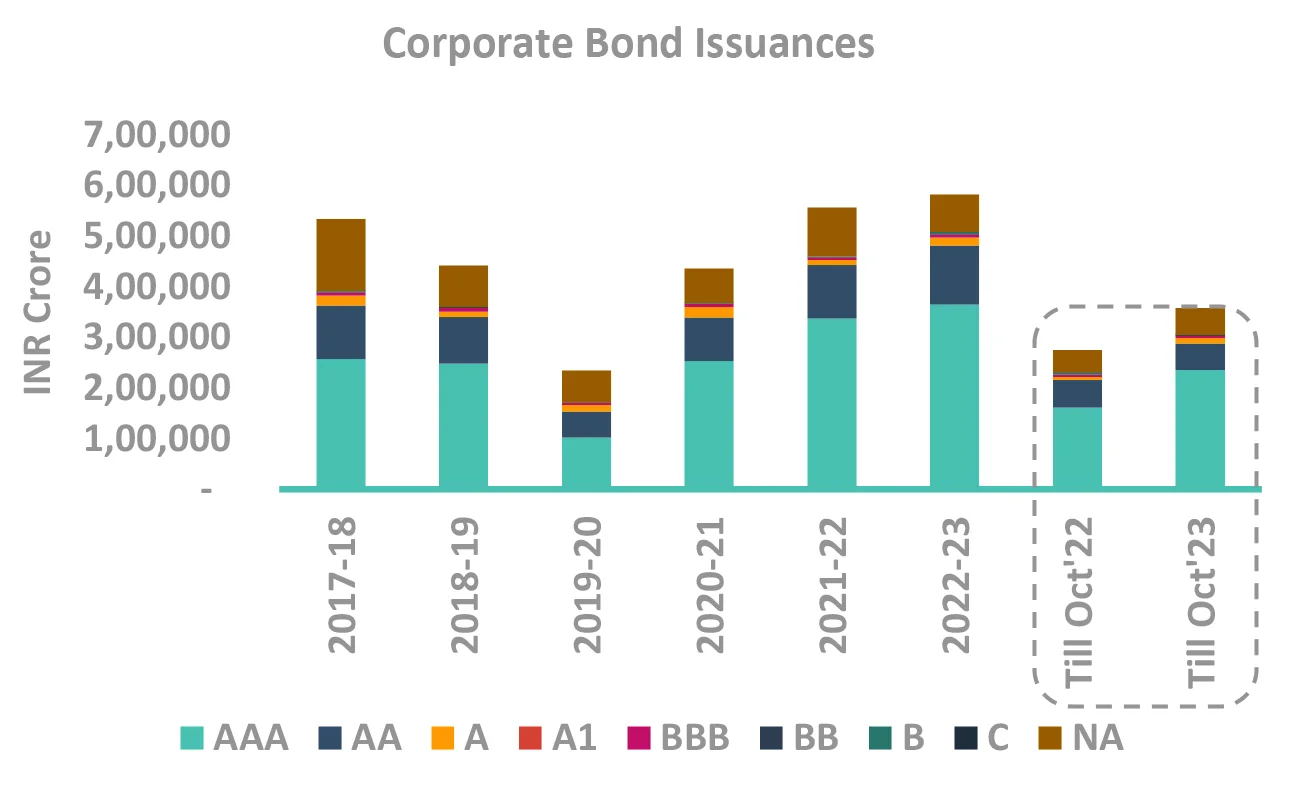
Supply has remained manageable so far
- 7mFY24 issuance at ~1.3x of 7mFY23 led by AAA segment
- Supply in Nov at ~88k crores
- ✓ Led by banks (expected to continue in Dec as well)
- ✓ 20k crores issuance by a large pvt. sector corporate
-
New NBFC regulations to lead to more issuances
- NBFC to shift part borrowing to bonds form bank loans
- To result in further rise in NBFC spreads
- ✓ Depending upon liquidity and supply
-
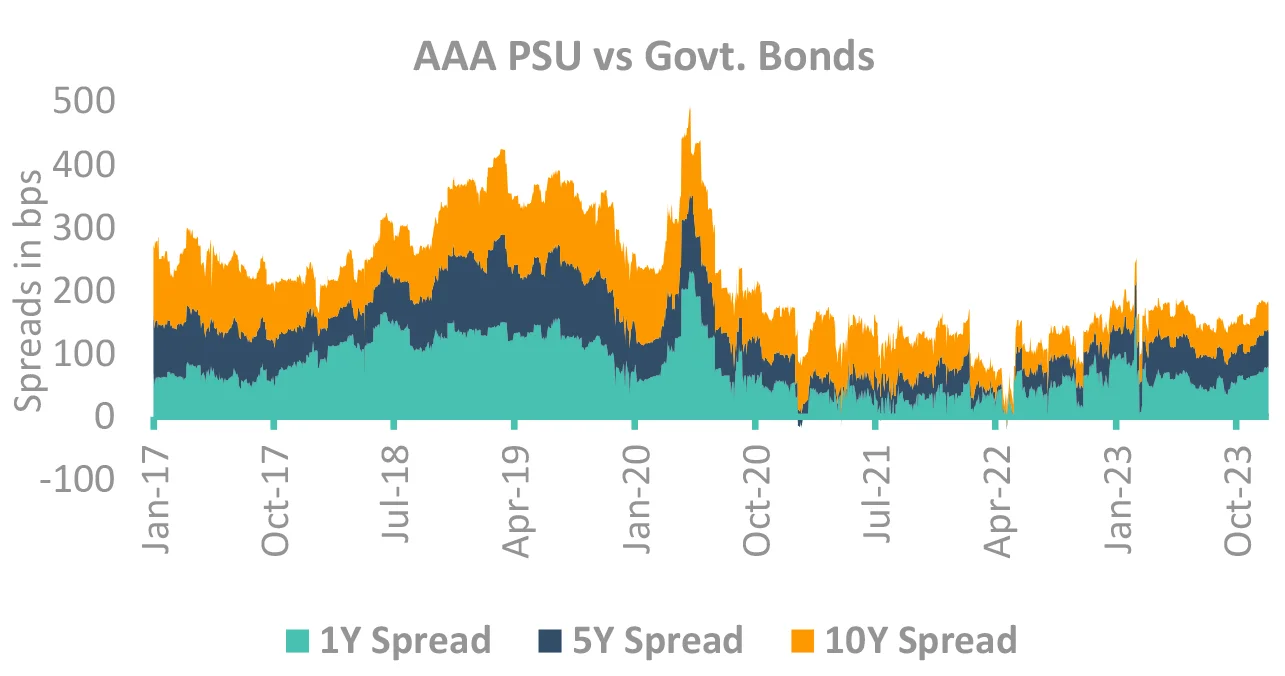
The corporate bond spreads are reasonable
- 2-5Y NBFCs providing steady accrual
- ✓ But tight liquidity pressures remain
- AAA PSU Spreads remain to be in the narrow band of 60-65bps
- Spreads in short papers may remain elevated,
- ✓ We still like long bonds: demand from insurance, PF
- 2-5Y NBFCs providing steady accrual
Takeaway:
Corporate bond spreads near their long term average, spread curve flat.
Source – Bloomberg, CCIL, Internal PSU: Public Sector Undertaking, NBFC: Non-Bank Financial Companies
DSP Credit Investment Process – Focus on Governance
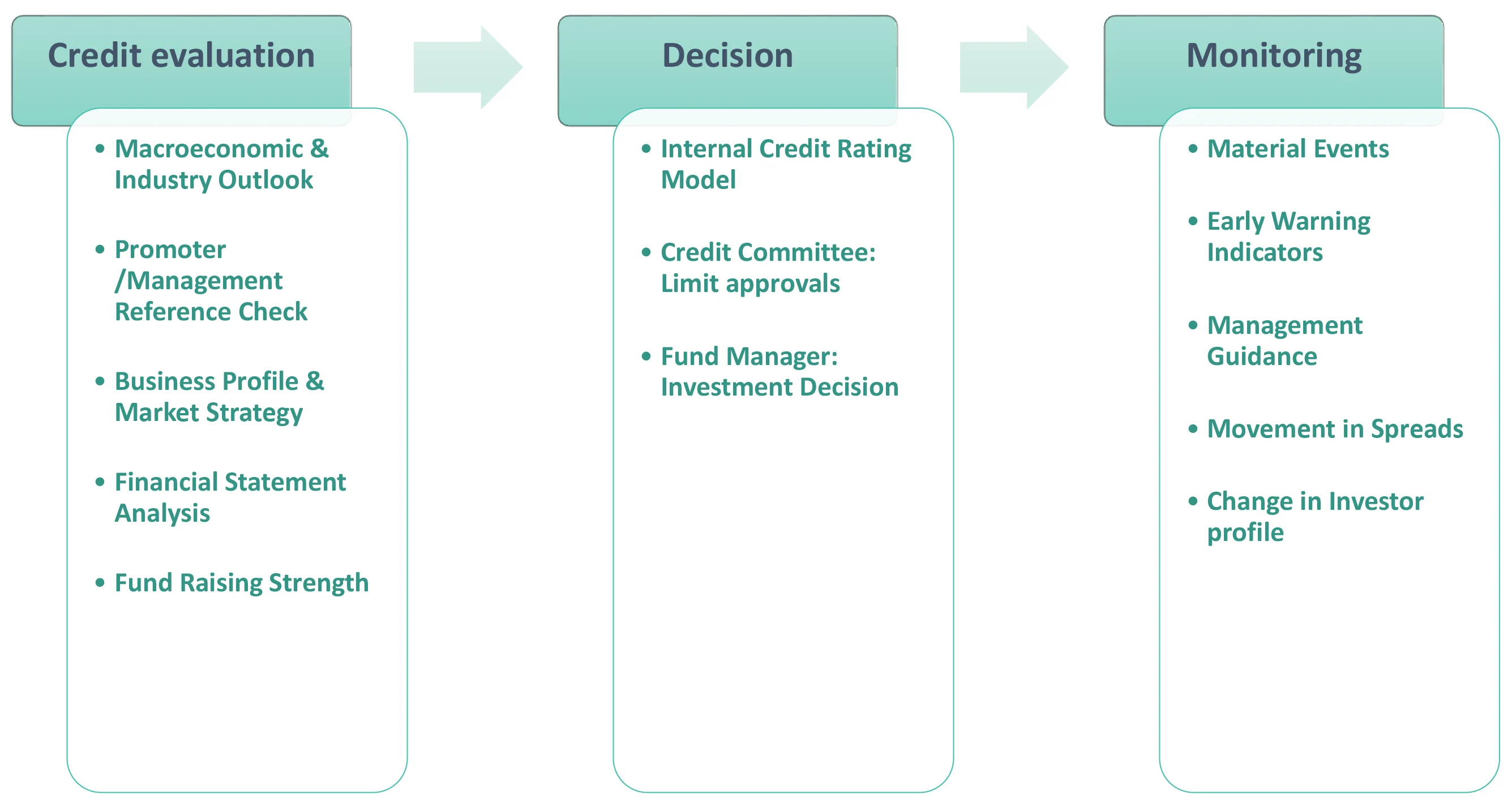
Information sources: Financial results, Management Discussion, Rating Agency Feedback, Sell Side Research, Equity analyst feedback, Lender’s feedback, etc.
DSP Credit view on sectors

Done with our market view framework?
Now
Our Portfolio creation framework
DSP Portfolio Creation: Multi-step process
DSP Fixed Income Funds follow a defined methodology for fund portfolio construction
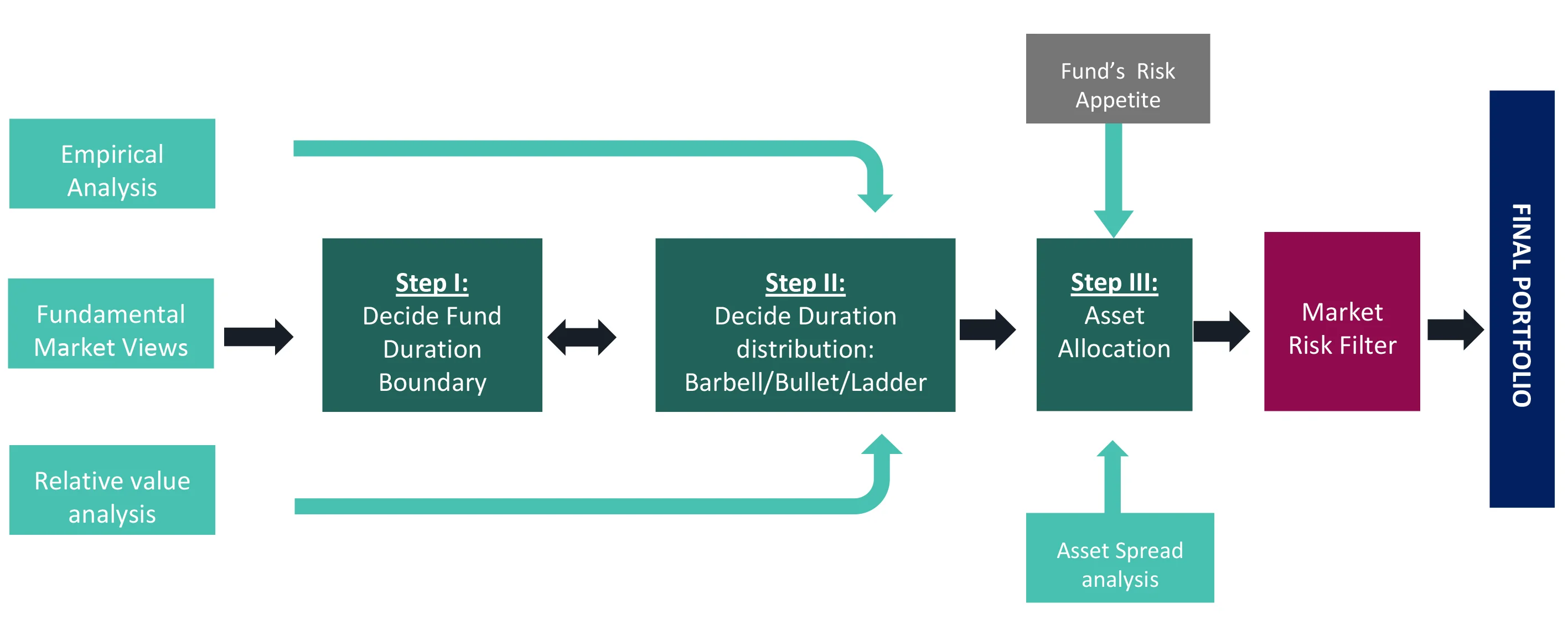
- We apply market risk filter which can help the Fund Managers not to take extreme risks. Thus, Value at Risk is limited by ensuring the positions are balanced.
Investment approach / framework/ strategy mentioned herein is currently followed & same may change in future depending on market conditions & other factors.
Key Risks associated with investing in Fixed Income Schemes
Interest Rate Risk - When interest rates rise, bond prices fall, meaning the bonds you hold lose value. Interest rate movements are the major cause of price volatility in bond markets.
Credit risk - If you invest in corporate bonds, you take on credit risk in addition to interest rate risk. Credit risk is the possibility that an issuer could default on its debt obligation. If this happens, the investor may not receive the full value of their principal investment.
Market Liquidity risk - - Liquidity risk is the chance that an investor might want to sell a fixed income asset, but they’re unable to find a buyer.
Re-investment Risk - If the bonds are callable, the bond issuer reserves the right to “call” the bond before maturity and pay off the debt. That can lead to reinvestment risk especially in a falling interest rate scenario.
Rating Migration Risk - - If the credit rating agencies lower their ratings on a bond, the price of those bonds will fall.
Other Risks
Risk associated with
- floating rate securities
- derivatives
- transaction in units through stock exchange Mechanism
- investments in Securitized Assets
- Overseas Investments
- Real Estate Investment Trust (REIT) and Infrastructure Investment Trust (InvIT)
- investments in repo of corporate debt securities
- Imperfect Hedging using Interest Rate Futures
- investments in Perpetual Debt Instrument (PDI)








 .
.