Account Statement
  Capital Gain Statement
  Key Information Memorandum
  PAN Updation
  Register / Modify KYC Online
  Nominee Registration
  Email / Phone Updation
  OTM / eNACH Registration
  Voluntary Lock-in for Mutual Fund Folios
  FAQs
FAQs Reach us


DSP Converse - August 2023
Our Framework
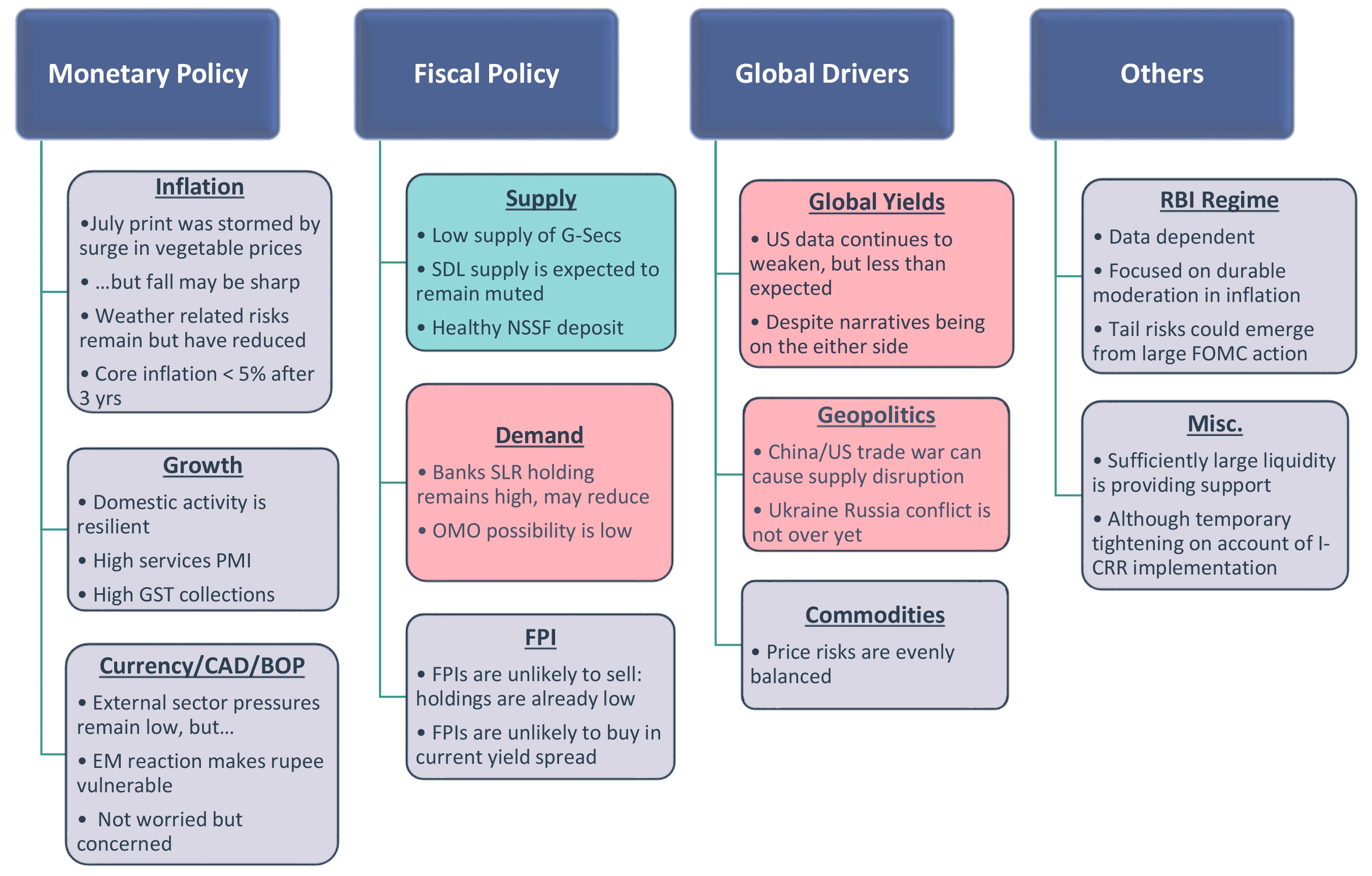
Takeaway:
No major driver for yields. We are bullish on account of attractive valuations.
CAD – Current Account Deficit; BoP – Balance of Payment; SLR – Statutory Liquidity Ratio; SDL – State Development Loans; RBI: Reserve Bank of India; G-Sec: Government Securities; OMO: Open Market Operation; FPI: Foreign Portfolio Investment; FOMC: Federal Open Market Committee; I-CRR: Incremental Cash Reserve Ratio; PMI: Purchasing Managers’ Index; GST: Goods and Services Tax; NSSF: National Small Savings Fund
We are bullish
Why? Because of Valuations!
Markets are pricing in a lot of negativity
Yet, inconclusive evidence to justify fall in yields. Or rise in yields.
Any positive news may cause a sharper rally, than a sell-off due to negative news
View Summary: Bullish
Our Strategy: We turn long in our active funds
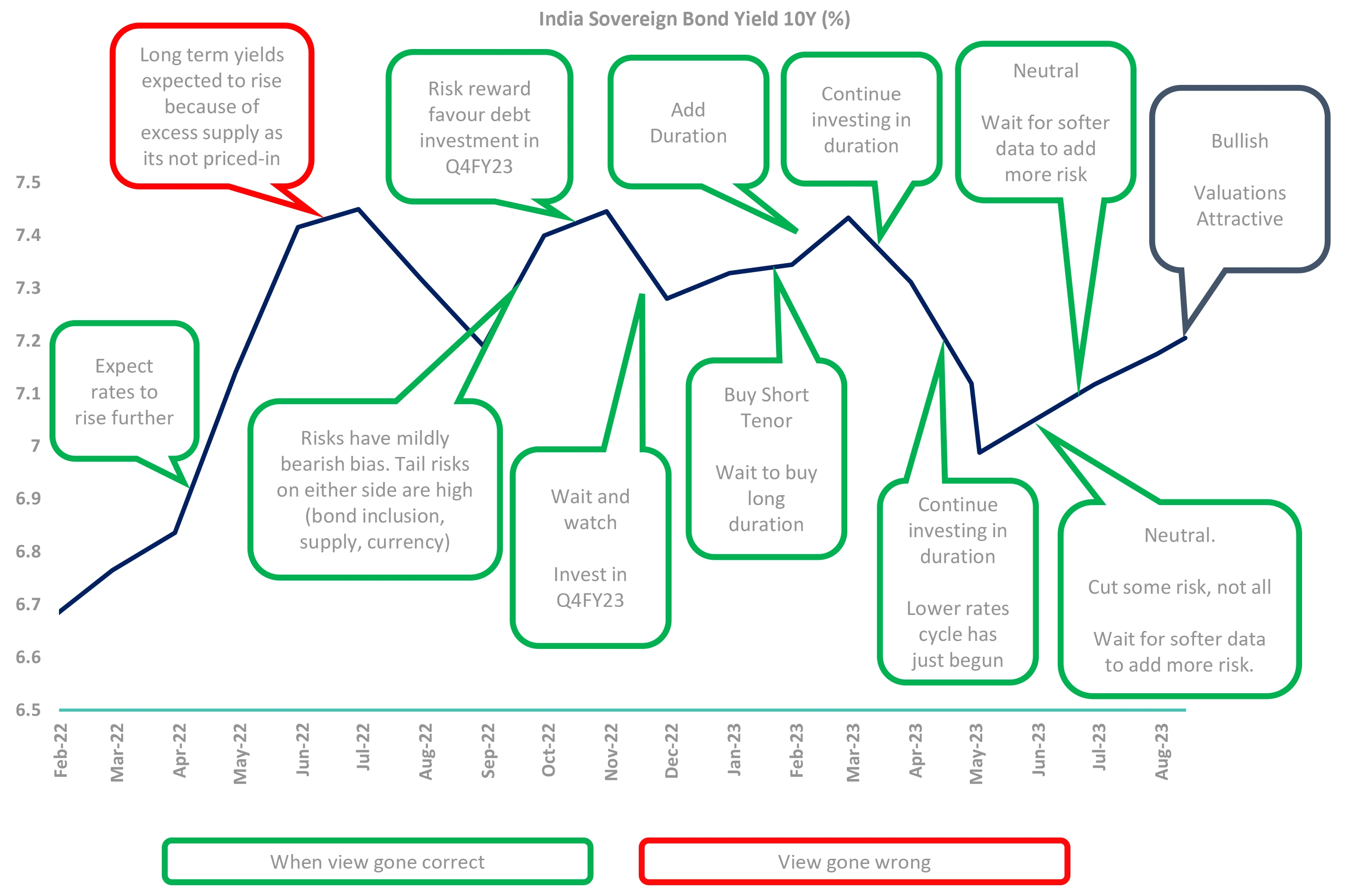
10Y Indian G-sec yields have risen to ~7.20: upper end of our expected range, tracking US yields (and may continue in future).
Even though the US labor, CPI and services data have weakened, its lower than the expectations. Unless US economic data softens significantly, rate cuts won’t be expected. Until then yields won’t fall.
On the other hand, risks of FED being hawkish are real – yet tail risks. Data is softening, previous rate hikes are still percolating in the economy – and higher rates for longer can lead to black swan events – which no one can predict.
While Indian CPI has come at ~7.4%, it will not lead to a trend. As we always mention, in India the volatility of supply driven CPI can only create noise – not trend. In few months as tomatoes and vegetable prices fall naturally – so will CPI. Markets (and RBI) should look right through it – though there will be noise.
For money markets investment: We will keep adding duration as and when the spreads look attractive. The surplus liquidity and matched demand-supply will keep a cap on rates, despite CRR hike.
-
Reasons for our view
- Data isn’t a one-way street – so why are markets?: US data is softening, but not fast enough. Indian CPI has risen but its transient. Why should central banks take strong rate actions? In such times, recent yield spike makes valuations attractive.
- India term premium is still high, especially considering the fiscal strength. With benign rate outlook, current yields are attractive.
-
Risks to our view
- Are we running a hope trade and biases? Are we “hoping” for data to weaken – when we ourselves mention that data is not looking weak. We have ensured that we are not having a confirmation bias – we look at data from both sides of the spectrum.
- Tight stop loss: We are aware that we are digressing from our framework. Frameworks are to be followed– but digression is needed at times. Digression means more responsibility: (i) one needs to be aware of why and when we digress, and (ii) one needs to be disciplined to exit such trades if they do not work - not wait it out. We have followed first part – and wont hesitate to follow the second part.
G-Sec: Government Securities; CPI: Consumer Price Inflation; FED: Federal Reserve; RBI: Reserve Bank of India; CRR: Cash Reserve Ratio
Let’s revisit our rates call trajectory
Source – Bloomberg
To start with,
Recap of events since last release.
RBI continued with a PAUSE
With caution around inflation
India CPI at 15m high (led by veggies)
FED raised rates by 25bps
US CPI and labor market show signs of cooling off – but not enough
RBI continued with a PAUSE
-
Rate Action
- Unanimously voted to keep key policy rates unchanged at 6.5%
Stance
- 5 of 6 members voted for remaining focused on withdrawal of accommodation
-
Inflation
- Revised higher by 30bps to 5.4% for FY24
- X Revised up sharply for Q2 from 5.2% to 6.2%
- - Spike in vegetable prices to exert sizeable upside pressures on near-term headline inflation trajectory (although likely to correct with fresh market arrivals)
- X Impact of uneven rainfall distribution warrants careful monitoring
- X Crude oil prices have firmed up amidst production cuts
- Revised higher by 30bps to 5.4% for FY24
-
Growth
- GDP forecast retained at 6.5% for FY24
- ✓ Recovery in kharif sowing and rural incomes, buoyancy in services and consumer optimism to support consumption
- X Weak external demand and geo-political tensions remain a concern
- GDP forecast retained at 6.5% for FY24
RBI: Reserve Bank of India; GDP: Gross Domestic Product
US Data continues to soften: but markets want more
-
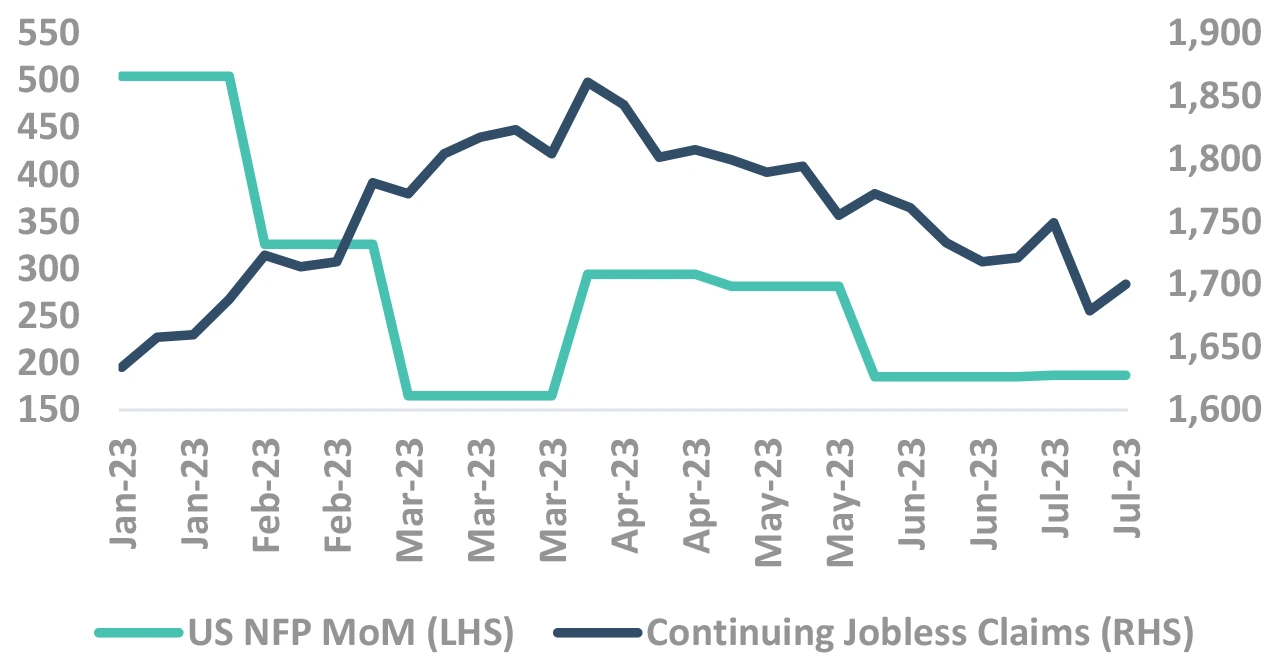
Labor market is showing cooling-off signs
- Continuing jobless claims seem to have bottomed out
- Jul NFP expanded at 187k vs 200k expected
- ✓ May and Jun also revised lower by 25k and 24k
- Average hourly earnings growth is down to 4.4% from an 18m peak of 5.6% (although remains sticky)
-
Services PMI softened for 2nd consecutive month
-
Core CPI (sticky) also showing signs of moderation
- Momentum is softening sequentially as well

Takeaway:
Services sector being the major contributor to employment and inflation, any further softening to provide a tailwind
Source – Bloomberg NFP: Non Farm Payroll, PMI: Purchasing Managers’ Index; CPI: Consumer Price Inflation
Now our framework
And
What we track
Our Framework
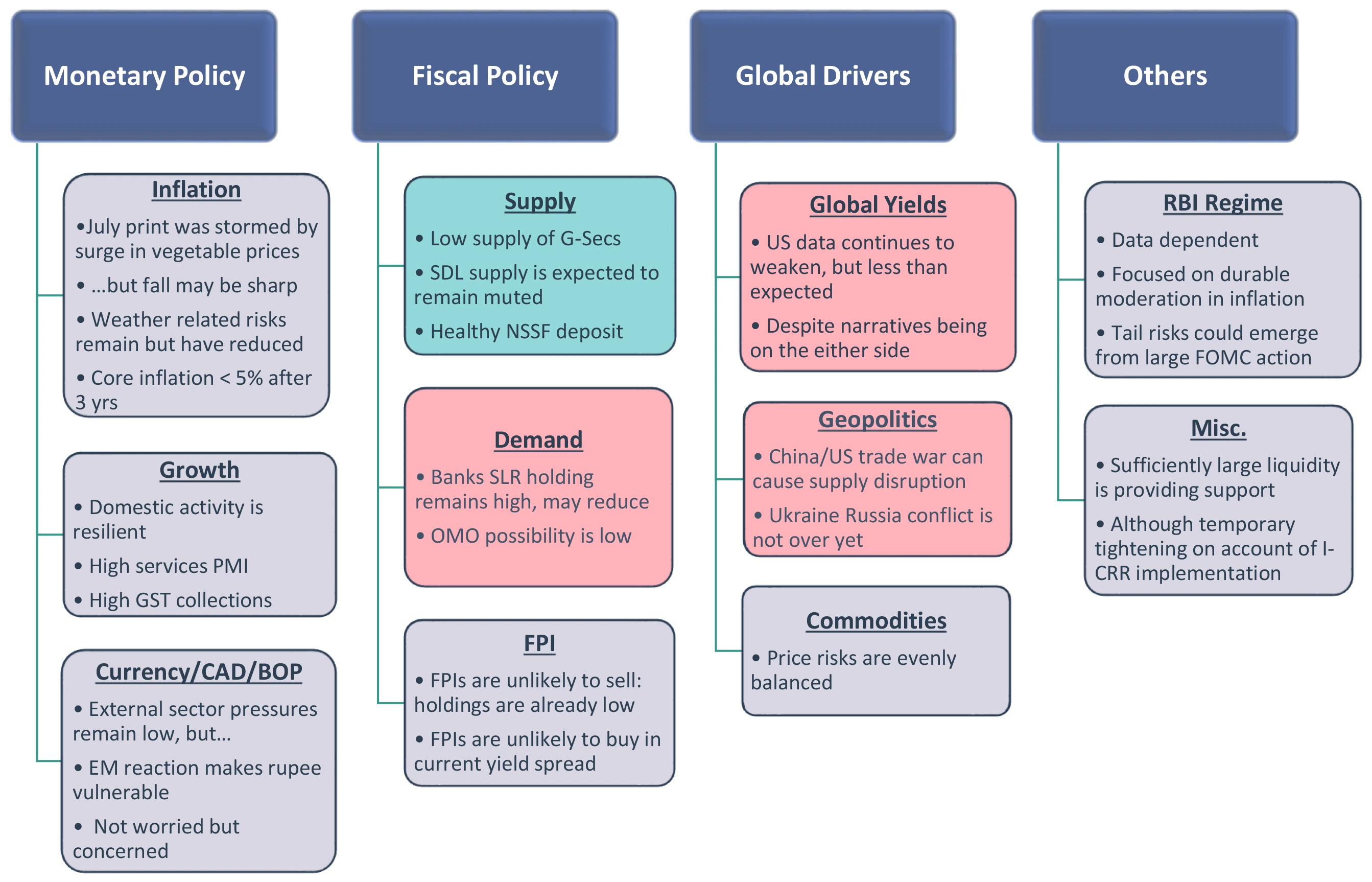
Takeaway:
No major driver for yields. We are bullish on account of attractive valuations.
CAD – Current Account Deficit; BoP – Balance of Payment; SLR – Statutory Liquidity Ratio; SDL – State Development Loans; RBI: Reserve Bank of India; G-Sec: Government Securities; OMO: Open Market Operation; FPI: Foreign Portfolio Investment; FOMC: Federal Open Market Committee; I-CRR: Incremental Cash Reserve Ratio; PMI: Purchasing Managers’ Index; GST: Goods and Services Tax; NSSF: National Small Savings Fund
RBI commentary:
“Stable Domestic Macros”
“Vegetable price led inflation surge”
“Core print of sub 5% provides comfort”
“MPC can look through high inflation print
…caused by such shocks”
Headline inflation at 15m high, Core CPI falls – don’t fret!
-
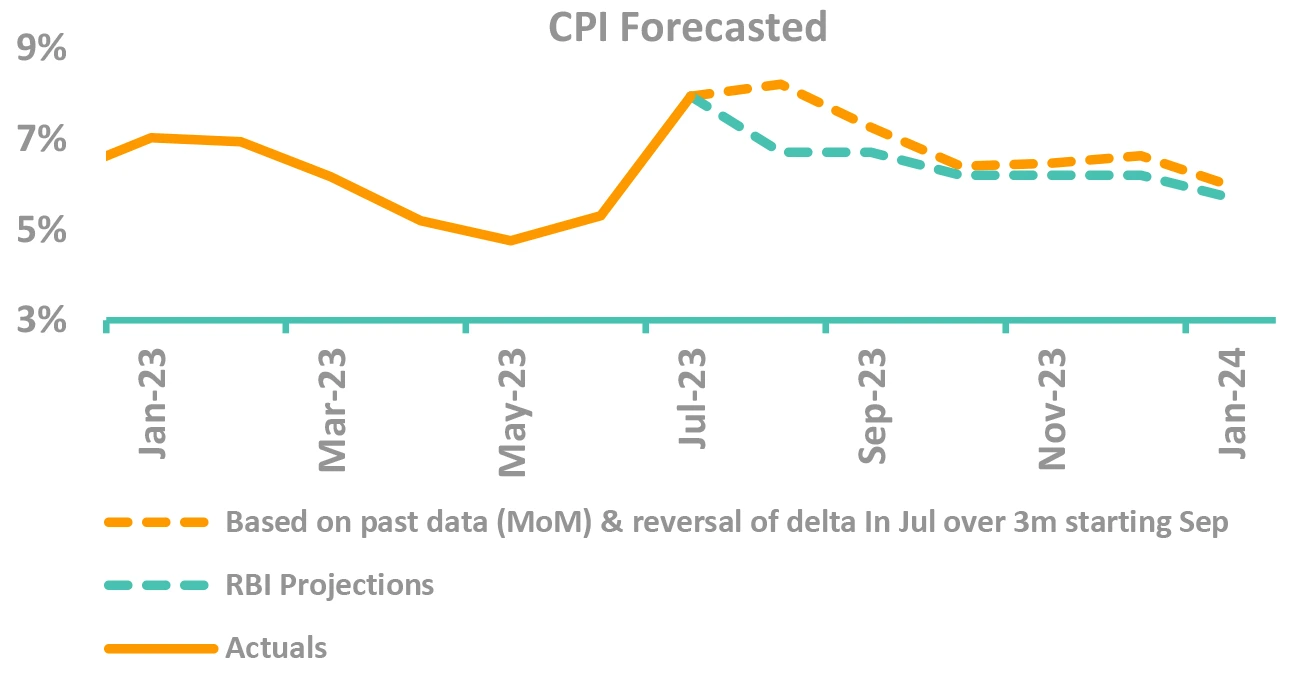
July’23 CPI at 15m high of 7.44% - temporary?
- Vegetable prices contributed to ~32% of the CPI (mainly tomatoes)
- Tomato prices have already eased since then
- Uncertainty remains from adverse weather events, but have reduced significantly
Core CPI below 5% after 3 years (at 4.9%)
We, and probably markets, will look through this CPI spike.
-
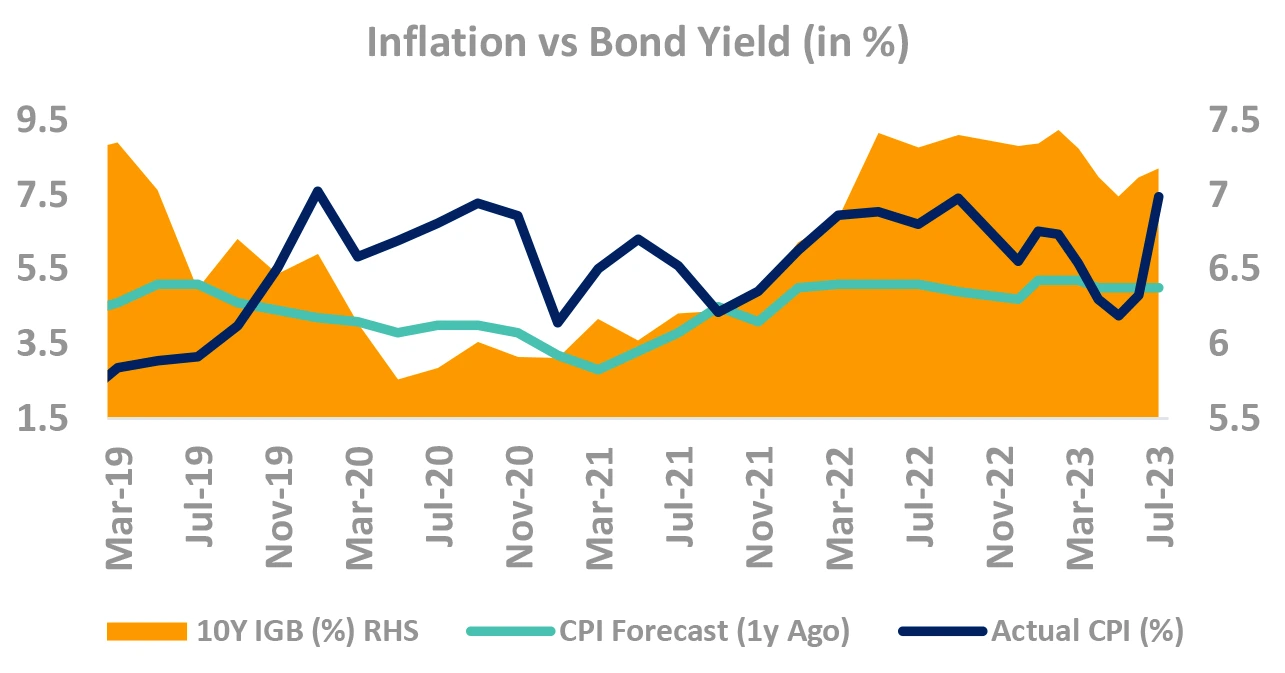
Do yields track inflation projection? No.
- Orange area (chart) is 10Y yields, Blue line is CPI
Can forecasters predict Indian CPI? No.
- Green line is forecasters CPI 1-Yr ahead prediction
- Blue line is where inflation actually came
- Guess the error of margin!
CPI forecast corelated (not causality) to yields
- Low predictive power, high current corelation
Takeaway:
Caution around inflation. Rules out any rate cuts for now.
Source – Bloomberg, RBI, Internal CPI: Consumer Price Inflation; RBI: Reserve Bank of India; IGB: India Government Bond
El Nino a very high possibility albeit may not be a major risk to inflation
-
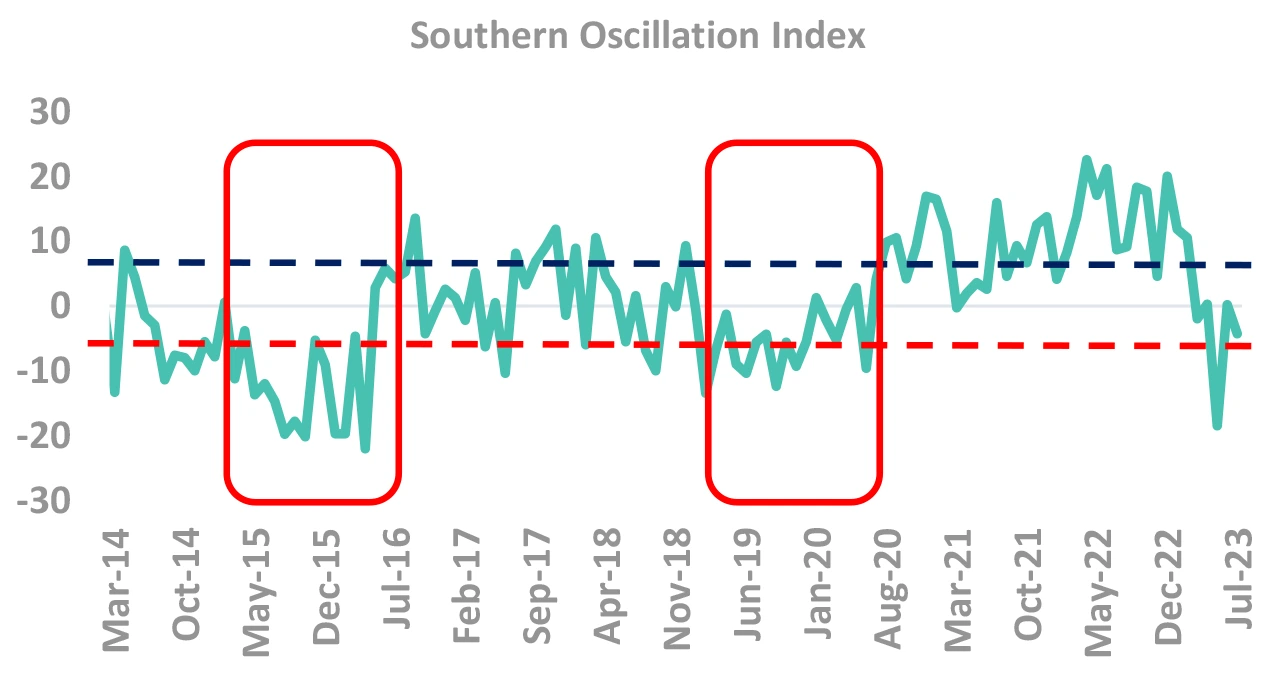
El Nino is a possibility, but impact dubious
- Southern Oscillation Index value lower than −7 often indicate El Nino episodes.
- India monsoon rain now in deficit vs surplus (since last DSP converse)
- ✓ The temporal & spatial distribution of monsoon has been uneven
-
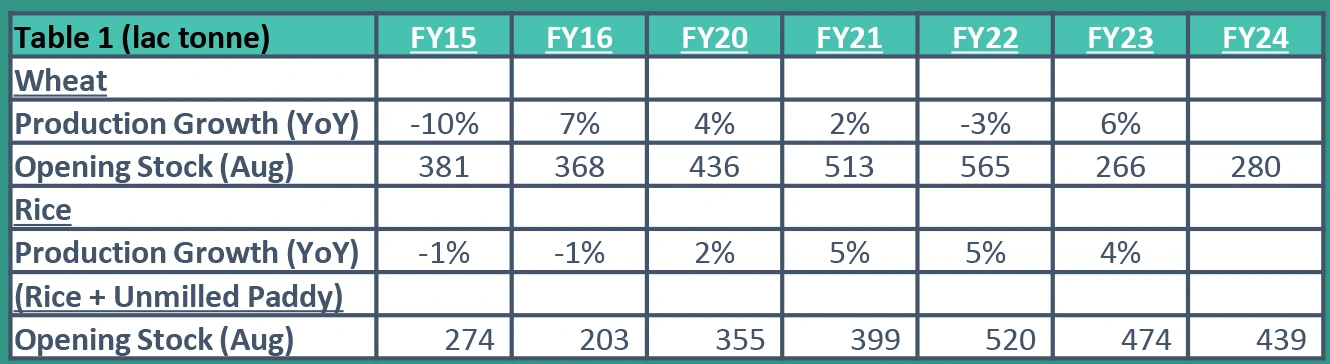
El Nino impact on cereal prices was inconclusive as in past occurrences (refer to table below)
- Rice (including paddy) stock at adequate levels
- Wheat stocks are on the lower side
- Might get exacerbated with Russia/Ukraine embargo
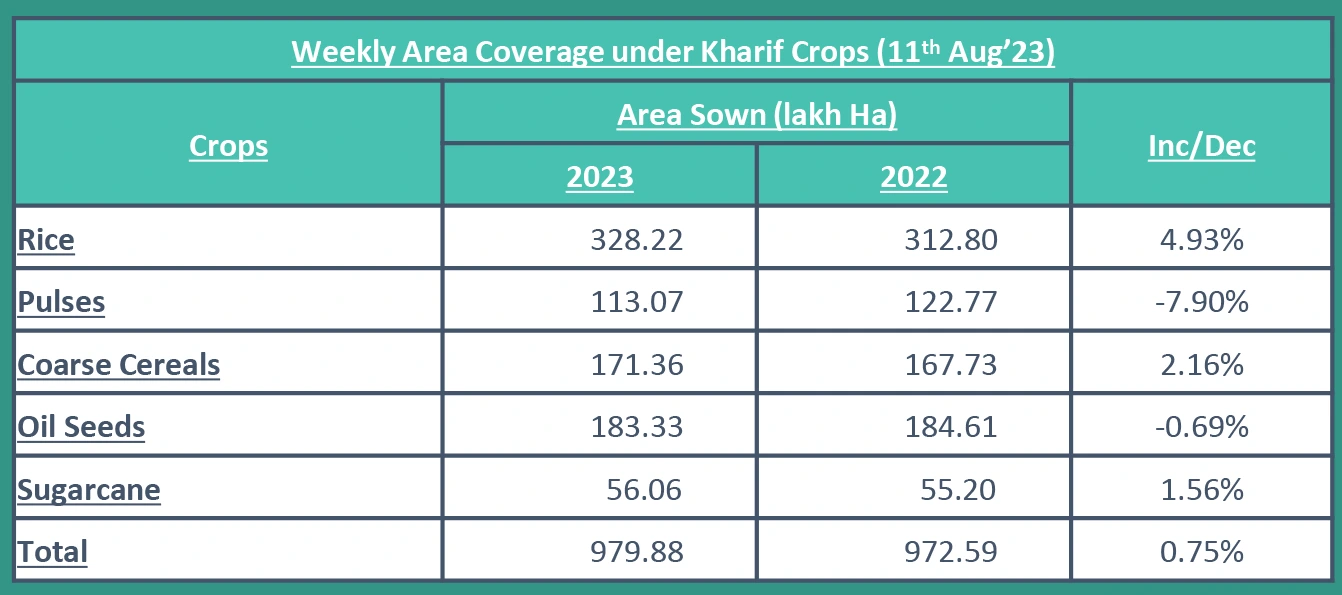
Overall Kharif sowing already higher vs last year
Takeaway:
El Nino risks remain, however, not a major risk to inflation
Source – FCI, Australian Govt BoM, NFSM
India’s
growth remains resilient
across high and low frequency data.
Will global slowdown test domestic growth?
-
Domestic growth data is still robust
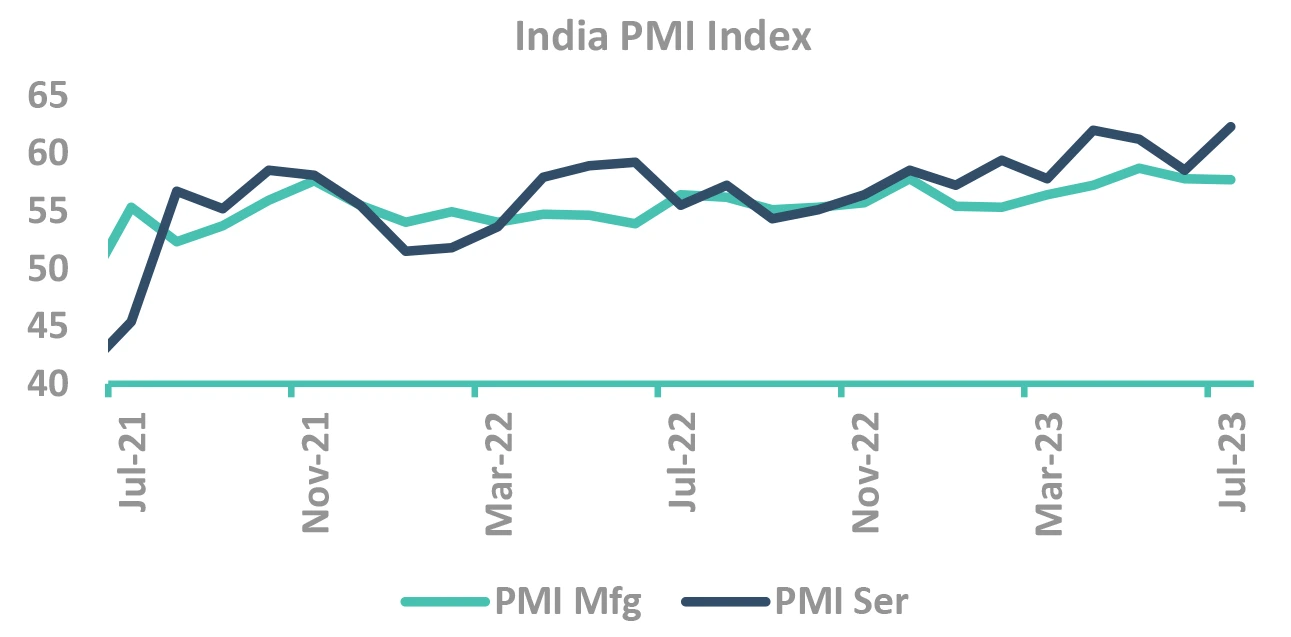
- PMI continues to be in expansionary mode
- July Services PMI at 13y high of 62.3
- GST collections at ₹ 1.65 tn; YoY growth at 11%
Strong credit growth
- Led by retail, MSME and services
- Credit to large industry is also picking up (specially in infra related sectors)
-
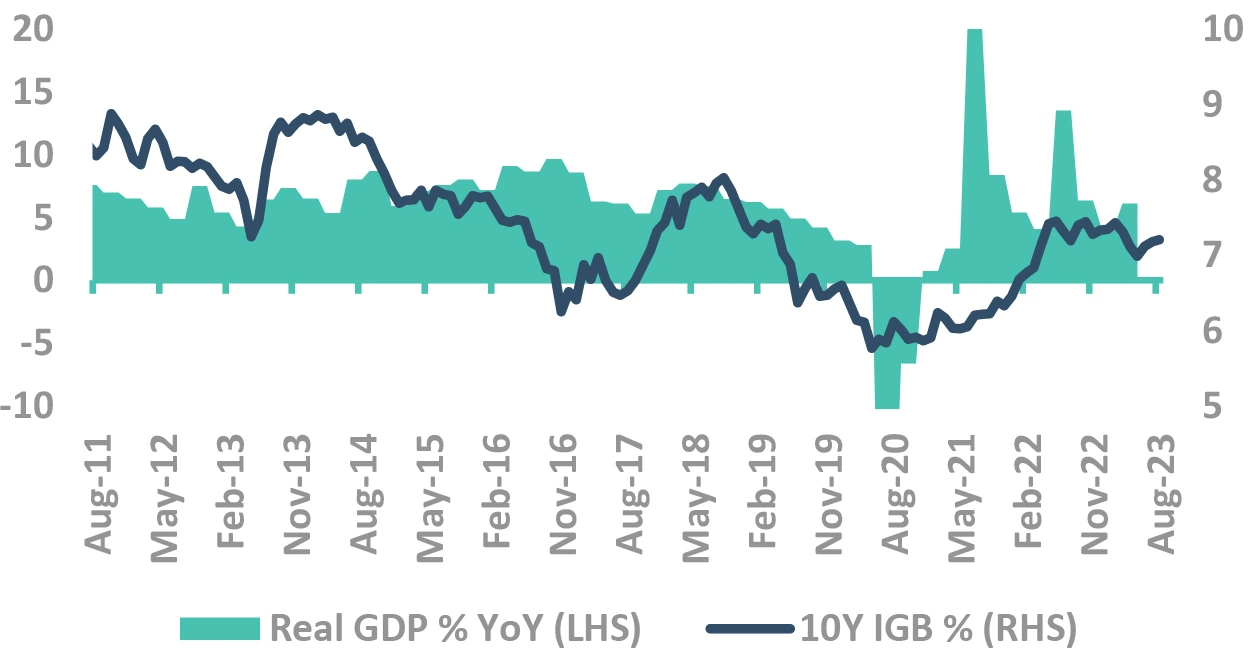
How closely do yields track growth?
- Yields have usually tracked GDP growth, with correlation being stronger when growth slows, barring
- ✓ 2013, rupee depreciation and debt outflows
- ✓ 2017, during demonetization
- Yields have usually tracked GDP growth, with correlation being stronger when growth slows, barring
FY24, growth may not be big driver for yields
- FY23 GDP came in at 16.1%, in line with RBI projections
Takeaway:
Domestic growth seems to be resilient so far despite global slowdown fears
Source – Bloomberg GDP: Gross Domestic Product; PMI: Purchasing Managers’ Index; GST: Goods and Service Tax; IGB: India Government Bond; Mfg: Manufacturing; MSME – Micro, Small & Medium Enterprises; RBI: Reserve Bank of India
What made RBI Pause?
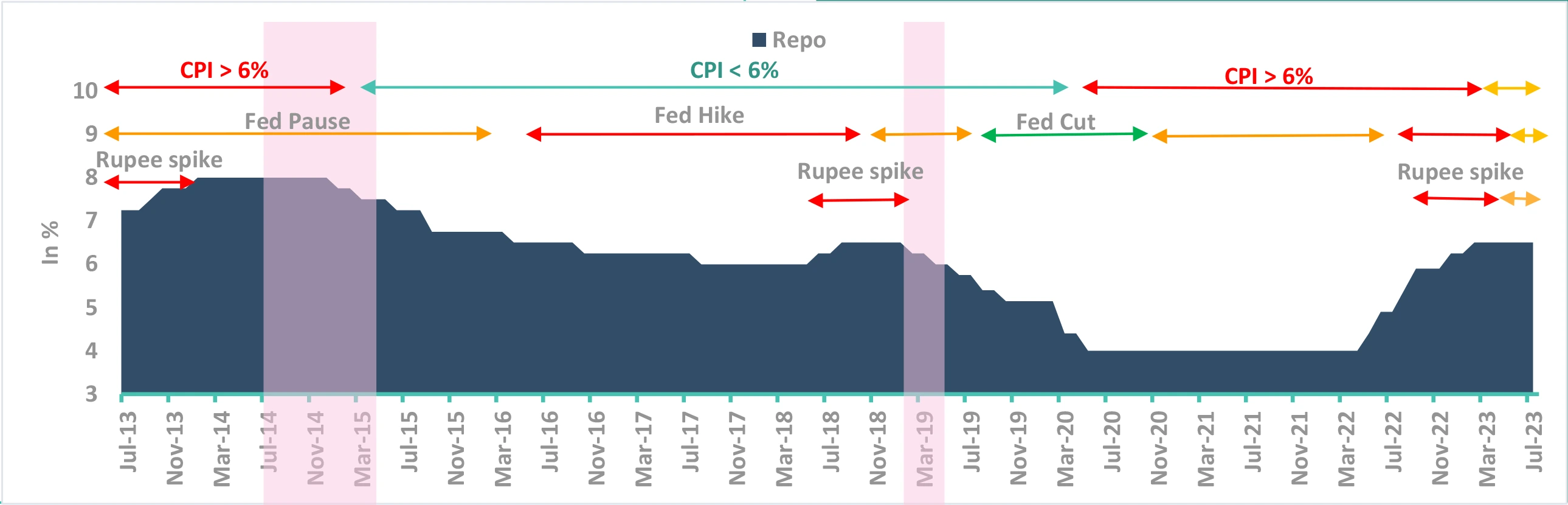
What drives pauses: Series of hygiene factors - Neutral
The checklist for pause:
-
When the US Fed starts pausing
- Reduces risk of capital outflows
-
When inflation is within comfort
- Reduces risk of inflationary policy
- Barring 2014, when RBI did not have 6% CPI target
- ✓ But CPI was falling in 2014
-
When BoP (and currency) is stable
- Reduces inflationary / external risks
How is the checklist now?
-
↔ US markets indicating no more hikes
- Even though FED remains data dependent
- FED itself says we are closer to rate hike cycle
-
✓ Inflation is high, but not a major worry
- Transient high inflation + core CPI is easing
-
BoP is stable, but rupee has fallen
- Bop in surplus in Q4FY23
- But EM currencies are weakening, and so has rupee
Takeaway:
So far, there is no conclusive reasons for any rate action by RBI.
Source – Bloomberg RBI: Reserve Bank of India; US FED: US Federal Reserve; BoP – Balance of Payment; CPI: Consumer Price Inflation; EM: Emerging Markets
What makes RBI Hike?
FX and FED (primarily), and CPI (hardly).
Although hike unlikely, as the FX reserves have increased significantly
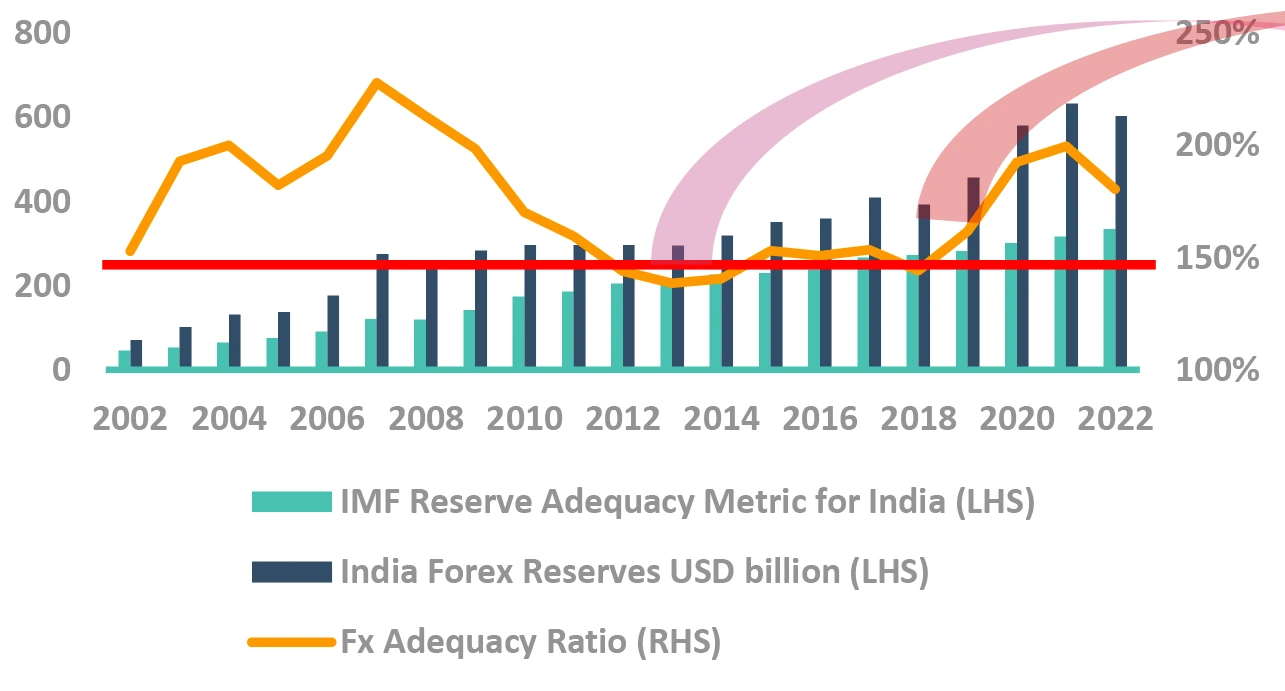
Did you know – when our Fx reserves dip, RBI hikes
-
RBI FX reserves have increased significantly
- Forex reserves increased significantly to ~$601bn
RBI FX Reserve / IMF FX adequacy ratio declined sharply
- Buffer of more than $100 bn to reach 2013 and 2018 levels (~150% ratio)
-
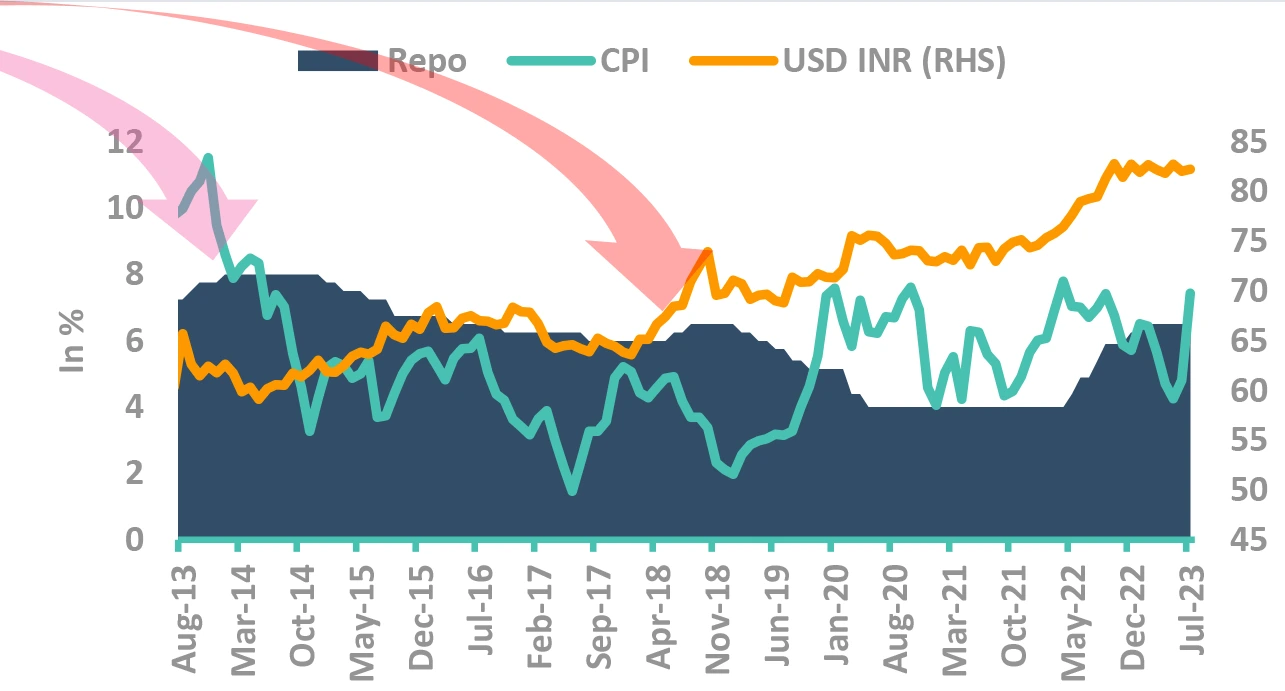
RBI only hiked rates twice in past 10 years, barring now
- Increased rates to control rupee, not inflation
RBI has tolerance for inflation, not rupee fall
- In 2018, inflation was within RBI’s target levels
- In 2013, inflation was high for long yet RBI cut
When RBI FX reserve fall
- RBI avoids using reserves and does rate hikes to control rupee.
Takeaway:
FX Reserves have increased significantly, and there is enough ammunition to protect rupee
Source – Bloomberg RBI: Reserve Bank of India; IMF: International Monetary Fund; US FED: US Federal Reserve; FX: Forex; CPI: Consumer Price Inflation
Data has worsened since last DSP Converse
Rupee is higher, CPI is higher, US data weakened (although less than expected)
We reiterate what we said last time:
“tail risks remain from any large FOMC action”
Let’s turn to Fiscal policy
Generally, it drives the long bond yields
It is reflected in demand/supply mismatch.
Fiscal policy is less of a driver right now – though election risks will precipitate in next few months
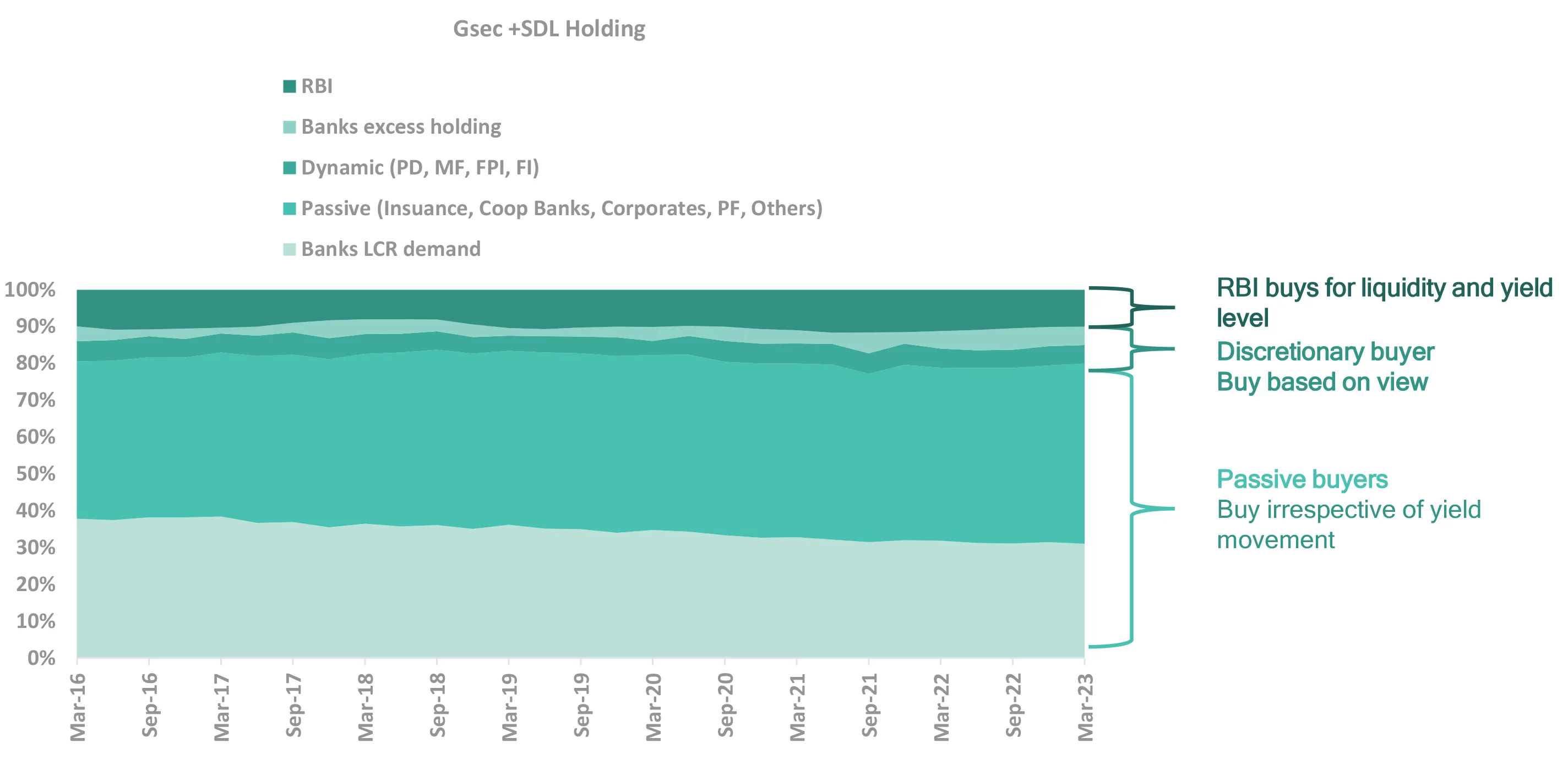
Only a small part of bond buyers are
discretionary buyers
They drive yields
Supply fluctuation is borne by these buyers
Gsec market is still driven by lumpy institutions
Takeaway:
Increase in supply impacts the discretionary buying. Banks excess holding, passive buyers have been absorbing the supply
Source – DBIE LCR – Liquidity Coverage Ratio; SDL – State Development Loans; PF – Provident Funds; PD – Primary Dealerships; MF – Mutual Funds; FPI – Foreign Portfolio Investors; FI – Financial Institutions; RBI: Reserve Bank of India; G-Sec: Government Securities
Comfortable supply/demand dynamics for FY24
But it will be bumpy ride
Last 4 months demand/supply has been rosy
(latent purchases, low SDL issuances)
Comfortable SDL demand-supply metrics
-
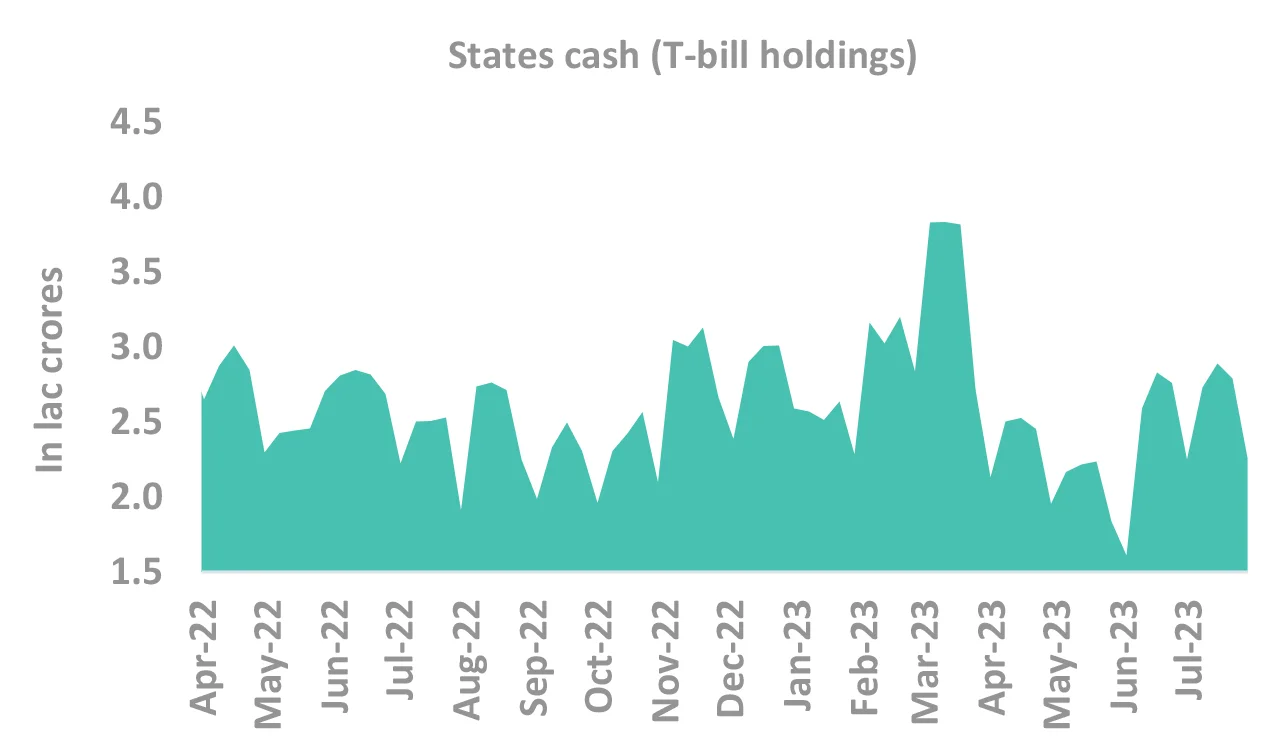
State cash balance is above ₹ 2 trillion
-
Center has front-loaded devolution of tax
Issuance is expected to be in line with the calendar /marginally lower at best
-
SDL borrowing has now normalized
- Apr’23 borrowing 60% lower than calendar
- May’23 higher than calendar (Rs 3k cr)
- June’23 borrowing largely in line with calendar
- Jul’23: 16% lower than calendar
-
SDL issuance impact is expected to be limited
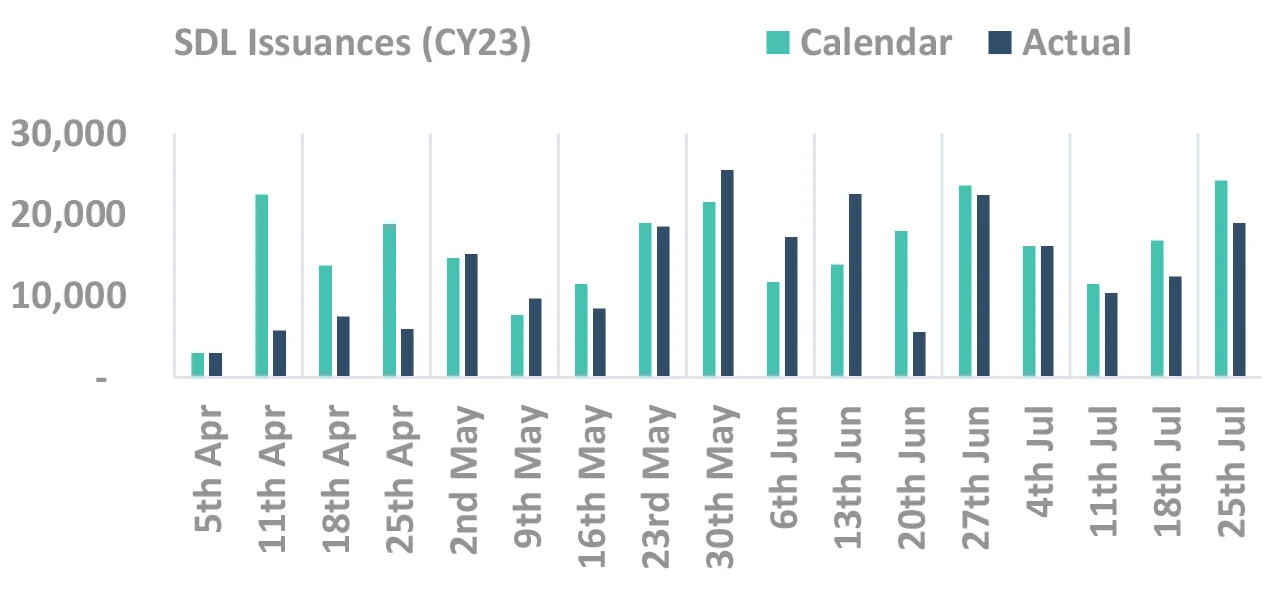
Takeaway:
SDL supply may remain muted in FY24
Source – DBIE, RBI T-bill: Treasury Bill; SDL: State Development Loans
Banks have already bought significantly!
-
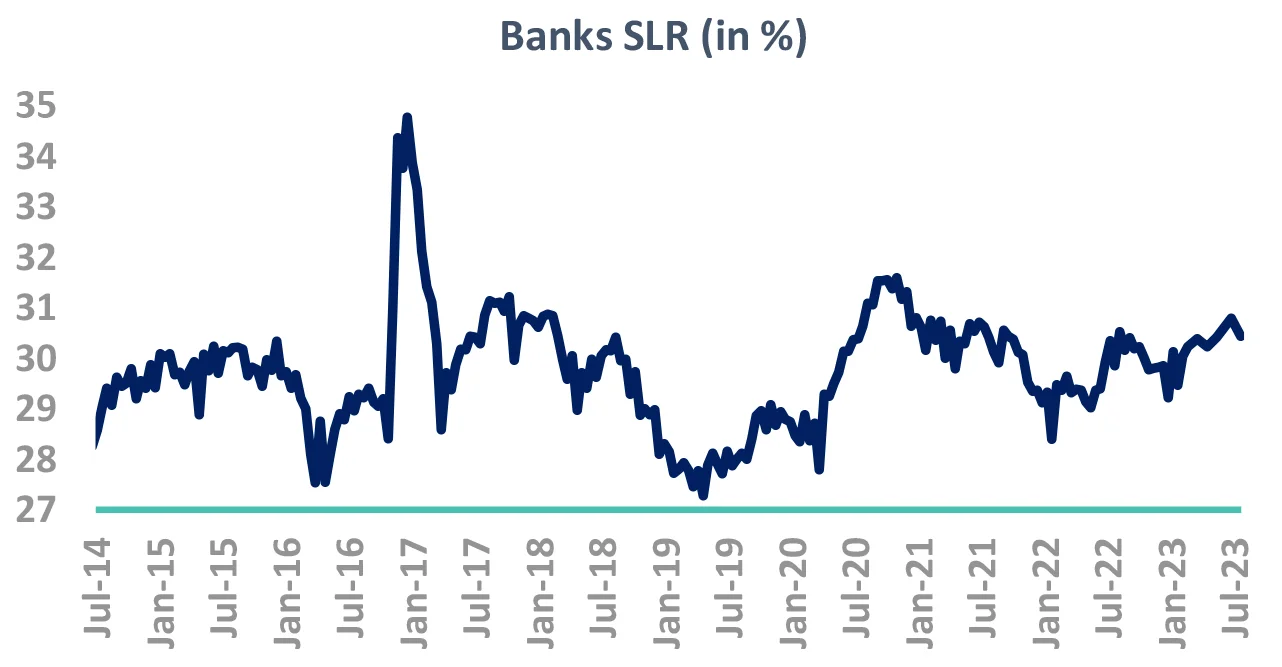
Banks SLR holdings has risen sharply
- Part of SLR holding (~1%) is hedges of FRA & TRS, and not naked holdings
- Yet, SLR holding remains high
-
SLR ratio may reduce, still absolute demand will absorb supply for FY24
- Natural NDTL growth will still lead to demand
But banks have bought nearly ₹ 3.5 tn in 4mFy24
- Rest of the year demand will be muted
-
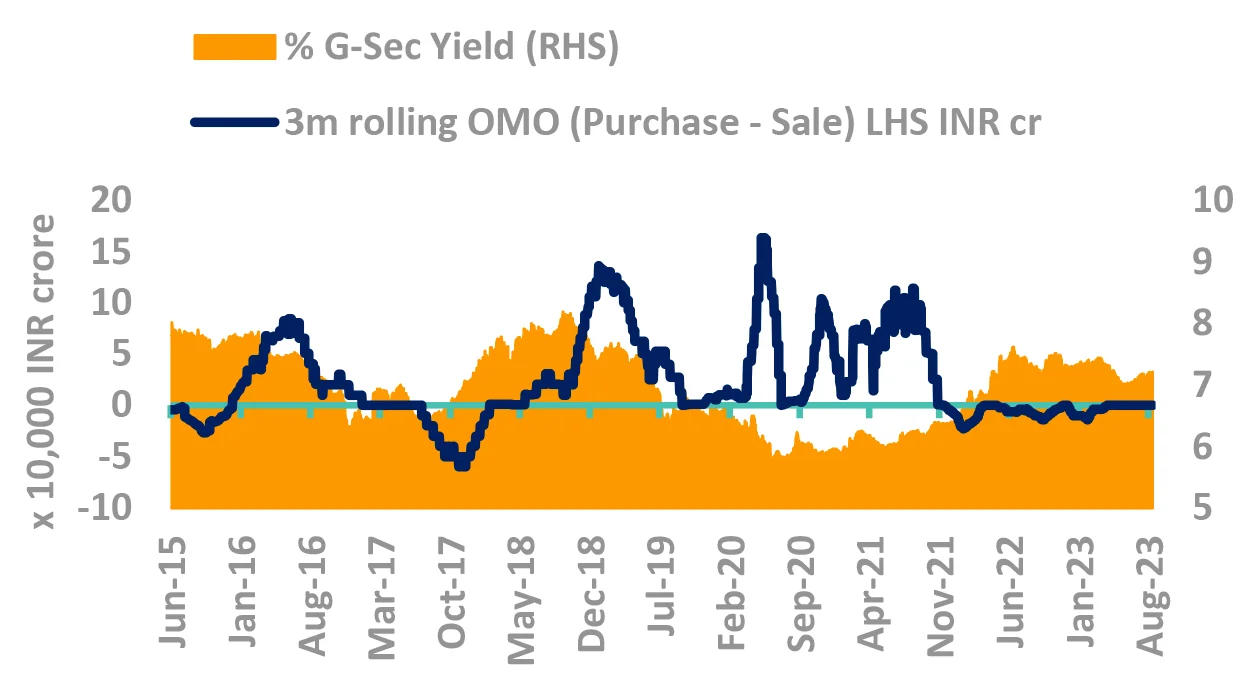
Yields track RBI OMO purchases
- Yields have strong correlation with RBI OMO
- Demand/Supply mismatch is filled in by RBI
-
RBI OMO is pushed to latter half of FY24
Takeaway:
Banks’ probably lesser demand in future to be negative.
Source – Bloomberg, DBIE, Internal OMO – Open Market Operations, SLR – Statutory Liquidity Ratio; G-Sec – Government Securities; RBI: Reserve Bank of India; FRA: Forward Rate Agreement; TRS: Total Return Swap
Large liquidity overhang continues
-
RBI announced withdrawal of ₹ 2000 notes (Demonetization 2.0)
- 88% of ₹ 2000 notes (3.14 tn) in circulation was already returned as of Jul’31
- Of this, ₹ 2.76 tn was in the form of deposits
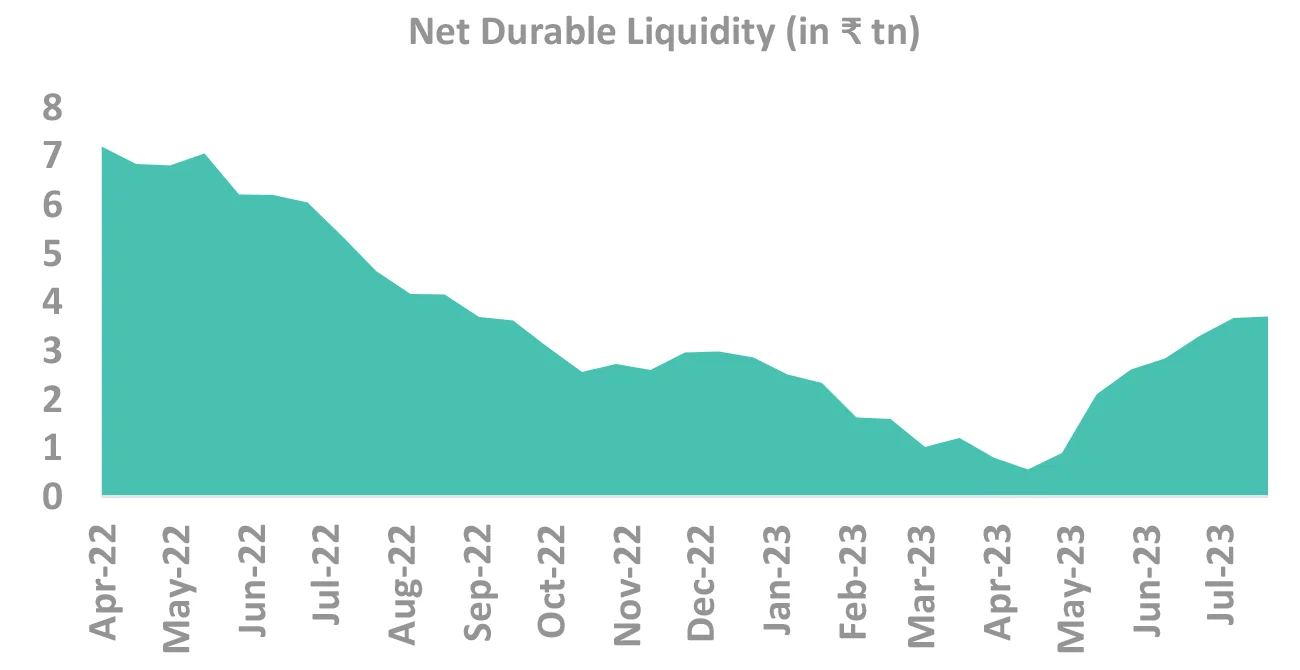
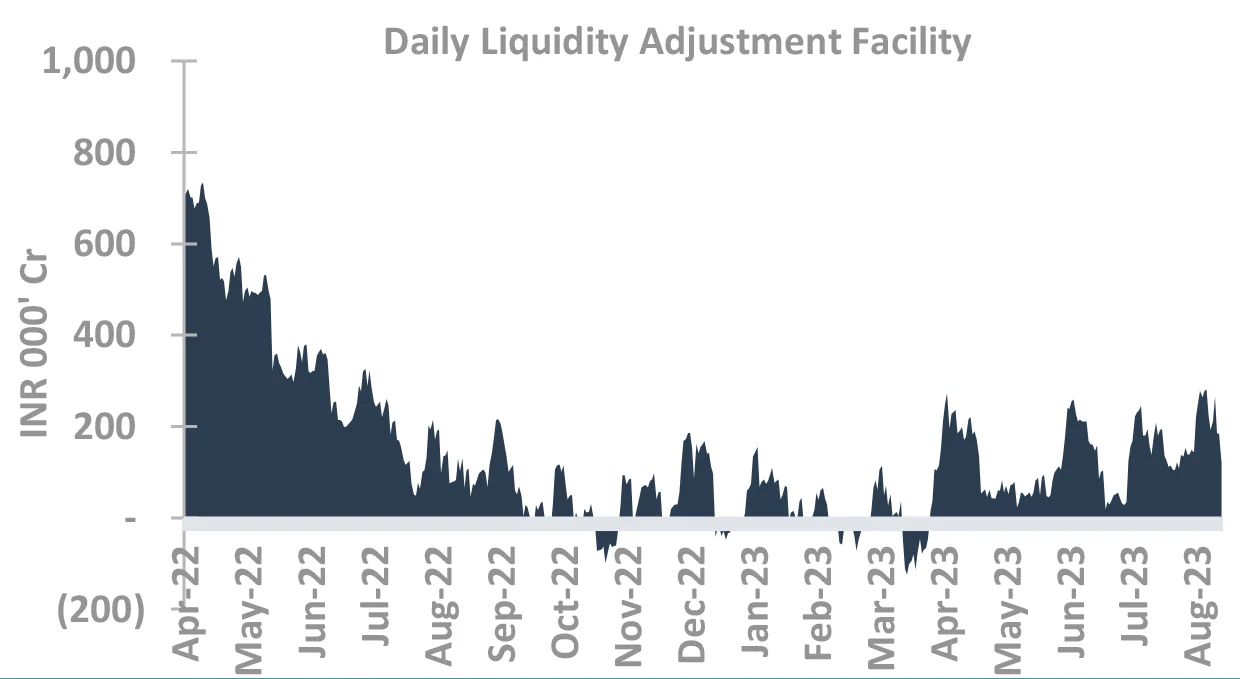
Core liquidity is comfortable at more than ₹ 3.5lac crores
-
RBI announced dividend of ₹ 87K cr
- Surpassing budget estimates of ₹ 48K cr
-
Liquidity is expected to remain in surplus for few months
- Due to seasonality of liquidity
- Seasonal infusion of ₹ 45-60K cr as we enter a period of reversal in CIC until Q3FY24
Takeaway:
Liquidity expected to remain adequate
Source – Bloomberg, RBI: Reserve Bank of India; CIC: Currency in Circulation
RBI’s intent to anchor overnight rates at REPO
-
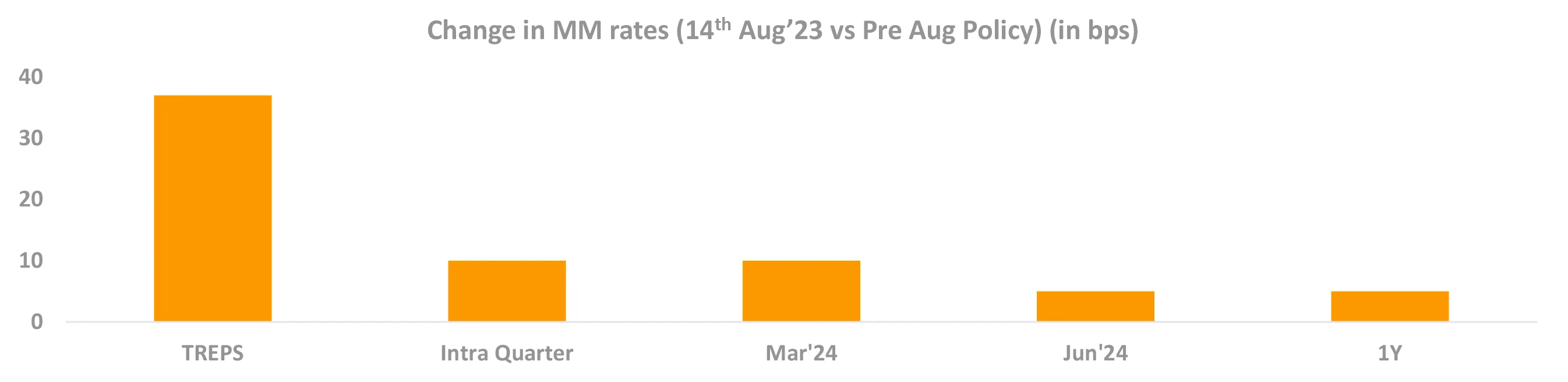
RBI introduced incremental CRR (I-CRR) of 10%
- This applies to incremental NDTL between 19th May to 28th Jul
- Expected to suck-out liquidity of around 1.1tn
- To be reviewed on 8th Sep or earlier
- Expected to have a temporary impact on liquidity
- ✓ However, overnight rates to trade closer to REPO
-
Background
- Excessive liquidity poses risk to price and financial stability
- Banks were not tendering enough in VRRR auctions which the RBI was using to moderate liquidity
- Overnight rates were hovering at SDF levels
Takeaway:
RBI to keep overnight rates anchored at or around REPO levels
Source – RBI, Internal I-CRR: Incremental Cash Reserve Ratio; MM: Money Market; NDTL: Net Demand and Time Liabilities; SDF: Standing Deposit Facility; VRRR: Variable Reverse Repo Rate; RBI: Reserve Bank of India
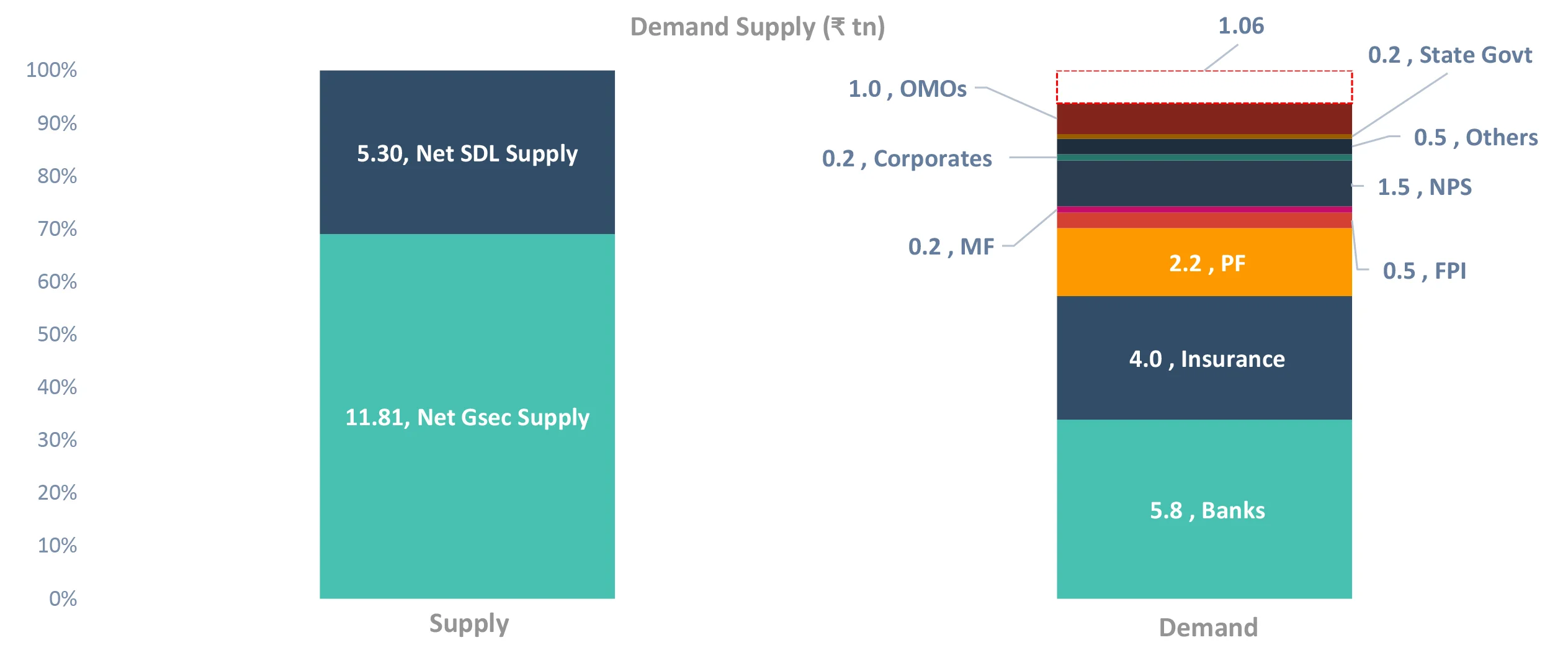
How much is the excess supply
-
Excess supply can be matched
- ✓ G-sec supply is higher only by 7% over FY23, however demand is expected to rise much more
- ✓ Continuing strong demand from long end investors like EPFO, Insurance and PFs
- ✓ NSSF deposits at ₹ 1.94tn (till June) vs ₹ 1.34tn (till Jun’22)
Takeaway:
Estimated excess supply of ₹ 1.06 tn is not very significant. NPS may grow at 20% (we have taken 13%), Banks may sustain current SLR ratio of 30.5% (we have taken 30%)
Source – Internal, CGA G-Sec: Government Securities; OMO: Open Market Operation; RBI: Reserve Bank of India; FPI: Foreign Portfolio Investment; NPS: National Pension System; MF: Mutual Fund; SDL: State Development Loans; SLR: Statutory Liquidity Ratio; PF: Provident Fund; EPFO: Employees’ Provident Fund Organisation; NSSF: National Small Savings Fund
In last DSP Converse we said that US yields may
not drive Indian
No more
With domestic data being neutral and
directionless…
We will dance to the tune of US yields.
With less beta, but still correlated
Indian yields – Dancing to the tune of US Yields
-
FOMC rate at 5.50% - more hikes at play?
- Labor data has softened, but no conclusive evidence yet
- Tails risks of services inflation remaining sticky
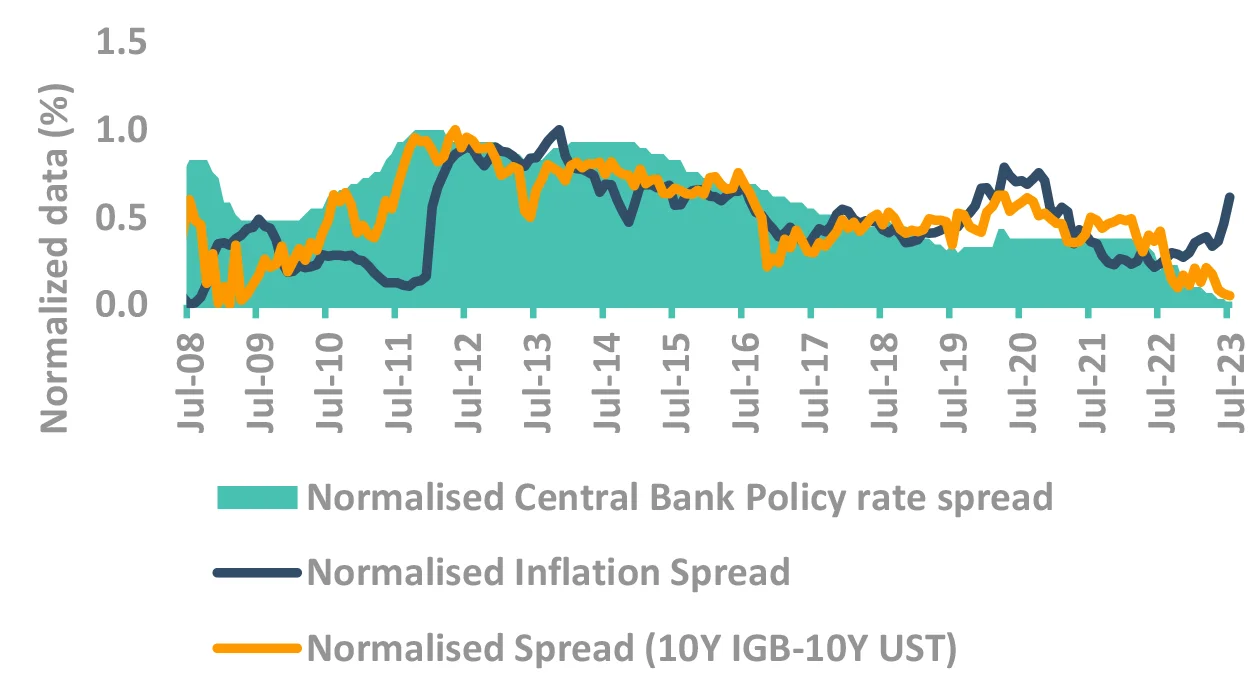
Are spreads of US Treasury and Indian Govt. Bonds low?
- No, Bond yields difference mimics the inflation and policy rate differential.
- ✓ 10Y yields seem to have priced in the inflation spread
- No, Bond yields difference mimics the inflation and policy rate differential.
-
Even if US yields don’t fall, Indian yields may.
-
Are Indian yields tracking US Rates? Yes
- Domestic data on the neutral side
- Tail risks remain from any large FOMC action
- India yields tracking US yields

Takeaway:
With domestic data being on the neutral side, India yields tracking US yields
Source – Bloomberg, Internal Fed: Federal Reserve; CPI: Consumer Price Inflation; RBI: Reserve Bank of India; IGB: India Government Bond; FOMC: Federal Open Market Committee; UST: US Treasury
US Yield Curve and WIRP
-
US yield curve has bear steepened
- No major change in expectation of rate action by the FED
- However, longer end of the yield curve has moved up
- Reflects a “higher for longer” view
- That inflation will only gradually decline, but may be higher than the “2%” in past
- Excess US fiscal supply, and demand constrained as Quantitative Tightening on
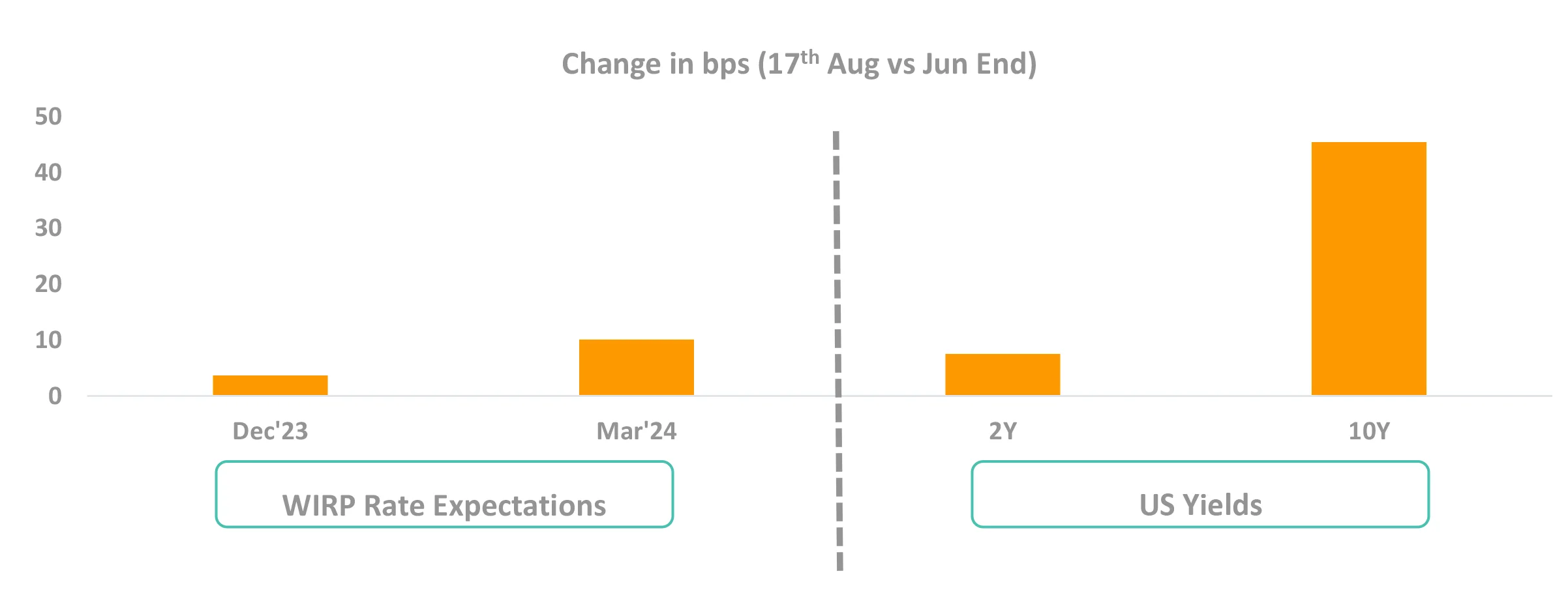
Takeaway:
US yield curve impacted by higher for longer and demand-supply issues
Source – Bloomberg
What else
that
can’t be bunched up
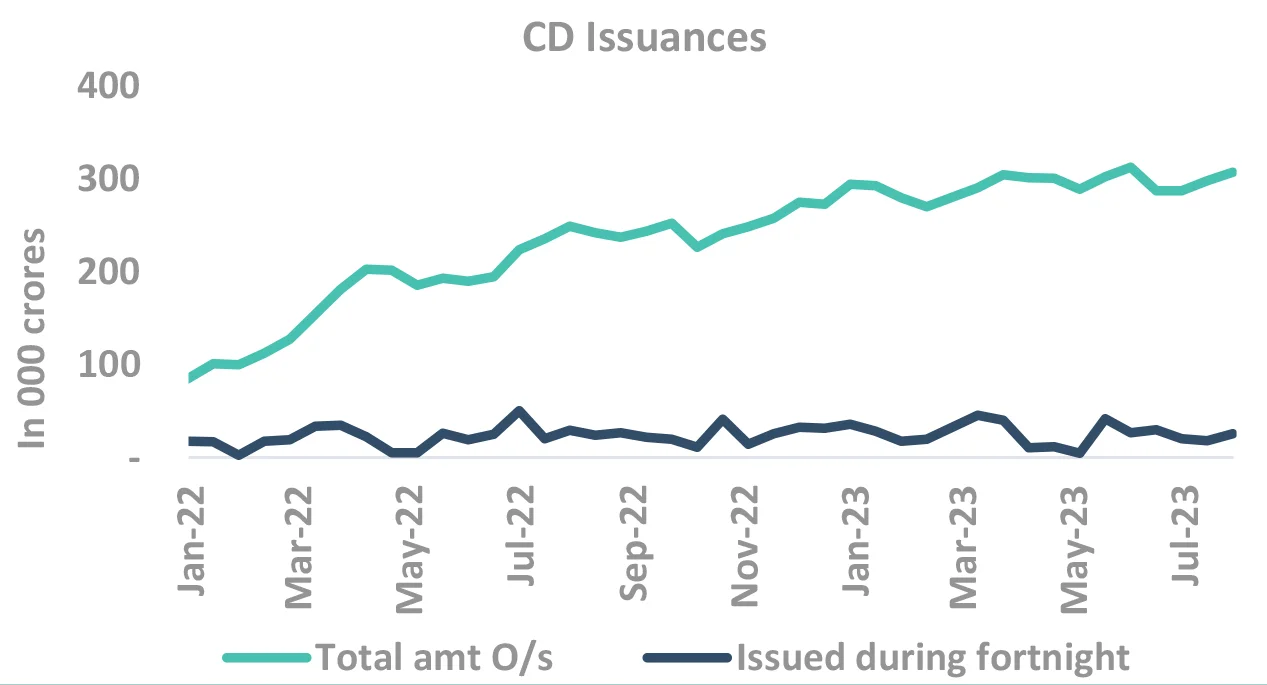
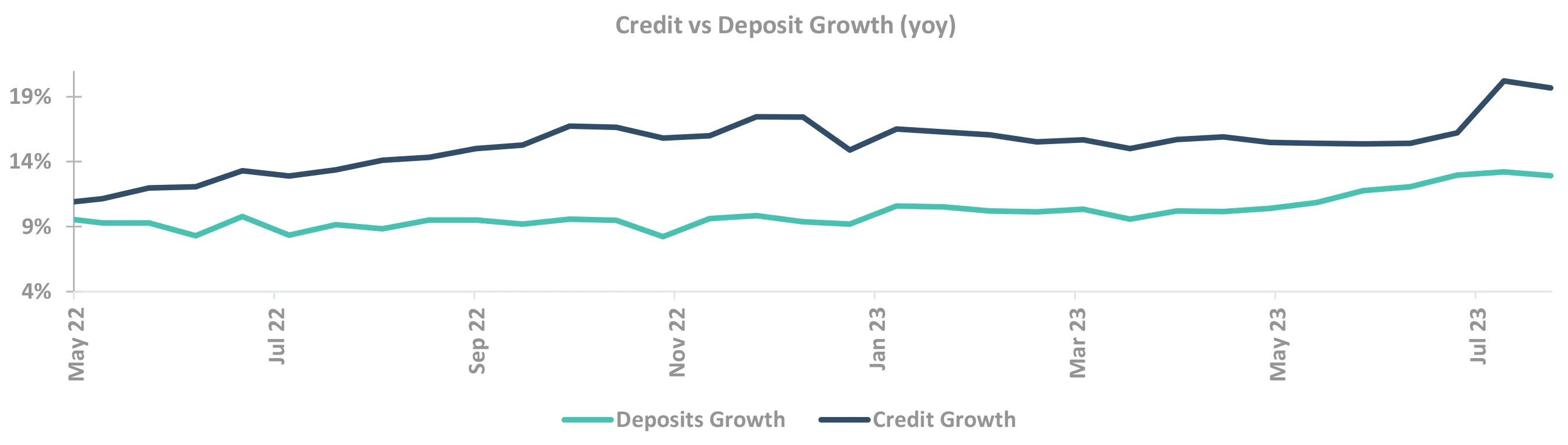
Supply-demand and liquidity: Key driver for short end yields
- Divergence between credit and deposit growth continues
- Demand supply seems to be well-matched
- I-CRR (RBI’s intent of anchoring overnight rates to REPO) may cause liquidity disruptions
- Expect a volatility of 10-15bps
Source – Bloomberg, Internal CD: Certificate of Deposits; RBI: Reserve Bank of India; T-bill: Treasury Bill, I-CRR: Incremental Cash Reserve Ratio
Term premia: It’s a BUY!
-
This slide is the reason why we have long bias – Valuations
- So far, every point in our presentation was neutral or hawkish…
-
…But that bad news has been priced in
-
Even if RBI hikes (unlikely and even then probably last hike)…
- The spread with 5-Year bond is 50bp!
- Take away covid (hikes were expected) and reverse demonetization: currently the spread is neutral…
- …then price in future rate cuts in FY25 (as in 2014-2017 and 2019) – suddenly bonds are a good buy
Since last DSP converse, data has worsened – so have yields. The odds are in favor.
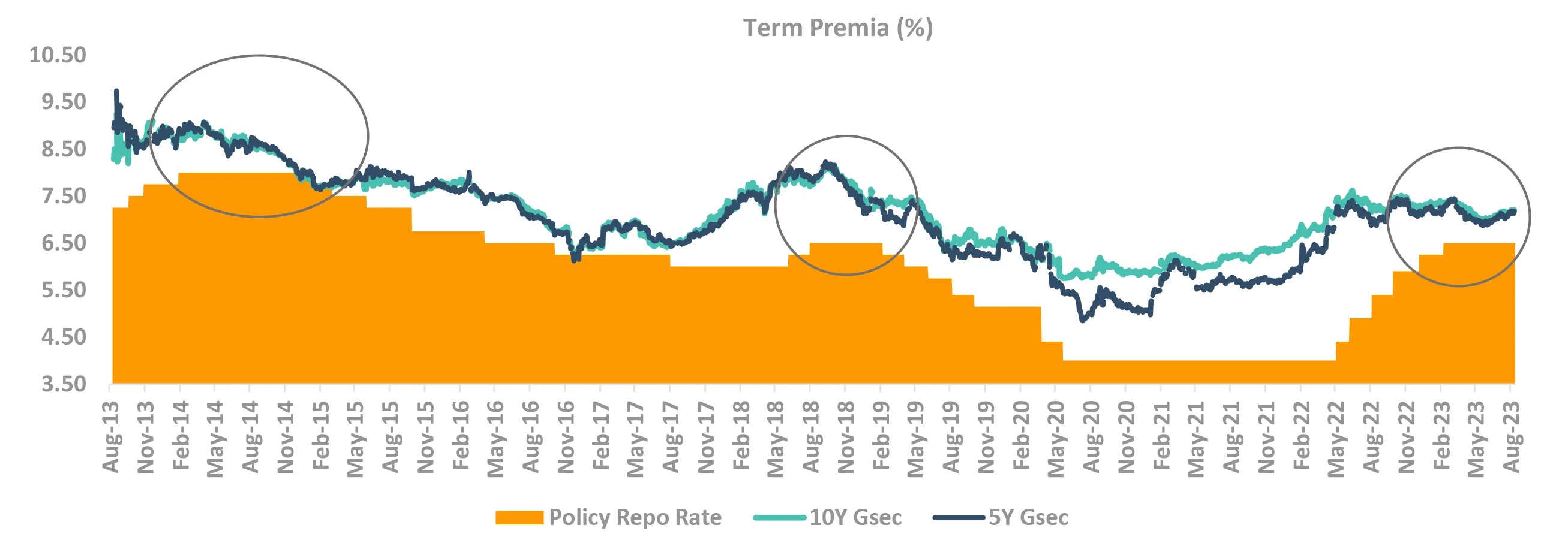
Takeaway:
India term premium is still high.
Source – Bloomberg RBI: Reserve Bank of India
DSP FI Framework checklist

DSP Duration decision: Negative data priced in. Valuation attractive

The chart shows how much expected yield fall/rise is already
priced in the current curve.
Large gap between the current yield and forward yield shows
that yield change is priced in – and thus yield change will not
give capital gain/loss.
Similarly small gap means that the market is not pricing change
in yields.
Market expects yield curve to remain flat
- The future rate curve is close to current yield curve, expecting yields to remain range bound

Source – Bloomberg; as on 17/Aug/23
Done with our market view framework?
Now
Our Portfolio creation framework
DSP Portfolio Creation: Multi-step process
DSP Fixed Income Funds follow a defined methodology for fund portfolio construction
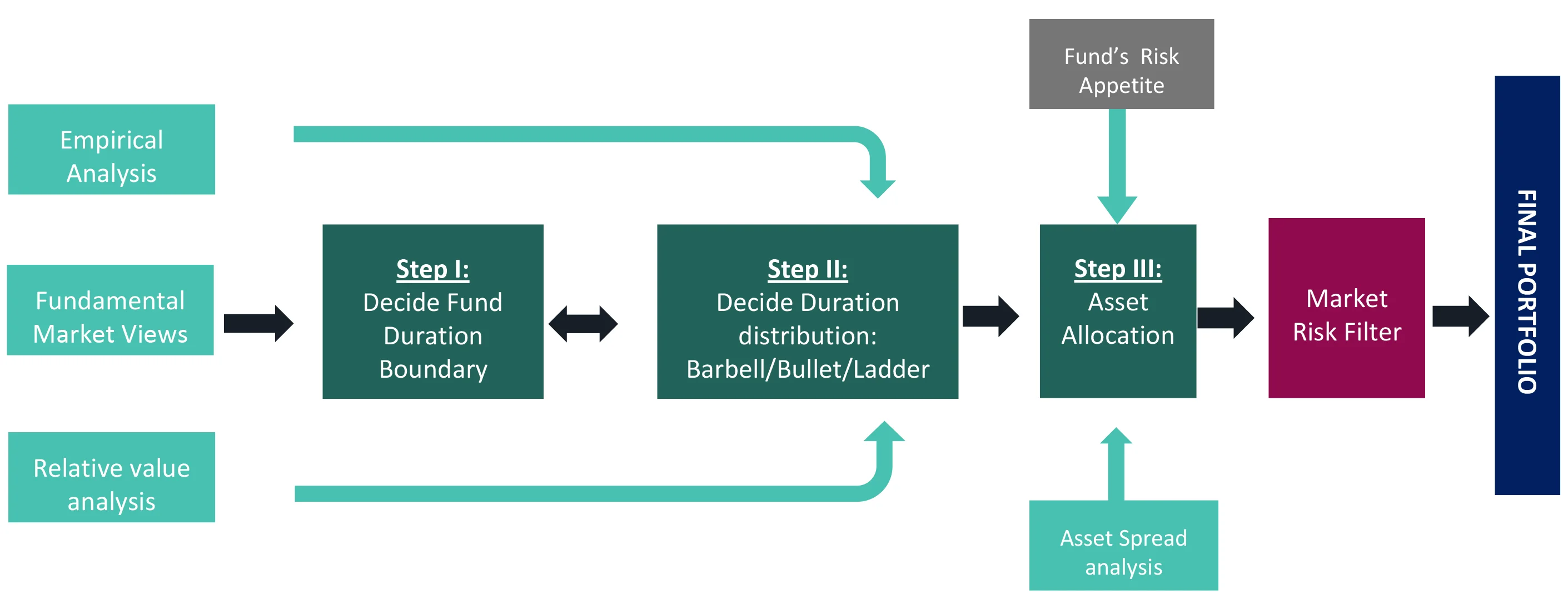
- We apply market risk filter which can help the Fund Managers not to take extreme risks. Thus, Value at Risk is limited by ensuring the positions are balanced.
Investment approach / framework/ strategy mentioned herein is currently followed & same may change in future depending on market conditions & other factors.
DSP Credit Investment Process – Better Safe, than Sorry!
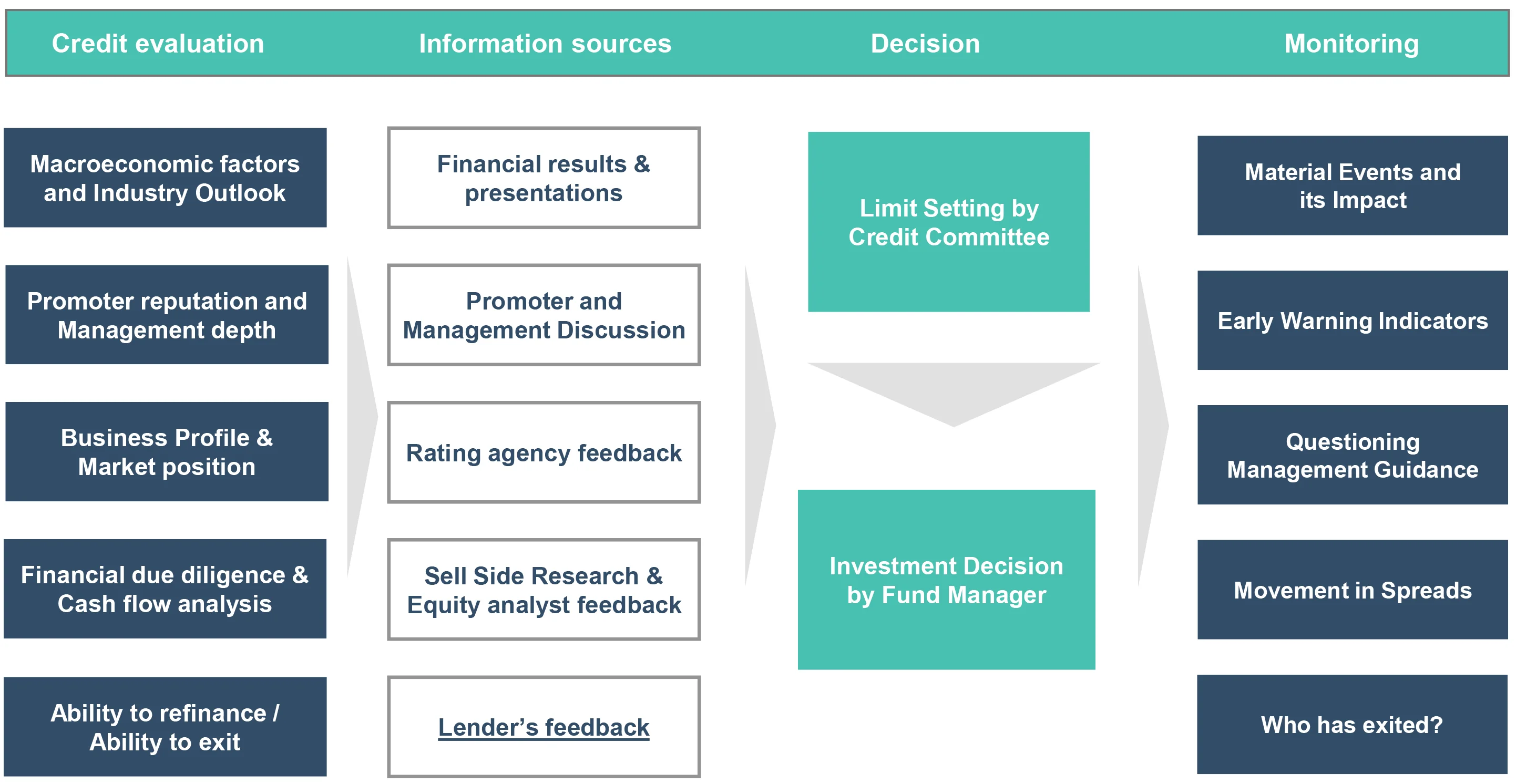
DSP Asset Allocation: Corporate bonds vs. Sovereign Bonds
-
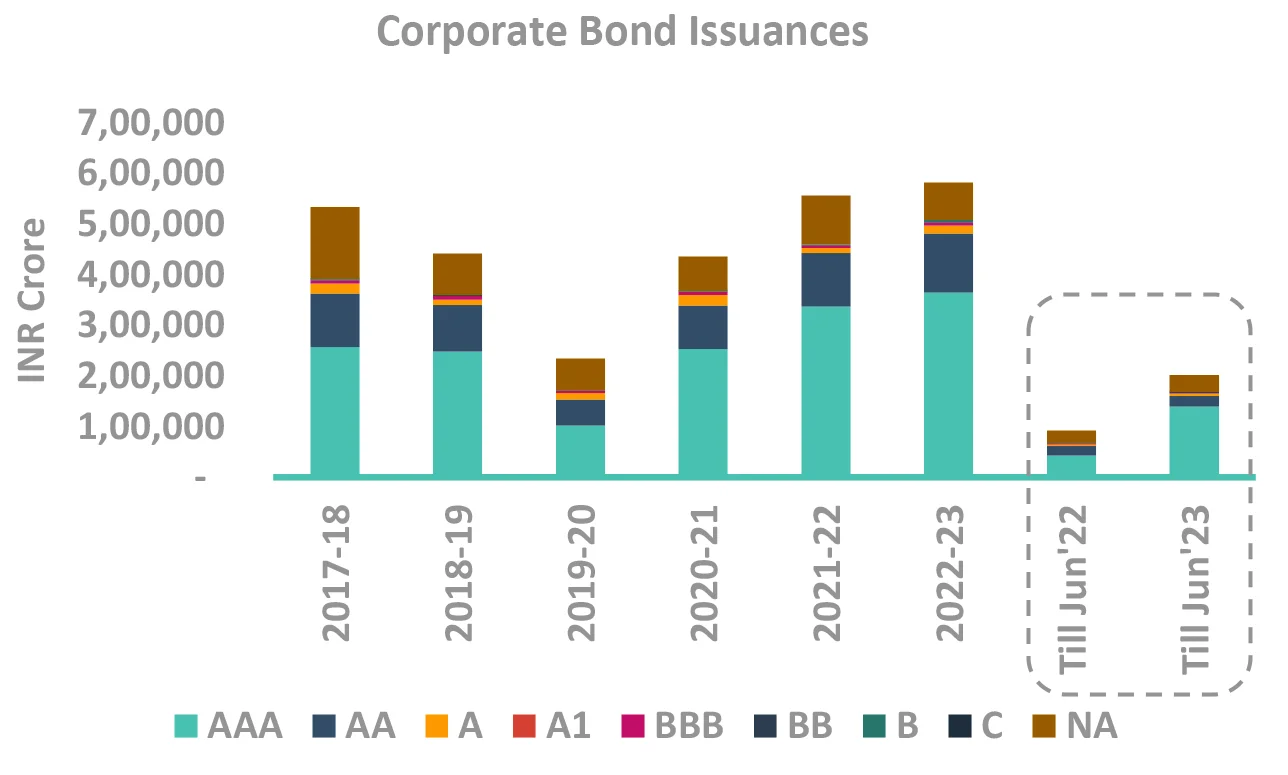
Higher supply of corporate bonds so far
- Q1FY24 issuance at ~2x of Q1FY23 led by AAA rated segment
- AAA supply decreased from ₹ 77k crores in June to ₹ 49k crores in July
- PSU & NBFC supply slowed down this month as issuers await further clarity on rates & liquidity
Issuances expected to pick up again in Sep
-
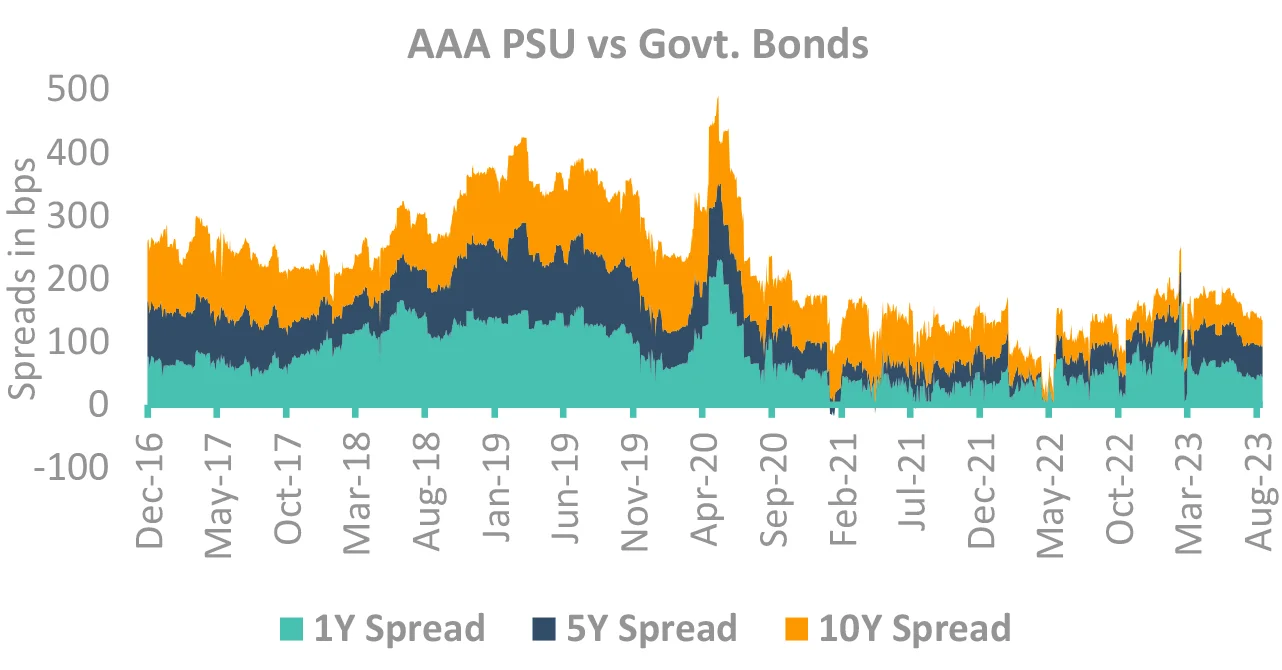
The corporate bond spread remains elevated
- 2-3Y NBFCs providing steady accrual
- AAA PSU Spreads remain to be in the narrow band of 45-55bps
- Demand-supply well-matched & expected to remain the same
Takeaway:
Corporate bond spreads near their long term average, spread curve flat.
Source – Bloomberg, CCIL, Internal PSU: Public Sector Undertaking, NBFC: Non-Bank Financial Companies
Key Risks associated with investing in Fixed Income Schemes
Interest Rate Risk - When interest rates rise, bond prices fall, meaning the bonds you hold lose value. Interest rate movements are the major cause of price volatility in bond markets.
Credit risk - If you invest in corporate bonds, you take on credit risk in addition to interest rate risk. Credit risk is the possibility that an issuer could default on its debt obligation. If this happens, the investor may not receive the full value of their principal investment.
Market Liquidity risk - - Liquidity risk is the chance that an investor might want to sell a fixed income asset, but they’re unable to find a buyer.
Re-investment Risk - If the bonds are callable, the bond issuer reserves the right to “call” the bond before maturity and pay off the debt. That can lead to reinvestment risk especially in a falling interest rate scenario.
Rating Migration Risk - - If the credit rating agencies lower their ratings on a bond, the price of those bonds will fall.
Other Risks
Risk associated with
- floating rate securities
- derivatives
- transaction in units through stock exchange Mechanism
- investments in Securitized Assets
- Overseas Investments
- Real Estate Investment Trust (REIT) and Infrastructure Investment Trust (InvIT)
- investments in repo of corporate debt securities
- Imperfect Hedging using Interest Rate Futures
- investments in Perpetual Debt Instrument (PDI)








 .
.